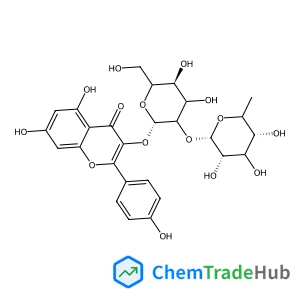
5,7-Dihydroxy-2-(4-hydroxyphenyl)-4-oxo-4H-chromen-3-yl 2-O-(6-deoxy-alpha-L-mannopyranosyl)-beta-D-glucopyranoside
CAS Number:
32602-81-6
Molecular Formula:
C27H30O15
Valery Andrushchenko, Walter Pohle
The amphiphiles 1-octadecanol (octadecyl (stearyl) alcohol, ODA) and 1,2-dioleoylglycerol (DOG) were studied by IR spectroscopy and X-ray diffraction combined with multiscale theoretical modeling. The computations allowed us to rationalize the experimental findings and deduce the supramolecular structure of the formed assemblies while providing a fairly detailed insight into their hydrogen-bonding patterns. IR spectra revealed that the amphiphilic assemblies dramatically differ in structural order and hydrogen-bond strength, both being high in ODA and low in DOG. On the other hand, both compounds demonstrated common features, namely a splitting of the IR bands arising from O–H stretching vibrations (νOH) as well as complete hydrophobicity. However, the observed phenomena have different origins in the two amphiphiles. While the νOH split in ODA occurs due to a vibrational coupling along the string of inter-layer O–H⋯O hydrogen bonds, in DOG it arises from different types of hydrogen bonds (intra- and intermolecular). The hydrophobicity of ODA stems from the very tight O–H⋯O hydrogen bonding network connecting the opposite monolayers in a densely packed tilted crystalline phase (Lc′), whereas in DOG it occurs because the polar sites are locked inside reverted micellar-like assemblies. ODA and DOG illustrate that, in the assemblies of amphiphilic hydroxyl compounds, hydrogen bonds can be formed in a wide structural latitude, which is primarily governed by the chemical nature of apolar chains. Such a wide structural variability of OH-involving hydrogen bonds can be essential for the biological functioning of relevant molecules, such as glycolipids, acylglycerols, and, potentially, glycoproteins and carbohydrates.

Biocatalysis and Biotransformation

Journal of Chemical Sciences

Herald of the Russian Academy of Sciences

Bioorganic & Medicinal Chemistry

Journal of Asian Natural Products Research

Atomization and Sprays

Polycyclic Aromatic Compounds

Journal of the Indian Institute of Science

NDT & E International

Acta Metallurgica Sinica-English Letters
Elisabeth Therese Ulrikkeholm, Jan Rossmeisl, Ib Chorkendorff
DOI: 10.1039/C6CP04575H
Tobias Schmidt, Rhett Kempe, Stephan Kümmel
DOI: 10.1039/C6CP06520A
Karin Fink, Valeriu Mereacre, Christopher E. Anson
DOI: 10.1039/C6CP03157A
Qiang Hao, Xiuxiu Niu, Changshun Nie, Simeng Hao, Wei Zou, Jiangman Ge, Daimei Chen, Wenqing Yao
DOI: 10.1039/C6CP06122B
Huijing Li, Annapaola Migani, Lluís Blancafort, Quansong Li, Zesheng Li
DOI: 10.1039/C6CP06290C
Hui Zhao, Wei-xiao Ji, Chang-wen Zhang, Ping Li, Feng Li, Pei-ji Wang, Run-wu Zhang
DOI: 10.1039/C6CP06034J
Reda Boulmène, Muthuramalingam Prakash, Majdi Hochlaf
DOI: 10.1039/C6CP04650A
Alexander J. E. Rettie, Vijay R. Singh, Jianshi Zhou, Bethany Lamoureux, Hendrik Bluhm
DOI: 10.1039/C6CP04526J
Neelanjana Sengupta
DOI: 10.1039/C6CP05041G
Ayyanar Karuppasamy, Kesavan Stalindurai, Jia-De Peng, Kuo-Chuan Ho, Chennan Ramalingan
DOI: 10.1039/C6CP05722E
When handling 2-Chloro-1,2-bis(4-methylphenyl)ethanone (CAS: 71193-32-3), it is ...
4-Ethoxy-3-(5-methyl-4-oxo-7-propyl-1,4-dihydroimidazo[5,1-f][1,2,4]triazin-2-yl...
Methyl 3-Oxo-4-Androsten-17-Carboxylate (CAS: 2681-55-2) should be stored in a c...
(R)-3-Amino-4-(3-hexylphenylamino)-4-oxobutylphosphonic acid is primarily used i...
2-Methyl-2-propanyl 3-amino-3-carbamoyl-1-azetidinecarboxylate (CAS: 1254120-14-...
There are alternative reagents that can be used in synthesis instead of (E)-4-(t...
[2-(3-Chlorophenyl)-1,3-thiazol-4-yl]methanol (CAS: 121202-20-8) is a crystallin...
The market and research trends for Methyl (2S)-[(4S)-2,2-dimethyl-1,3-dioxolan-4...
The market for 1-Bromo-2-isocyanatoethane (CAS: 42865-19-0) is driven by its use...
4-Nitro-D-phenylalanine hydrochloride (CAS: 147065-06-3) is primarily used in re...

Physical Chemistry Chemical Physics (PCCP) is an international journal co-owned by 19 physical chemistry and physics societies from around the world. This journal publishes original, cutting-edge research in physical chemistry, chemical physics and biophysical chemistry. To be suitable for publication in PCCP, articles must include significant innovation and/or insight into physical chemistry; this is the most important criterion that reviewers and Editors will judge against when evaluating submissions. The journal has a broad scope and welcomes contributions spanning experiment, theory, computation and data science. Topical coverage includes spectroscopy, dynamics, kinetics, statistical mechanics, thermodynamics, electrochemistry, catalysis, surface science, quantum mechanics, quantum computing and machine learning. Interdisciplinary research areas such as polymers and soft matter, materials, nanoscience, energy, surfaces/interfaces, and biophysical chemistry are welcomed if they demonstrate significant innovation and/or insight into physical chemistry. Joined experimental/theoretical studies are particularly appreciated when complementary and based on up-to-date approaches.
![2-Hydroxy-4-[({[(4-methylphenyl)sulfonyl]oxy}acetyl)amino]benzoic acid structure](https://static.chemtradehub.com/structs/501/501919-59-1-579f.webp "2-Hydroxy-4-[({[(4-methylphenyl)sulfonyl]oxy}acetyl)amino]benzoic acid structure")