












Efficient as-cast semi-transparent organic solar cells with efficiency over 9% and a high average visible transmittance of 27.6%
Literature Information
Publication Date
2019-04-29
DOI
10.1039/C9CP01101C
Impact Factor
3.676
Authors
Wenyan Su, Qunping Fan, Xia Guo, Jingnan Wu, Maojie Zhang
View Original
Abstract
As promising candidates for future applications in building-integrated photovoltaics, semitransparent organic solar cells (ST-OSCs) have made tremendous progress. However, power conversion efficiency (PCE) of the ST-OSCs is limited by intrinsic narrow absorption spectra concentrated in the near infrared region (NIR), weak extinction coefficient, and mismatched molecular energy levels of thin active layers. Here, an efficient ST-OSC based on a donor/acceptor electron pair of a trifluorinated polymer donor PBFTT and a tetrachlorinated acceptor IT-4Cl was fabricated. Due to halogenation, photovoltaic materials show stronger extinction coefficient, improved crystallinity and higher charge carrier mobility; PBFTT shows lower electronic energy levels, and IT-4Cl shows a red-shifted absorption spectrum. As a result, the PBFTT:IT-4Cl pair shows matched energy levels, complementary absorption spectra in the NIR region and a good blend morphology. Hence, as-cast OSCs based on PBFTT:IT-4Cl achieved a high PCE of 11.1% with a high short-circuit current density of 19.7 mA cm−2 and a high fill factor of 73.9%. Owing to the complementary absorption spectra in the NIR region, high EQE values between 600 and 830 nm and a favourable transparency window between 400 and 600 nm, while the human eye has the highest sensitivity in the yellow-green wavelength region (500–600 nm), ST-OSCs using an ultra-thin (10–20 nm) Au cathode showed high PCEs of 7.9–9.1% at a high average visible transmittance of 37.3–27.6% in the photopic region. The PCE of 9.1% is one of the highest values reported in the literature for ST-OSCs without any extra treatment and with an AVT of more than 25% in the photopic region so far.
Recommended Journals
Related Literature
A computational study on the superionic behaviour of ThO2
P. S. Ghosh, A. Arya, G. K. Dey, N. Kuganathan, R. W. Grimes
2016-10-24
Paper
DOI: 10.1039/C6CP05794B
Theoretical study of the H/D isotope effect on phase transition of hydrogen-bonded organic conductor κ-H3(Cat-EDT-TTF)2
Kaichi Yamamoto, Yusuke Kanematsu, Umpei Nagashima, Akira Ueda, Hatsumi Mori, Masanori Tachikawa
2016-10-06
Communication
DOI: 10.1039/C6CP05414E
Nitrosodisulfide [S2NO]− (perthionitrite) is a true intermediate during the “cross-talk” of nitrosyl and sulfide
Juan P. Marcolongo, Uriel N. Morzan, Ari Zeida, Damián A. Scherlis, José A. Olabe
2016-10-12
Paper
DOI: 10.1039/C6CP06314D
Investigating the coverage dependent behaviour of CO on Gd/Pt(111)
Elisabeth Therese Ulrikkeholm, Jan Rossmeisl, Ib Chorkendorff
2016-09-22
Paper
DOI: 10.1039/C6CP04575H
A comparative study of Ni–Mn layered double hydroxide/carbon composites with different morphologies for supercapacitors
M. Li, F. Liu, X. B. Zhang, J. P. Cheng
2016-10-06
Paper
DOI: 10.1039/C6CP05119G
High anisotropy of fully hydrogenated borophene
Zhiqiang Wang, Tie-Yu Lü, Yuan Ping Feng
2016-11-01
Paper
DOI: 10.1039/C6CP06164H
The effect of C–OH functionality on the surface chemistry of biomass-derived molecules: ethanol chemistry on Rh(100)
C. J. (Kees-Jan) Weststrate
2016-10-12
Paper
DOI: 10.1039/C6CP06069B
Electron acceptor of Ni decorated porous carbon nitride applied in photocatalytic hydrogen production
Lingling Bi, Dedong Meng, Qijing Bu, Yanhong Lin, Tengfeng Xie
2016-10-26
Paper
DOI: 10.1039/C6CP05618K
Peeling the astronomical onion
Alexander Rosu-Finsen, Demian Marchione, Tara L. Salter, James W. Stubbing, Wendy A. Brown, Martin R. S. McCoustra
2016-11-08
Paper
DOI: 10.1039/C6CP05751A
The impact of endohedral atoms on the electronic and optical properties of Au25(SR)18 and Au38(SR)24
2016-05-24
Paper
DOI: 10.1039/C6CP02691E
You might also like
Compound Q&A
What precautions should be taken when handling 2-Chloro-1,2-bis(4-methylphenyl)ethanone (CAS: 71193-32-3)?
When handling 2-Chloro-1,2-bis(4-methylphenyl)ethanone (CAS: 71193-32-3), it is ...
71193-32-32-Chloro-1,2-bis(4-m...
Compound Q&A
What industries use 4-Ethoxy-3-(5-methyl-4-oxo-7-propyl-1,4-dihydroimidazo[5,1-f][1,2,4]triazin-2-yl)benzenesulfonyl chloride (CAS: 224789-26-8)?
4-Ethoxy-3-(5-methyl-4-oxo-7-propyl-1,4-dihydroimidazo[5,1-f][1,2,4]triazin-2-yl...
224789-26-84-Ethoxy-3-(5-methyl...
Compound Q&A
How should Methyl 3-Oxo-4-Androsten-17-Carboxylate (CAS: 2681-55-2) be stored?
Methyl 3-Oxo-4-Androsten-17-Carboxylate (CAS: 2681-55-2) should be stored in a c...
2681-55-2Methyl 3-Oxo-4-Andro...
Compound Q&A
What are the main uses of (R)-3-Amino-4-(3-hexylphenylamino)-4-oxobutylphosphonic acid (CAS: 909725-61-7)?
(R)-3-Amino-4-(3-hexylphenylamino)-4-oxobutylphosphonic acid is primarily used i...
909725-61-7(R)-3-Amino-4-(3-hex...
Compound Q&A
What regulatory guidelines apply to 2-Methyl-2-propanyl 3-amino-3-carbamoyl-1-azetidinecarboxylate (CAS: 1254120-14-3)?
2-Methyl-2-propanyl 3-amino-3-carbamoyl-1-azetidinecarboxylate (CAS: 1254120-14-...
1254120-14-32-Methyl-2-propanyl ...
Compound Q&A
Are there alternatives to (E)-4-(tert-Butoxy)-4-oxobut-2-enoic acid (CAS: 135355-96-3) in synthesis?
There are alternative reagents that can be used in synthesis instead of (E)-4-(t...
135355-96-3(E)-4-(tert-Butoxy)-...
Compound Q&A
What are the physical and chemical properties of [2-(3-Chlorophenyl)-1,3-thiazol-4-yl]methanol (CAS: 121202-20-8)?
[2-(3-Chlorophenyl)-1,3-thiazol-4-yl]methanol (CAS: 121202-20-8) is a crystallin...
121202-20-8[2-(3-Chlorophenyl)-...
Compound Q&A
What is the market or research trend for Methyl (2S)-[(4S)-2,2-dimethyl-1,3-dioxolan-4-yl]{[(4-methylphenyl)sulfonyl]oxy}acetate (CAS: 166249-17-8)?
The market and research trends for Methyl (2S)-[(4S)-2,2-dimethyl-1,3-dioxolan-4...
166249-17-8Methyl (2S)-[(4S)-2,...
Compound Q&A
What is the market or research trend for 1-Bromo-2-isocyanatoethane (CAS: 42865-19-0)?
The market for 1-Bromo-2-isocyanatoethane (CAS: 42865-19-0) is driven by its use...
42865-19-01-Bromo-2-isocyanato...
Compound Q&A
What are the main uses of 4-Nitro-D-phenylalanine hydrochloride (CAS: 147065-06-3)?
4-Nitro-D-phenylalanine hydrochloride (CAS: 147065-06-3) is primarily used in re...
147065-06-34-Nitro-D-phenylalan...
Source Journal
Physical Chemistry Chemical Physics

CiteScore:
5.5
Self-citation Rate:
10.3%
Articles per Year:
3036
Physical Chemistry Chemical Physics (PCCP) is an international journal co-owned by 19 physical chemistry and physics societies from around the world. This journal publishes original, cutting-edge research in physical chemistry, chemical physics and biophysical chemistry. To be suitable for publication in PCCP, articles must include significant innovation and/or insight into physical chemistry; this is the most important criterion that reviewers and Editors will judge against when evaluating submissions. The journal has a broad scope and welcomes contributions spanning experiment, theory, computation and data science. Topical coverage includes spectroscopy, dynamics, kinetics, statistical mechanics, thermodynamics, electrochemistry, catalysis, surface science, quantum mechanics, quantum computing and machine learning. Interdisciplinary research areas such as polymers and soft matter, materials, nanoscience, energy, surfaces/interfaces, and biophysical chemistry are welcomed if they demonstrate significant innovation and/or insight into physical chemistry. Joined experimental/theoretical studies are particularly appreciated when complementary and based on up-to-date approaches.
Recommended Compounds
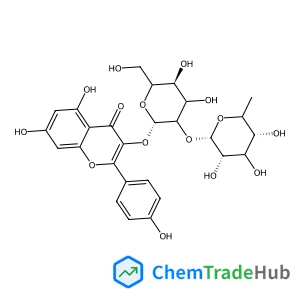
5,7-Dihydroxy-2-(4-hydroxyphenyl)-4-oxo-4H-chromen-3-yl 2-O-(6-deoxy-alpha-L-mannopyranosyl)-beta-D-glucopyranoside
CAS Number:
32602-81-6
Molecular Formula:
C27H30O15
![2-Hydroxy-4-[({[(4-methylphenyl)sulfonyl]oxy}acetyl)amino]benzoic acid structure](https://static.chemtradehub.com/structs/501/501919-59-1-579f.webp "2-Hydroxy-4-[({[(4-methylphenyl)sulfonyl]oxy}acetyl)amino]benzoic acid structure")
2-Hydroxy-4-[({[(4-methylphenyl)sulfonyl]oxy}acetyl)amino]benzoic acid
CAS Number:
501919-59-1
Molecular Formula:
C16H15NO7S

Recommended Suppliers





Disclaimer
This page provides academic journal information for reference and research purposes only. We are not affiliated with any journal publishers and do not handle publication submissions. For publication-related inquiries, please contact the respective journal publishers directly.
If you notice any inaccuracies in the information displayed, please contact us at support@chemtradehub.com. We will promptly review and address your concerns.