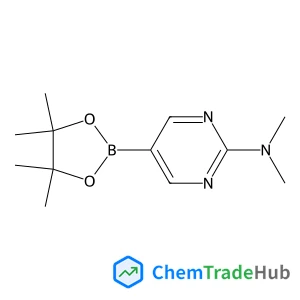
N,N-Dimethyl-5-(4,4,5,5-tetramethyl-1,3,2-dioxaborolan-2-yl)-2-pyrimidinamine
CAS Number:
1032759-30-0
Molecular Formula:
C12H20BN3O2
Alex J. W. Thom, Eric J. Sundstrom
We propose a method for calculation of oxidation states in transition metal complexes, utilizing a bonding analysis based on localized molecular orbitals in conjunction with traditional population analyses. The localized orbital bonding analysis (LOBA) is seen to accurately produce both the oxidation state and chemically intuitive views of bonding in the complexes studied. This is in contrast to simple population analyses where the oxidation states are not reproduced for even simple systems and more complex analyses which break down on problematic systems. We report the application to a manganese complex with potential activity as oxygen-evolving catalyst, determining the location of the oxidations.

Russian Journal of General Chemistry

Current Opinion in Colloid & Interface Science

Acta Materialia

Chemical Communications

Russian Journal of Coordination Chemistry

Crystallography Reports

Russian Journal of Applied Chemistry

Chemistry Education Research and Practice

Drug Discovery Today

Russian Journal of Organic Chemistry
Nans Roques, Daniel Maspoch, Inhar Imaz, Angela Datcu, Jean-Pascal Sutter, Concepció Rovira, Jaume Veciana
DOI: 10.1039/B802196A
Claudia Caltagirone, Philip A. Gale, Jennifer R. Hiscock, Simon J. Brooks, Michael B. Hursthouse, Mark E. Light
DOI: 10.1039/B806238B
Kyung-Soo Moon, Eunji Lee, Myongsoo Lee
DOI: 10.1039/B801108G
Masao Morita, Yasushi Obora, Yasutaka Ishii
DOI: 10.1039/B702293J
Lin Yang, Hua-Jie Wang, Hua-Yan Yang, Shan-Hu Liu, Bao-Fang Zhang, Kui Wang, Xiao-Ming Ma, Zhi Zheng
DOI: 10.1039/B804274H
Victor A. Streltsov, Joseph N. Varghese
DOI: 10.1039/B803911A
Richard J. Spandl, Hèléne Rudyk, David R. Spring
DOI: 10.1039/B807278G
DOI: 10.1039/B802289E
Ning Du, Hui Zhang, Bingdi Chen, Xiangyang Ma, Deren Yang
DOI: 10.1039/B800401C
When considering alternatives to 1-(4-Chlorophenyl)-N-hydroxymethanimine (CAS: 3...
This compound should be stored in a cool, dry place away from direct sunlight. I...
3-(4-Bromophenyl)-5-(2-fluorophenyl)-1,2,4-oxadiazole is synthesized through a m...
5-Chloro-2-(4-chlorophenyl)-4-methyl-6-[3-(1-piperidinyl)propoxy]pyrimidine (CAS...
2-Chloro-4-(difluoromethoxy)pyridine is used in the pharmaceutical industry for ...
3-Chloro-6-methylpyridazine (CAS: 1121-79-5) is classified under the Globally Ha...
Several alternatives can be used in the synthesis of Methyl 4,5-dimethyl-2-nitro...
Alternatives to (2E,2'E)-3,3'-(1,4-Phenylene)bisacrylaldehyde include other acry...
3-Amino-5-chloropyridin-2-ol hydrochloride is an organic compound with the CAS n...
When handling 6,7-Difluoro-2,3-dihydro-4H-chromen-4-one, it is essential to wear...

Physical Chemistry Chemical Physics (PCCP) is an international journal co-owned by 19 physical chemistry and physics societies from around the world. This journal publishes original, cutting-edge research in physical chemistry, chemical physics and biophysical chemistry. To be suitable for publication in PCCP, articles must include significant innovation and/or insight into physical chemistry; this is the most important criterion that reviewers and Editors will judge against when evaluating submissions. The journal has a broad scope and welcomes contributions spanning experiment, theory, computation and data science. Topical coverage includes spectroscopy, dynamics, kinetics, statistical mechanics, thermodynamics, electrochemistry, catalysis, surface science, quantum mechanics, quantum computing and machine learning. Interdisciplinary research areas such as polymers and soft matter, materials, nanoscience, energy, surfaces/interfaces, and biophysical chemistry are welcomed if they demonstrate significant innovation and/or insight into physical chemistry. Joined experimental/theoretical studies are particularly appreciated when complementary and based on up-to-date approaches.