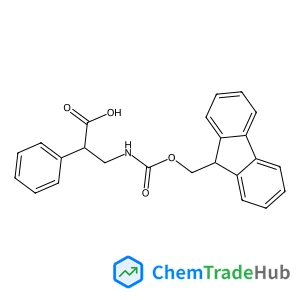
(S)-3-((((9H-Fluoren-9-yl)methoxy)carbonyl)amino)-2-phenylpropanoic acid
CAS Number:
1217663-60-9
Molecular Formula:
C24H21NO4
Antony M. Hooper, Samuel Dufour, Xaoli He, Alexander Muck, Jing-Jiang Zhou, Reinaldo Almeida, Linda M. Field, Aleš Svatoš, John A. Pickett
Chip-assisted high-throughput ESI-MS analysis of the pheromone-binding protein of the silkworm moth Bombyx mori, BmorPBP1, incubated with its pheromone components bombykol, bombykal and analogues was developed. The protein bound to bombykol ((10E,12Z)-hexadecadien-1-ol) and all 3 of its geometric isomers to a lesser extent, and showed relaxed specificity toward different chain lengths possessing unsaturation. BmorPBP1 did not bind to bombykal ((10E,12Z)-hexadecadienal), demonstrating molecular recognition of the insect pheromone components.
Panpan Zhang, Haixia Wang, Wei Xu, Yang Li, Qing Li, Gang Wei, Zhiqiang Su
DOI: 10.1039/C5BM00058K
M. V. Balarama Krishna, A. C. Sahayam, D. Karunasagar
DOI: 10.1039/C1AY05624G
Hasan Baig, Hiroyuki Kanda, Abdullah M. Asiri, Mohammad Khaja Nazeeruddin, Tapas Mallick
DOI: 10.1039/D0SE90048F
Chandrasekaran Nithya, Gowtham Thiyagaraj
DOI: 10.1039/D0SE00469C
Sreerangappa Ramesh, Makhlouf Amoura, Damien P. Debecker
DOI: 10.1039/D0SE00211A
(1R,3S)-1,3-Cyclopentanediol finds applications in various industries. In the ph...
When handling N'-[4-(Dimethylamino)phenyl]-N,N-dimethyl-1,4-benzenediamine, it i...
There are several alternatives to 5-(2,4-Difluorophenyl)-2-methoxypyrimidine in ...
1-(3-Methoxyphenoxy)propan-2-ol (CAS: 382141-68-6) must comply with the Globally...
Tetrodotoxin Citrate is extremely dangerous and should be handled with extreme c...
2-Methyl-2-propanyl [(1R,3S)-3-hydroxycyclopentyl]carbamate (CAS: 225641-84-9) i...
Waste containing 4-(2-Hydroxyhexafluoroisopropyl)Benzoic Acid (CAS: 16261-80-6) ...
2-Methyl-2-proanyl {(2S)-1-[(benzyloxy)amino]-3-hydroxy-3-methyl-1-oxo-2-butanyl...
Benzeneethanamine, α-ethyl-, hydrochloride (1:1) is an organic compound with the...
In the synthesis of compounds similar to 3-{(E)-[4-(Dimethylamino)phenyl]diazeny...

ChemComm publishes urgent research which is of outstanding significance and interest to experts in the field, while also appealing to the journal’s broad chemistry readership. Our communication format is ideally suited to short, urgent studies that are of such importance that they require accelerated publication. Our scope covers all topics in chemistry, and research at the interface of chemistry and other disciplines (such as materials science, nanoscience, physics, engineering and biology) where there is a significant novelty in the chemistry aspects. Major topic areas covered include: Analytical Chemistry Catalysis Chemical Biology and medicinal chemistry Computational Chemistry and Machine Learning Energy and sustainable chemistry Environmental Chemistry Green Chemistry Inorganic Chemistry Materials Chemistry Nanoscience Organic Chemistry Physical Chemistry Polymer Chemistry Supramolecular Chemistry