













Furthering the reaction mechanism of cationic vanadium clusters towards oxygen
Literature Information
Publication Date
2019-05-03
DOI
10.1039/C9CP01192G
Impact Factor
3.676
Authors
Haiming Wu
View Original
Abstract
Vanadium is a polyvalent metallic element. The fact that V–O bears a much larger bond energy than the V–V metal bond challenges the preparation of pure vanadium clusters and the observation of their reactions with oxygen-containing chemicals. Utilizing a customized reflection time-of-flight mass spectrometer (Re-TOFMS), here we have prepared well-resolved small and large cationic vanadium clusters Vn+ (n < 30), and we conducted a comprehensive study on their reactivity with oxygen. It is illustrated that cationic Vn+ clusters readily react with oxygen leading to the production of both etched building blocks and oxygen-rich VnOm+ (n < m) species profiting from the ion–molecule attraction and hence increased collisional cross section. Furthermore, DFT-based energy calculations reveal that the oxygen-addition reactions are thermodynamically and kinetically favorable pathways. Also the generalized charge decomposition analysis (GCDA) illustrates that the ion–molecule charge-transfer interactions initiate the incorporation of vanadium oxides. This finding of synchronous channels of both etching and growth of vanadium clusters clarifies the reactivity of Vn+ clusters with oxygen, interprets the readily formed VnOm+ clusters within the classification of the CxAyBz series (A = VO2, B = VO3, C = VO), and enriches the understanding of the industrial chemistry of vanadium.
Recommended Journals
Related Literature
Microscopic investigations of site and functional selectivity of triazole for CO2 capture and catalytic applications
Reda Boulmène, Muthuramalingam Prakash, Majdi Hochlaf
2016-10-07
Paper
DOI: 10.1039/C6CP04650A
Ionic liquid induced G-quadruplex formation and stabilization: spectroscopic and simulation studies
Sagar Satpathi, Mandar Kulkarni, Arnab Mukherjee, Partha Hazra
2016-10-06
Paper
DOI: 10.1039/C6CP05732B
Conformational features of the Aβ42 peptide monomer and its interaction with the surrounding solvent
Prabir Khatua, Jaya C. Jose, Neelanjana Sengupta, Sanjoy Bandyopadhyay
2016-10-12
Paper
DOI: 10.1039/C6CP04925G
Formation of lamellar micelle-like oligomers and membrane disruption revealed by the study of short peptide hIAPP18–27
Ying Wei, Jun Lu, Tong Lu, Feihong Meng, Jia Xu, Li Wang, Yang Li, Liping Wang, Fei Li
2016-09-29
Paper
DOI: 10.1039/C6CP04431J
Deprotonation of formic acid in collisions with a liquid water surface studied by molecular dynamics and metadynamics simulations
Garold Murdachaew, Gilbert M. Nathanson, Lauri Halonen
2016-10-10
Paper
DOI: 10.1039/C6CP06071D
How does ammonia bind to the oxygen-evolving complex in the S2 state of photosynthetic water oxidation? Theoretical support and implications for the W1 substitution mechanism
Yu Guo, Lan-Lan He, Dong-Xia Zhao, Li-Dong Gong, Cui Liu, Zhong-Zhi Yang
2016-10-21
Paper
DOI: 10.1039/C6CP05725J
Extensive H-atom abstraction from benzoate by OH-radicals at the air–water interface
Shinichi Enami, Michael R. Hoffmann, Agustín J. Colussi
2016-11-02
Paper
DOI: 10.1039/C6CP06652F
Stabilizing effect of TMAO on globular PNIPAM states: preferential attraction induces preferential hydration
Julian Michalowsky, Birgit Fischer, Jens Smiatek
2016-11-03
Paper
DOI: 10.1039/C6CP05991K
Planarity and multiple components promote organic photovoltaic efficiency by improving electronic transport
Matthew B. Goldey, Daniel Reid, Juan de Pablo, Giulia Galli
2016-09-09
Paper
DOI: 10.1039/C6CP04999K
Investigating the electronic structure of a supported metal nanoparticle: Pd in SiCN
Tobias Schmidt, Rhett Kempe, Stephan Kümmel
2016-11-09
Paper
DOI: 10.1039/C6CP06520A
You might also like
Compound Q&A
What precautions should be taken when handling 2-Chloro-1,2-bis(4-methylphenyl)ethanone (CAS: 71193-32-3)?
When handling 2-Chloro-1,2-bis(4-methylphenyl)ethanone (CAS: 71193-32-3), it is ...
71193-32-32-Chloro-1,2-bis(4-m...
Compound Q&A
What industries use 4-Ethoxy-3-(5-methyl-4-oxo-7-propyl-1,4-dihydroimidazo[5,1-f][1,2,4]triazin-2-yl)benzenesulfonyl chloride (CAS: 224789-26-8)?
4-Ethoxy-3-(5-methyl-4-oxo-7-propyl-1,4-dihydroimidazo[5,1-f][1,2,4]triazin-2-yl...
224789-26-84-Ethoxy-3-(5-methyl...
Compound Q&A
How should Methyl 3-Oxo-4-Androsten-17-Carboxylate (CAS: 2681-55-2) be stored?
Methyl 3-Oxo-4-Androsten-17-Carboxylate (CAS: 2681-55-2) should be stored in a c...
2681-55-2Methyl 3-Oxo-4-Andro...
Compound Q&A
What are the main uses of (R)-3-Amino-4-(3-hexylphenylamino)-4-oxobutylphosphonic acid (CAS: 909725-61-7)?
(R)-3-Amino-4-(3-hexylphenylamino)-4-oxobutylphosphonic acid is primarily used i...
909725-61-7(R)-3-Amino-4-(3-hex...
Compound Q&A
What regulatory guidelines apply to 2-Methyl-2-propanyl 3-amino-3-carbamoyl-1-azetidinecarboxylate (CAS: 1254120-14-3)?
2-Methyl-2-propanyl 3-amino-3-carbamoyl-1-azetidinecarboxylate (CAS: 1254120-14-...
1254120-14-32-Methyl-2-propanyl ...
Compound Q&A
Are there alternatives to (E)-4-(tert-Butoxy)-4-oxobut-2-enoic acid (CAS: 135355-96-3) in synthesis?
There are alternative reagents that can be used in synthesis instead of (E)-4-(t...
135355-96-3(E)-4-(tert-Butoxy)-...
Compound Q&A
What are the physical and chemical properties of [2-(3-Chlorophenyl)-1,3-thiazol-4-yl]methanol (CAS: 121202-20-8)?
[2-(3-Chlorophenyl)-1,3-thiazol-4-yl]methanol (CAS: 121202-20-8) is a crystallin...
121202-20-8[2-(3-Chlorophenyl)-...
Compound Q&A
What is the market or research trend for Methyl (2S)-[(4S)-2,2-dimethyl-1,3-dioxolan-4-yl]{[(4-methylphenyl)sulfonyl]oxy}acetate (CAS: 166249-17-8)?
The market and research trends for Methyl (2S)-[(4S)-2,2-dimethyl-1,3-dioxolan-4...
166249-17-8Methyl (2S)-[(4S)-2,...
Compound Q&A
What is the market or research trend for 1-Bromo-2-isocyanatoethane (CAS: 42865-19-0)?
The market for 1-Bromo-2-isocyanatoethane (CAS: 42865-19-0) is driven by its use...
42865-19-01-Bromo-2-isocyanato...
Compound Q&A
What are the main uses of 4-Nitro-D-phenylalanine hydrochloride (CAS: 147065-06-3)?
4-Nitro-D-phenylalanine hydrochloride (CAS: 147065-06-3) is primarily used in re...
147065-06-34-Nitro-D-phenylalan...
Source Journal
Physical Chemistry Chemical Physics

CiteScore:
5.5
Self-citation Rate:
10.3%
Articles per Year:
3036
Physical Chemistry Chemical Physics (PCCP) is an international journal co-owned by 19 physical chemistry and physics societies from around the world. This journal publishes original, cutting-edge research in physical chemistry, chemical physics and biophysical chemistry. To be suitable for publication in PCCP, articles must include significant innovation and/or insight into physical chemistry; this is the most important criterion that reviewers and Editors will judge against when evaluating submissions. The journal has a broad scope and welcomes contributions spanning experiment, theory, computation and data science. Topical coverage includes spectroscopy, dynamics, kinetics, statistical mechanics, thermodynamics, electrochemistry, catalysis, surface science, quantum mechanics, quantum computing and machine learning. Interdisciplinary research areas such as polymers and soft matter, materials, nanoscience, energy, surfaces/interfaces, and biophysical chemistry are welcomed if they demonstrate significant innovation and/or insight into physical chemistry. Joined experimental/theoretical studies are particularly appreciated when complementary and based on up-to-date approaches.
Recommended Compounds

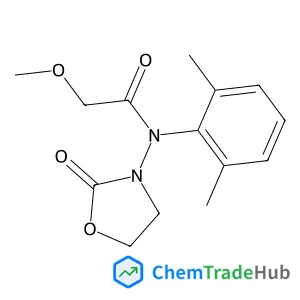
N-(2,6-Dimethylphenyl)-2-methoxy-N-(2-oxo-1,3-oxazolidin-3-yl)acetamide
CAS Number:
77732-09-3
Molecular Formula:
C14H18N2O4

Recommended Suppliers






Disclaimer
This page provides academic journal information for reference and research purposes only. We are not affiliated with any journal publishers and do not handle publication submissions. For publication-related inquiries, please contact the respective journal publishers directly.
If you notice any inaccuracies in the information displayed, please contact us at support@chemtradehub.com. We will promptly review and address your concerns.