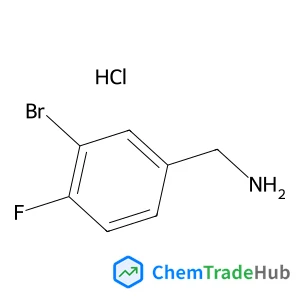
1-(3-Bromo-4-fluorophenyl)methanamine hydrochloride (1:1)
CAS Number:
202865-68-7
Molecular Formula:
C7H8BrClFN
Lukas J. Gooßen, Christophe Linder, Nuria Rodríguez, Paul P. Lange, Andreas Fromm
A silver-based catalyst system has been discovered that effectively promotes the protodecarboxylation of various carboxylic acids at temperatures of 80–120 °C—more than 50 °C below those of the best known copper catalysts.
Hasan Baig, Hiroyuki Kanda, Abdullah M. Asiri, Mohammad Khaja Nazeeruddin, Tapas Mallick
DOI: 10.1039/D0SE90048F
Cecilia Solís, María Balaguer, Julio Garcia-Fayos, Elena Palafox, José M. Serra
DOI: 10.1039/D0SE00324G
Panpan Zhang, Haixia Wang, Wei Xu, Yang Li, Qing Li, Gang Wei, Zhiqiang Su
DOI: 10.1039/C5BM00058K
Andreas Eschenbacher, Alireza Saraeian, Brent H. Shanks, Peter Arendt Jensen, Ulrik Birk Henriksen, Jesper Ahrenfeldt, Anker Degn Jensen
DOI: 10.1039/D0SE00303D
Wei Zhang, Shuping Li, Jia Xie
DOI: 10.1039/D0SE00512F
Yupeng Wang, Zhijian Luo, Dongfang Zhou, Xuefeng Wang
DOI: 10.1039/D1BM00087J
Hassan A. Alabdrabalameer, Juho Kauppinen, Toni Pikkarainen
DOI: 10.1039/D0SE00155D
(1R,3S)-1,3-Cyclopentanediol finds applications in various industries. In the ph...
When handling N'-[4-(Dimethylamino)phenyl]-N,N-dimethyl-1,4-benzenediamine, it i...
There are several alternatives to 5-(2,4-Difluorophenyl)-2-methoxypyrimidine in ...
1-(3-Methoxyphenoxy)propan-2-ol (CAS: 382141-68-6) must comply with the Globally...
Tetrodotoxin Citrate is extremely dangerous and should be handled with extreme c...
2-Methyl-2-propanyl [(1R,3S)-3-hydroxycyclopentyl]carbamate (CAS: 225641-84-9) i...
Waste containing 4-(2-Hydroxyhexafluoroisopropyl)Benzoic Acid (CAS: 16261-80-6) ...
2-Methyl-2-proanyl {(2S)-1-[(benzyloxy)amino]-3-hydroxy-3-methyl-1-oxo-2-butanyl...
Benzeneethanamine, α-ethyl-, hydrochloride (1:1) is an organic compound with the...
In the synthesis of compounds similar to 3-{(E)-[4-(Dimethylamino)phenyl]diazeny...

ChemComm publishes urgent research which is of outstanding significance and interest to experts in the field, while also appealing to the journal’s broad chemistry readership. Our communication format is ideally suited to short, urgent studies that are of such importance that they require accelerated publication. Our scope covers all topics in chemistry, and research at the interface of chemistry and other disciplines (such as materials science, nanoscience, physics, engineering and biology) where there is a significant novelty in the chemistry aspects. Major topic areas covered include: Analytical Chemistry Catalysis Chemical Biology and medicinal chemistry Computational Chemistry and Machine Learning Energy and sustainable chemistry Environmental Chemistry Green Chemistry Inorganic Chemistry Materials Chemistry Nanoscience Organic Chemistry Physical Chemistry Polymer Chemistry Supramolecular Chemistry