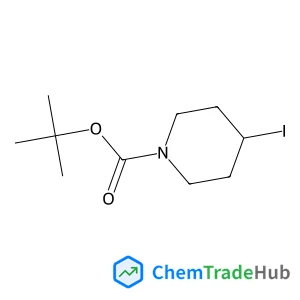
2-Methyl-2-propanyl 4-iodo-1-piperidinecarboxylate
CAS Number:
301673-14-3
Molecular Formula:
C10H18INO2
Naimish Sardesai, Shenmin Pan
We report the first electrochemiluminescent immunosensor combining single-wall carbon nanotube forests with RuBPY–silica–secondary antibody nanoparticles for sensitive detection of cancer biomarker prostate specific antigen.
Tanya Karakouz, Alexander B. Tesler, Takumi Sannomiya, Yishay Feldman, Alexander Vaskevich, Israel Rubinstein
DOI: 10.1039/C3CP50198A
Céline Charbonneau, Christophe Chassenieux, Olivier Colombani, Taco Nicolai
DOI: 10.1039/C3CP43653E
Hadi Ramezani-Dakhel, Peter A. Mirau, Rajesh R. Naik, Marc R. Knecht, Hendrik Heinz
DOI: 10.1039/C3CP00135K
James A. Miller, Stephen J. Klippenstein
DOI: 10.1039/C3CP44337J
Jingying Shi, Donge Wang, Can Li
DOI: 10.1039/C3CP50295C
Frank Wackenhut, Alfred J. Meixner
DOI: 10.1039/C3CP43988G
Pinyi Yang, Diane K. Zhong, Mingjian Yuan, Andrew H. Rice, Daniel R. Gamelin, Christine K. Luscombe
DOI: 10.1039/C3CP50325A
Thomas Read, Rouslan V. Olkhov, Andrew M. Shaw
DOI: 10.1039/C3CP50758K
Shi Yin, Zhechen Wang, Elliot R. Bernstein
DOI: 10.1039/C3CP50183C
Guillermo Pérez-Hernández, Burkhard Schmidt
DOI: 10.1039/C3CP44278K
Waste containing (6-Bromo-2-naphthyl)oxy](dimethyl)(2-methyl-2-propanyl)silane (...
7-Fluoro-4-isoquinolinecarboxylic acid can be synthesized via a multi-step proce...
2,3,5,6-Tetrabromothieno[3,2-b]thiophene is a crystalline compound with a high m...
1-[4-(Benzylamino)-7,8-dihydro-5H-pyrano[4,3-d]pyrimidin-2-yl]-2-methyl-1H-indol...
The market for imidazo[5,1-d]-1,2,3,5-tetrazine-8-carboxylic acid, 3,4-dihydro-3...
3-(Triisopropylsilyl)propiolaldehyde is a synthetic organic compound with the CA...
6-Nitro-2H-1,4-benzoxazin-3(4H)-one (CAS: 81721-87-1) is subject to various regu...
Waste containing (3-Fluorophenyl)(4-{[(2-methyl-2-propanyl)oxy]carbonyl}-1-piper...
N,N'-4,4'-Biphenyldiyldiisonicotinamide is a white crystalline solid with a mole...
6-Bromo-8-fluoro-2-quinazolinol is primarily used in the pharmaceutical industry...

ChemComm publishes urgent research which is of outstanding significance and interest to experts in the field, while also appealing to the journal’s broad chemistry readership. Our communication format is ideally suited to short, urgent studies that are of such importance that they require accelerated publication. Our scope covers all topics in chemistry, and research at the interface of chemistry and other disciplines (such as materials science, nanoscience, physics, engineering and biology) where there is a significant novelty in the chemistry aspects. Major topic areas covered include: Analytical Chemistry Catalysis Chemical Biology and medicinal chemistry Computational Chemistry and Machine Learning Energy and sustainable chemistry Environmental Chemistry Green Chemistry Inorganic Chemistry Materials Chemistry Nanoscience Organic Chemistry Physical Chemistry Polymer Chemistry Supramolecular Chemistry

![N-[(E)-Phenylmethylene]benzenesulfonamide structure](https://static.chemtradehub.com/structs/139/13909-34-7-8167.webp "N-[(E)-Phenylmethylene]benzenesulfonamide structure")