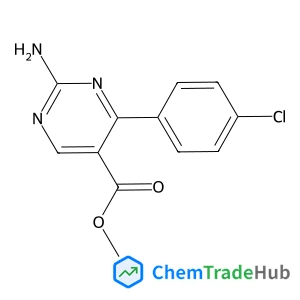
Methyl 2-amino-4-(4-chlorophenyl)-5-pyrimidinecarboxylate
CAS Number:
1133115-56-6
Molecular Formula:
C12H10ClN3O2
The first page of this article is displayed as the abstract.
Yan Wang, Haoran Li, Daqing Chen, Danhua Ge, Xiaojun Chen
DOI: 10.1039/D3NJ04276F
Ahmed Fatimi, Rajender S. Varma, Mohammed Berrada
DOI: 10.1039/D3TB01712E
Chang-Mou Wu, Kebena Gebeyehu Motora, Pankaj Koinkar, Akihiro Furube
DOI: 10.1039/D3NJ04410F
Fatemeh Pirouzi, Hossein Eshghi, Hossein Sabet-Sarvestani
DOI: 10.1039/D3NJ90185H
Anqi Ju, Shuxian Zhang, Dong Li, Kunming Li, Xuepeng Ni, Yi Li, Yang Jiang
DOI: 10.1039/D3NJ04456D
Lili Wang, Yuyang Zhou, Haixiang Wang, Qiaoli Lu, Jinmei Wang, Dawei Gao
DOI: 10.1039/D3NJ04717B
Wei-Nan Zhao, Hongjuan Li, Shiguo Sun, Yongqian Xu
DOI: 10.1039/D3TB01564E
Chunyu Shao, Xiuyan Gong, Dongxiang Zhang, Xin-Dong Jiang, Jianjun Du, Guiling Wang
DOI: 10.1039/D3TB02132G
Francisco Gámez, Roberto Gallardo, Manuel Pernia Leal
DOI: 10.1039/D3TB01821K
Faqi Yu, Ruiyang Fan, Yansheng Zhao, Yijun Chen, Xiuqi Kong
DOI: 10.1039/D3TB02232C
6-(3-Fluorophenyl)picolinic acid is generally considered safe for laboratory use...
(3R)-3-Pyrrolidinol is used in the pharmaceutical industry as a precursor for dr...
When handling (4R,5R)-4,5-Diethoxycarbonyl-2,2-dimethyldioxolane (CAS: 59779-75-...
1-(6-Chloroimidazo[1,2-b]pyridazin-3-yl)ethanone is often synthesized via a mult...
The market for N-Ethyl-3,4-dimethylbenzylamine (CAS: 39180-83-1) remains steady,...
Tert-butyl 3-(pyrrolidin-1-yl)azetidine-1-carboxylate is a chemical compound wit...
1-Bromo-3-chloro-2,4-dimethoxybenzene (CAS: 1228956-93-1) falls under the classi...
The safety of 8-Bromo-2-methyl-3,4-dihydroisoquinolin-1(2H)-one (CAS: 1368622-07...
Benzyl [(3S)-2,6-dioxo-3-piperidinyl]carbamate is generally safe when handled wi...
1-{[4-(4,4,5,5-Tetramethyl-1,3,2-dioxaborolan-2-yl)phenyl]sulfonyl}pyrrolidine s...

ChemComm publishes urgent research which is of outstanding significance and interest to experts in the field, while also appealing to the journal’s broad chemistry readership. Our communication format is ideally suited to short, urgent studies that are of such importance that they require accelerated publication. Our scope covers all topics in chemistry, and research at the interface of chemistry and other disciplines (such as materials science, nanoscience, physics, engineering and biology) where there is a significant novelty in the chemistry aspects. Major topic areas covered include: Analytical Chemistry Catalysis Chemical Biology and medicinal chemistry Computational Chemistry and Machine Learning Energy and sustainable chemistry Environmental Chemistry Green Chemistry Inorganic Chemistry Materials Chemistry Nanoscience Organic Chemistry Physical Chemistry Polymer Chemistry Supramolecular Chemistry
![5-Bromo-3-isopropyl-1H-pyrrolo[2,3-b]pyridine structure](https://static.chemtradehub.com/structs/125/1256819-54-1-8620.webp "5-Bromo-3-isopropyl-1H-pyrrolo[2,3-b]pyridine structure")