












Nitrogen oxide reaction with six-atom silver clusters supported on LTA zeolite
Literature Information
Publication Date
2009-06-23
DOI
10.1039/B903870A
Impact Factor
3.676
Authors
Amgalanbaatar Baldansuren, Rüdiger-A. Eichel, Emil Roduner
View Original
Abstract
Silver containing catalysts were prepared by aqueous ion exchange of Ag+ against Na+ in an LTA zeolite. A well-defined paramagnetic cluster consisting of six equivalent silver nuclei was obtained after oxidation and hydrogen reduction. Continuous wave EPR demonstrates that the reduced Ag6+ clusters are isolated and all silver atoms are close to equivalent. Upon addition of NO gas at room temperature, the spectrum of the Ag6+ cluster disappears immediately. A new spectrum has the character of adsorbed NO. Its line is split by hyperfine interaction between the unpaired electron with 14N of the adsorbed NO, and by the nuclear spin of one Ag nucleus to which NO is bound. The experimental isotropic hyperfine coupling aNiso≈ 11.0 G is too large for being observed in the HYSCORE spectrum, but a small 14N-hyperfine interaction is observed and assigned to a second nitrogen spin in the vicinity of the silver cluster. In the presence of trace oxygen NO transforms slowly into NO2, but no further activity was observed at room temperature. The NO2 molecule exhibits dynamics in the temperature range of 30 to 125 K. The rotational diffusion is axially symmetric about the molecular y axis of the adsorbed NO2. Above 50 K, it becomes rapidly nearly isotropic. Analysis of the correlation time (τc) derived from the EPR lineshapes provides the kinetic parameters, and an Arrhenius representation gives access to the activation energy for the rotational motion.
Related Literature
Many-body effects in silicene, silicane, germanene and germanane
Ying Dai, Baibiao Huang, Timo Jacob
2013-04-11
Paper
DOI: 10.1039/C3CP51078F
Raman spectral characteristics of 4-aminobenzenethiol adsorbed on ZnO nanorod arrays
Kwan Kim, Kyung Lock Kim, Kuan Soo Shin
2013-05-09
Paper
DOI: 10.1039/C3CP51204E
Accurate determination of the ultrafast proton transfer rate in porphycene using nuclear spin relaxation
Piotr Bernatowicz
2013-04-09
Paper
DOI: 10.1039/C3CP50963J
A variable temperature synchrotron X-ray diffraction study of the ferroelastic double perovskite Ba2GdMoO6
Thomas K. Wallace, Ross H. Colman, Abbie C. Mclaughlin
2013-01-03
Paper
DOI: 10.1039/C2CP43732E
Interesting thermal variations owing to cationic ring structural features in protic ionic liquids
Gitanjali Rai, Anil Kumar
2013-04-17
Communication
DOI: 10.1039/C3CP50314C
Photofragmentation at 263 nm of small peptides containing tyrosine: the role of the charge transfer on CO
Christophe Dehon, Satchin Soorkia, Mélanie Pedrazzani, Christophe Jouvet, Michel Barat, Jacqueline A. Fayeton, Bruno Lucas
2013-04-05
Paper
DOI: 10.1039/C3CP50720C
Insights into the polymorphism of glycine: membrane crystallization in an electric field
Gianluca Di Profio, Mika T. Reijonen, Rocco Caliandro, Antonietta Guagliardi, Efrem Curcio, Enrico Drioli
2013-05-09
Paper
DOI: 10.1039/C3CP50664A
Dissecting the structural determinants for the difference in mechanical stability of silk and amyloid beta-sheet stacks
Senbo Xiao, Shijun Xiao
2013-04-11
Paper
DOI: 10.1039/C3CP00067B
Faceting preferences for AuN and PdN nanoclusters with high-symmetry motifs
Z. Y. Li, Roy L. Johnston
2013-04-15
Paper
DOI: 10.1039/C3CP50978H
You might also like
Compound Q&A
What precautions should be taken when handling 2-Chloro-1,2-bis(4-methylphenyl)ethanone (CAS: 71193-32-3)?
When handling 2-Chloro-1,2-bis(4-methylphenyl)ethanone (CAS: 71193-32-3), it is ...
71193-32-32-Chloro-1,2-bis(4-m...
Compound Q&A
What industries use 4-Ethoxy-3-(5-methyl-4-oxo-7-propyl-1,4-dihydroimidazo[5,1-f][1,2,4]triazin-2-yl)benzenesulfonyl chloride (CAS: 224789-26-8)?
4-Ethoxy-3-(5-methyl-4-oxo-7-propyl-1,4-dihydroimidazo[5,1-f][1,2,4]triazin-2-yl...
224789-26-84-Ethoxy-3-(5-methyl...
Compound Q&A
How should Methyl 3-Oxo-4-Androsten-17-Carboxylate (CAS: 2681-55-2) be stored?
Methyl 3-Oxo-4-Androsten-17-Carboxylate (CAS: 2681-55-2) should be stored in a c...
2681-55-2Methyl 3-Oxo-4-Andro...
Compound Q&A
What are the main uses of (R)-3-Amino-4-(3-hexylphenylamino)-4-oxobutylphosphonic acid (CAS: 909725-61-7)?
(R)-3-Amino-4-(3-hexylphenylamino)-4-oxobutylphosphonic acid is primarily used i...
909725-61-7(R)-3-Amino-4-(3-hex...
Compound Q&A
What regulatory guidelines apply to 2-Methyl-2-propanyl 3-amino-3-carbamoyl-1-azetidinecarboxylate (CAS: 1254120-14-3)?
2-Methyl-2-propanyl 3-amino-3-carbamoyl-1-azetidinecarboxylate (CAS: 1254120-14-...
1254120-14-32-Methyl-2-propanyl ...
Compound Q&A
Are there alternatives to (E)-4-(tert-Butoxy)-4-oxobut-2-enoic acid (CAS: 135355-96-3) in synthesis?
There are alternative reagents that can be used in synthesis instead of (E)-4-(t...
135355-96-3(E)-4-(tert-Butoxy)-...
Compound Q&A
What are the physical and chemical properties of [2-(3-Chlorophenyl)-1,3-thiazol-4-yl]methanol (CAS: 121202-20-8)?
[2-(3-Chlorophenyl)-1,3-thiazol-4-yl]methanol (CAS: 121202-20-8) is a crystallin...
121202-20-8[2-(3-Chlorophenyl)-...
Compound Q&A
What is the market or research trend for Methyl (2S)-[(4S)-2,2-dimethyl-1,3-dioxolan-4-yl]{[(4-methylphenyl)sulfonyl]oxy}acetate (CAS: 166249-17-8)?
The market and research trends for Methyl (2S)-[(4S)-2,2-dimethyl-1,3-dioxolan-4...
166249-17-8Methyl (2S)-[(4S)-2,...
Compound Q&A
What is the market or research trend for 1-Bromo-2-isocyanatoethane (CAS: 42865-19-0)?
The market for 1-Bromo-2-isocyanatoethane (CAS: 42865-19-0) is driven by its use...
42865-19-01-Bromo-2-isocyanato...
Compound Q&A
What are the main uses of 4-Nitro-D-phenylalanine hydrochloride (CAS: 147065-06-3)?
4-Nitro-D-phenylalanine hydrochloride (CAS: 147065-06-3) is primarily used in re...
147065-06-34-Nitro-D-phenylalan...
Source Journal
Physical Chemistry Chemical Physics

CiteScore:
5.5
Self-citation Rate:
10.3%
Articles per Year:
3036
Physical Chemistry Chemical Physics (PCCP) is an international journal co-owned by 19 physical chemistry and physics societies from around the world. This journal publishes original, cutting-edge research in physical chemistry, chemical physics and biophysical chemistry. To be suitable for publication in PCCP, articles must include significant innovation and/or insight into physical chemistry; this is the most important criterion that reviewers and Editors will judge against when evaluating submissions. The journal has a broad scope and welcomes contributions spanning experiment, theory, computation and data science. Topical coverage includes spectroscopy, dynamics, kinetics, statistical mechanics, thermodynamics, electrochemistry, catalysis, surface science, quantum mechanics, quantum computing and machine learning. Interdisciplinary research areas such as polymers and soft matter, materials, nanoscience, energy, surfaces/interfaces, and biophysical chemistry are welcomed if they demonstrate significant innovation and/or insight into physical chemistry. Joined experimental/theoretical studies are particularly appreciated when complementary and based on up-to-date approaches.
Recommended Compounds
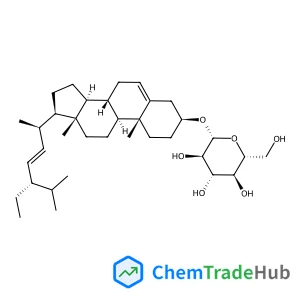
(3beta,22E)-Stigmasta-5,22-dien-3-yl beta-D-glucopyranoside
CAS Number:
19716-26-8
Molecular Formula:
C35H58O6
Recommended Suppliers






Disclaimer
This page provides academic journal information for reference and research purposes only. We are not affiliated with any journal publishers and do not handle publication submissions. For publication-related inquiries, please contact the respective journal publishers directly.
If you notice any inaccuracies in the information displayed, please contact us at support@chemtradehub.com. We will promptly review and address your concerns.