












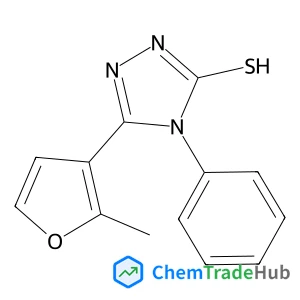
5-(2-Methyl-3-furyl)-4-phenyl-2,4-dihydro-3H-1,2,4-triazole-3-thione
CAS Number:
346464-59-3
Molecular Formula:
C13H11N3OS
Gary Hastings, Peter Krug, Ruili Wang, Jing Guo, Hari P. Lamichhane, Tian Tang, Yu-sheng Hsu, John Ward, David Katz, Julia Hilliard
FTIR microscopy has been used to collect spectra for uninfected (mock) Vero cells, and cells that have been infected with herpes simplex virus type 1 (HSV-1) and human adenovirus type 5 (Ad-5). Cells were infected at a multiplicity of infection of 10, and studied at 24 hours post exposure. The spectra for infected samples display many differences compared to the spectra for uninfected samples. To estimate how well the spectra for uninfected and infected samples could be discriminated, we used logistic and partial least squares regression methods. We show that the spectra for HSV-1 and mock infected samples are well differentiated and, for a sensitivity of 95%, we calculate a specificity of 0.999 using partial least squares regression. Spectra for Ad-5 and mock infected samples are also well differentiated. We find that applying our regression models constructed with one data set to a new validating data set still gives very high levels of specificity for a given sensitivity. Spectra for Ad-5 and HSV-1 infected samples are also differentiable. Applying our constructed regression models to new validating data, however, leads to a decrease in the discrimination capability in this instance. If one is simply interested in differentiating spectra associated with uninfected and infected cells, without distinguishing the type of infection, then we show that logistic regression models can break down whereas partial least squares regression models perform well.
Jieni Hu, Chuanhao Sun, Siqi Li, Yuan Yuan
DOI: 10.1039/D1PY00703C
Natanel Jarach, Daniel Golani, Ofer Asaf, Hanna Dodiuk, Yoav Shamir, Amir Goldbourt, Samuel Kenig, Naum Naveh
DOI: 10.1039/D1PY00116G
Xuejin Yang, Laura M. Murphy, Scott M. Grayson
DOI: 10.1039/D1PY00191D
A. Funes, R. Cuervo-Rodríguez
DOI: 10.1039/D1PY00098E
Jurrie Noordijk, Bert Gebben, Monique H. M. Meeusen-Wierts, Katrien V. Bernaerts
DOI: 10.1039/D1PY00005E
Marc Schmutz
DOI: 10.1039/D1PY00139F
Chai Won Kim, Ji Hye Lee, Seunguk Cho, Hyung Jong Kim, Jinhyo Hwang, Yong Woo Kim, Dae Hyuk Choi, Min Ju Cho, Kwangyeol Lee, Dong Hoon Choi
DOI: 10.1039/D1PY00497B
Yongjun Men, Tobias G. Brevé, Antonia G. Denkova, Rienk Eelkema
DOI: 10.1039/D1PY00514F
Chao Li, Li Han, Xiping Chen, Xinyu Bao, Qi Sun, Hongwei Ma, Yang Li
DOI: 10.1039/D1PY00416F
When handling lithium chloride hydrate (1:1:1) (CAS: 16712-20-2), it is importan...
4-(4H-1,2,4-Triazol-4-yl)piperidine is generally considered safe for use in phar...
Waste containing 1,3-Thiazole-2-carboxamide (CAS: 16733-85-0) should be collecte...
5-(Difluoromethyl)-2-fluorobenzonitrile (CAS: 934175-58-3) is subject to regulat...
Methyl 3-acetamido-2-thiophenecarboxylate can be synthesized by the reaction of ...
4-Isoquinolinecarbonitrile is a chemical compound with the CAS number 34846-65-6...
Store Methyl 1H-1,2,3-triazole-4-carboxylate (CAS: 877309-59-6) in a cool, dry p...
6-Bromo[1,3]thiazolo[5,4-b]pyridin-2-amine (CAS: 1160791-13-8) is subject to the...
(2S,3S)-2-Ammonio-3-(3,4-dihydroxyphenyl)-3-hydroxypropanoate (CAS: 23651-95-8) ...
7-Bromo-3-methyl-3,4-dihydroquinazolin-4-one is a solid with a crystalline form....

Analyst publishes analytical and bioanalytical research that reports premier fundamental discoveries and inventions, and the applications of those discoveries, unconfined by traditional discipline barriers.
![6-(Benzyloxy)-8-(2-bromoacetyl)-2H-benzo[b][1,4]oxazin-3(4H)-one structure](https://static.chemtradehub.com/structs/926/926319-53-1-2287.webp "6-(Benzyloxy)-8-(2-bromoacetyl)-2H-benzo[b][1,4]oxazin-3(4H)-one structure")
![1-[4-(4-Methyl-1H-imidazol-1-yl)phenyl]ethanone structure](https://static.chemtradehub.com/structs/142/142161-53-3-7f55.webp "1-[4-(4-Methyl-1H-imidazol-1-yl)phenyl]ethanone structure")





