


Physisorption and chemisorption of alkanes and alkenes in H-FAU: a combined ab initio–statistical thermodynamics study‡
Literature Information
Publication Date
2009-02-23
DOI
10.1039/B819435C
Impact Factor
3.676
Authors
Bart A. De Moor, Marie-Françoise Reyniers, Guy B. Marin
View Original
Abstract
The sorption in H-FAU zeolite of C4–C12 n-alkanes, and linear and branched C2–C8 alkenes has been quantified up to 800 K by combining QM-Pot(MP2//B3LYP) with statistical thermodynamics calculations. The physisorption strength increases linearly with increasing carbon number by 8.5 kJ mol−1 and does not depend on the detailed alkane or alkene structure. Van der Waals interactions are dominant in physisorption, but alkenes are additionally stabilized by 20 kJ mol−1 by formation of a π-complex. Protonation of an alkene leads to the formation of alkoxides, which are more stable than the physisorbed species. As for physisorption a linear relation between the chemisorption energy and the carbon number is obtained. Protonation energies are independent of the carbon number but depend on the type of CC double bond being protonated. The relative stability difference between the secondary and tertiary alkoxides is 15 kJ mol−1 in favor of the former. Both physisorption and chemisorption are accompanied with entropy losses which increase linearly with the carbon number. A typical compensation effect is obtained: the stronger the stabilization of the sorbed species the more pronounced the entropy loss. For temperatures ranging from 0 to 800 K, all of the derived linear relations expressing the physisorption and/or chemisorption enthalpy and entropy of the alkanes and the alkanes as function of the carbon number are independent of temperature. A good agreement between calculated and experimental values for alkanes is obtained at 500 K.
Recommended Journals

Journal of Enzyme inhibition and Medicinal Chemistry

Current Pharmaceutical Biotechnology

Nature Reviews Drug Discovery

Environmental Toxicology and Pharmacology

Advanced Engineering Materials

Angewandte Chemie International Edition

Coloration Technology

Molecular Diversity

Physical Chemistry Chemical Physics

Photochemical & Photobiological Sciences
Related Literature
Two short approaches to the COVID-19 drug β-d-N4-hydroxycytidine and its prodrug molnupiravir‡
Kevin E. Persaud, Rajesh R. Sahu, Michelle C. Neary, Anant R. Kapdi, Mahesh K. Lakshman
2023-12-15
Communication
DOI: 10.1039/D3OB02039H
Selective S-arylation of thiols with o-OTf-substituted diaryliodonium salts toward diarylsulfides
Yuxuan Zhang, Yu Wang, Limin Wang, Jianwei Han
2023-12-13
Communication
DOI: 10.1039/D3OB01922E
Highly selective Cu2+ detection with a naphthalimide-functionalised pillar[5]arene fluorescent chemosensor
Rong Chang, Chan-Yu Chen, Liya Gao, Yana Li, Zui-Harng Lee, Hongxia Zhao, Andrew C.-H. Sue, Kai-Chi Chang
2023-11-14
Paper
DOI: 10.1039/D3OB01558K
α-Alkylation of ketones with primary alcohols by an active non-noble metal Cu/CuOx catalyst
Hongli Wang, Chun-Ran Chang
2023-12-23
Paper
DOI: 10.1039/D3OB01836A
Photoredox radical cyclization reaction of o-vinylaryl isocyanides with acyl chlorides to access 2,4-disubstituted quinolines
Peng-Fei Huang, Jia-Le Fu, Jia-Jing Huang, Bi-Quan Xiong, Ke-Wen Tang, Yu Liu
2023-12-18
Paper
DOI: 10.1039/D3OB01915B
Cu(ii) salts as terminal oxidants in visible-light photochemical oxidation reactions
Grace A. Lutovsky, Tehshik P. Yoon
2023-11-22
Review Article
DOI: 10.1039/D3OB01678A
Histidine-assisted reduction of arylnitrenes upon photo-activation of phenyl azide chromophores in GFP-like fluorescent proteins
D. Dafydd Jones
2023-11-20
Paper
DOI: 10.1039/D3OB01450A
Synthesis and applications of symmetric amino acid derivatives
Chihiro Tsukano, Ayumi Uchino, Kazuhiro Irie
2023-10-21
Review Article
DOI: 10.1039/D3OB01379K
Two-step, high-yielding total synthesis of antibiotic pyrones
Akram Hussain, Sunitha Katta, Dhevalapally B. Ramachary
2023-12-14
Paper
DOI: 10.1039/D3OB01923C
Recent advances in ligand-enabled palladium-catalyzed divergent synthesis
Yue Wang, Jinzan Feng, Er-Qing Li, Zhenhua Jia, Teck-Peng Loh
2023-11-27
Review Article
DOI: 10.1039/D3OB01679J
You might also like
Compound Q&A
What regulatory guidelines apply to 4-Amino-3-bromophenol (CAS: 74440-80-5)?
4-Amino-3-bromophenol (CAS: 74440-80-5) falls under the classification of a haza...
74440-80-54-Amino-3-bromopheno...
Compound Q&A
How should (17beta)-3-Oxoestr-4-en-17-yl acetate (CAS: 1425-10-1) be stored?
(17beta)-3-Oxoestr-4-en-17-yl acetate should be stored in a cool, dry place away...
1425-10-1(17beta)-3-Oxoestr-4...
Compound Q&A
What are the physical and chemical properties of 2-[(2,2-Diethoxyethyl)disulfanyl]-1,1-diethoxyethane (CAS: 76505-71-0)?
2-[(2,2-Diethoxyethyl)disulfanyl]-1,1-diethoxyethane (CAS: 76505-71-0) is a colo...
76505-71-02-[(2,2-Diethoxyethy...
Compound Q&A
What is the market or research trend for 1-(β-D-ribofuranosyl)-1H-imidazo[4,5-c]pyridin-4-amine?
The market and research for 1-(β-D-ribofuranosyl)-1H-imidazo[4,5-c]pyridin-4-ami...
6736-58-91-(beta-D-Ribofurano...
Compound Q&A
How should waste containing Conjugated Estrogen (CAS: 12126-59-9) be handled?
Waste containing Conjugated Estrogen (CAS: 12126-59-9) should be collected and d...
12126-59-9Conjugated Estrogen
Compound Q&A
What is the market or research trend for Bis(2,2,2-trifluoroethyl) (methoxycarbonylmethyl)phosphonate?
The market for Bis(2,2,2-trifluoroethyl) (methoxycarbonylmethyl)phosphonate (CAS...
88738-78-7Bis(2,2,2-trifluoroe...
Compound Q&A
Are there alternatives to 3,4'-Di-O-methylellagic acid (CAS: 57499-59-9) in synthesis?
There are several alternatives to 3,4'-Di-O-methylellagic acid (CAS: 57499-59-9)...
57499-59-93,4'-Di-O-methylella...
Compound Q&A
What regulatory guidelines apply to 2-Chloro-N,N-dimethylpyridin-4-amine (CAS: 59047-70-0)?
2-Chloro-N,N-dimethylpyridin-4-amine (CAS: 59047-70-0) is regulated under the Gl...
59047-70-02-Chloro-N,N-dimethy...
Compound Q&A
What is cerium(3+);oxygen(2-);vanadium(5+) (CAS: 13597-19-8)?
Cerium(3+);oxygen(2-);vanadium(5+) (CAS: 13597-19-8) is a complex inorganic comp...
13597-19-8cerium(3+);oxygen(2-...
Compound Q&A
Is 7-Chloro-1-iodoisoquinoline (CAS: 1203579-27-4) safe?
7-Chloro-1-iodoisoquinoline (CAS: 1203579-27-4) is generally considered safe whe...
1203579-27-47-Chloro-1-iodoisoqu...
Source Journal
Physical Chemistry Chemical Physics
CiteScore:
5.5
Self-citation Rate:
10.3%
Articles per Year:
3036
Physical Chemistry Chemical Physics (PCCP) is an international journal co-owned by 19 physical chemistry and physics societies from around the world. This journal publishes original, cutting-edge research in physical chemistry, chemical physics and biophysical chemistry. To be suitable for publication in PCCP, articles must include significant innovation and/or insight into physical chemistry; this is the most important criterion that reviewers and Editors will judge against when evaluating submissions. The journal has a broad scope and welcomes contributions spanning experiment, theory, computation and data science. Topical coverage includes spectroscopy, dynamics, kinetics, statistical mechanics, thermodynamics, electrochemistry, catalysis, surface science, quantum mechanics, quantum computing and machine learning. Interdisciplinary research areas such as polymers and soft matter, materials, nanoscience, energy, surfaces/interfaces, and biophysical chemistry are welcomed if they demonstrate significant innovation and/or insight into physical chemistry. Joined experimental/theoretical studies are particularly appreciated when complementary and based on up-to-date approaches.
Recommended Compounds
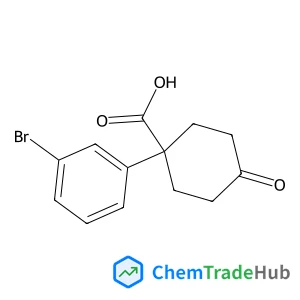
1-(3-Bromophenyl)-4-oxocyclohexanecarboxylic acid
CAS Number:
1385694-53-0
Molecular Formula:
C13H13BrO3
Recommended Suppliers




Disclaimer
This page provides academic journal information for reference and research purposes only. We are not affiliated with any journal publishers and do not handle publication submissions. For publication-related inquiries, please contact the respective journal publishers directly.
If you notice any inaccuracies in the information displayed, please contact us at support@chemtradehub.com. We will promptly review and address your concerns.