













Origin of the catalytic activity of graphite nitride for the electrochemical reduction of oxygen: geometric factors vs. electronic factors
Literature Information
Publication Date
2009-02-17
DOI
10.1039/B818408A
Impact Factor
3.676
Authors
Zikun Wang, Lixin Jia, Zhenlin Xiao
View Original
Abstract
Graphite nitride (GN) was prepared from graphite oxide (GO) by reacting with ammonia at high temperature. Its electrochemical properties as catalyst for oxygen reduction reaction (ORR) were evaluated by cyclic voltammetry (CV) and steady state polarization (SP) measurements. In order to explore the origin of the activity of the catalysts, the lattice symmetry, the component and the band structure of the catalyst surface were characterized by Raman spectroscopy, X-ray photoelectron spectroscopy (XPS) and ultraviolet photoelectron spectroscopy (UPS), respectively. The results indicate that the geometric factors, e.g. the surface area and the disorder degree, play only a minor role in the enhancement of the electrocatalytic activity of GN for ORR. The correlation between the electrocatalytic activity and the density of state (DOS) at 6.5 eV below Fermi level of GN demonstrates that the activity of the catalysts arises from the electronic states near Fermi level developed as a result of the incorporation of hetero-atoms, N and (or) Fe, especially N, into the graphite lattice.
Related Literature
Synthesis of functionalized tetrahydrodibenzo[b,g][1,8]naphthyridin-1(2H)-ones through base-promoted annulation of quinoline-derived dipolarophiles and cyclic enaminones
Wenjun Luo, Xinghua Zheng, Fanglian Zhang, Qiuya Luo, Wen-Ting Deng, Lipeng Long, Daohong Yu, Zhong-Xia Wang, Zhengwang Chen
2023-11-16
Communication
DOI: 10.1039/D3OB01547E
Direct synthesis of N-functionalized indoles through isomerization of azomethine ylides
2024-01-03
Communication
DOI: 10.1039/D3OB01393F
Copper-mediated [3 + 2] oxidative cyclization of oxime acetate and its utility in the formal synthesis of fentiazac
Harish B. Musale, Vivek T. Humne
2023-12-01
Paper
DOI: 10.1039/D3OB01882B
Synthesis of Cs-symmetrical C60 tetra-adducts via reactions of C60Cl6 with CH-acids and enol silyl ester
Olga A. Kraevaya, Alexander S. Peregudov
2023-12-05
Paper
DOI: 10.1039/D3OB01868G
Visible-light-promoted difluoroamidated oxindole synthesis via electron donor–acceptor complexes
Wei-Feng Wang, Tao Liu, Yan-Liang Cheng, Qin-Hua Song
2023-12-19
Paper
DOI: 10.1039/D3OB01885G
Photo-induced radical transformations of tosyl cyanide
Ya Liu, Rui Li, Bing Yu
2023-11-29
Review Article
DOI: 10.1039/D3OB01771K
A fluorescent electrophile for CLIPS: self indicating TrkB binders
Tye Thompson, Pornthip Piyanuch, Nantanit Wanichacheva, Anyanee Kamkaew, Kevin Burgess
2023-12-12
Paper
DOI: 10.1039/D3OB01654D
QN-302 demonstrates opposing effects between i-motif and G-quadruplex DNA structures in the promoter of the S100P gene
Effrosyni Alexandrou, Dilek Guneri, Stephen Neidle, Zoë A. E. Waller
2023-11-06
Communication
DOI: 10.1039/D3OB01464A
Azide-free cyclization reaction access to 4-aryl-NH-1,2,3-triazoles: P-toluenesulfonyl hydrazide and sulfamic acid as nitrogen sources
Min Li, Qing-Yu Wan, Ri-Lan Lin, Yan-Qing Peng, Wen-Ming Shu, Wei-Chu Yu, An-Xin Wu
2023-12-13
Communication
DOI: 10.1039/D3OB01661G
Synthesis of benzimidazole-fused 1,4-benzoxazepines and benzosultams spiro-connected to a 2-oxindole core via a tandem epoxide-opening/SNAr approach
Abhijit Gogoi, Subhamoy Mukhopadhyay, Raju Chouhan, Sajal Kumar Das
2023-12-01
Paper
DOI: 10.1039/D3OB01613G
You might also like
Compound Q&A
What regulatory guidelines apply to 4-Amino-3-bromophenol (CAS: 74440-80-5)?
4-Amino-3-bromophenol (CAS: 74440-80-5) falls under the classification of a haza...
74440-80-54-Amino-3-bromopheno...
Compound Q&A
How should (17beta)-3-Oxoestr-4-en-17-yl acetate (CAS: 1425-10-1) be stored?
(17beta)-3-Oxoestr-4-en-17-yl acetate should be stored in a cool, dry place away...
1425-10-1(17beta)-3-Oxoestr-4...
Compound Q&A
What are the physical and chemical properties of 2-[(2,2-Diethoxyethyl)disulfanyl]-1,1-diethoxyethane (CAS: 76505-71-0)?
2-[(2,2-Diethoxyethyl)disulfanyl]-1,1-diethoxyethane (CAS: 76505-71-0) is a colo...
76505-71-02-[(2,2-Diethoxyethy...
Compound Q&A
What is the market or research trend for 1-(β-D-ribofuranosyl)-1H-imidazo[4,5-c]pyridin-4-amine?
The market and research for 1-(β-D-ribofuranosyl)-1H-imidazo[4,5-c]pyridin-4-ami...
6736-58-91-(beta-D-Ribofurano...
Compound Q&A
How should waste containing Conjugated Estrogen (CAS: 12126-59-9) be handled?
Waste containing Conjugated Estrogen (CAS: 12126-59-9) should be collected and d...
12126-59-9Conjugated Estrogen
Compound Q&A
What is the market or research trend for Bis(2,2,2-trifluoroethyl) (methoxycarbonylmethyl)phosphonate?
The market for Bis(2,2,2-trifluoroethyl) (methoxycarbonylmethyl)phosphonate (CAS...
88738-78-7Bis(2,2,2-trifluoroe...
Compound Q&A
Are there alternatives to 3,4'-Di-O-methylellagic acid (CAS: 57499-59-9) in synthesis?
There are several alternatives to 3,4'-Di-O-methylellagic acid (CAS: 57499-59-9)...
57499-59-93,4'-Di-O-methylella...
Compound Q&A
What regulatory guidelines apply to 2-Chloro-N,N-dimethylpyridin-4-amine (CAS: 59047-70-0)?
2-Chloro-N,N-dimethylpyridin-4-amine (CAS: 59047-70-0) is regulated under the Gl...
59047-70-02-Chloro-N,N-dimethy...
Compound Q&A
What is cerium(3+);oxygen(2-);vanadium(5+) (CAS: 13597-19-8)?
Cerium(3+);oxygen(2-);vanadium(5+) (CAS: 13597-19-8) is a complex inorganic comp...
13597-19-8cerium(3+);oxygen(2-...
Compound Q&A
Is 7-Chloro-1-iodoisoquinoline (CAS: 1203579-27-4) safe?
7-Chloro-1-iodoisoquinoline (CAS: 1203579-27-4) is generally considered safe whe...
1203579-27-47-Chloro-1-iodoisoqu...
Source Journal
Physical Chemistry Chemical Physics

CiteScore:
5.5
Self-citation Rate:
10.3%
Articles per Year:
3036
Physical Chemistry Chemical Physics (PCCP) is an international journal co-owned by 19 physical chemistry and physics societies from around the world. This journal publishes original, cutting-edge research in physical chemistry, chemical physics and biophysical chemistry. To be suitable for publication in PCCP, articles must include significant innovation and/or insight into physical chemistry; this is the most important criterion that reviewers and Editors will judge against when evaluating submissions. The journal has a broad scope and welcomes contributions spanning experiment, theory, computation and data science. Topical coverage includes spectroscopy, dynamics, kinetics, statistical mechanics, thermodynamics, electrochemistry, catalysis, surface science, quantum mechanics, quantum computing and machine learning. Interdisciplinary research areas such as polymers and soft matter, materials, nanoscience, energy, surfaces/interfaces, and biophysical chemistry are welcomed if they demonstrate significant innovation and/or insight into physical chemistry. Joined experimental/theoretical studies are particularly appreciated when complementary and based on up-to-date approaches.
Recommended Compounds

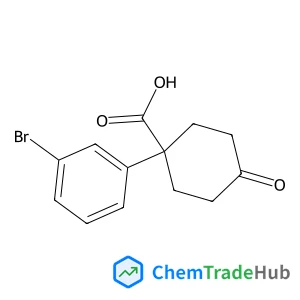
1-(3-Bromophenyl)-4-oxocyclohexanecarboxylic acid
CAS Number:
1385694-53-0
Molecular Formula:
C13H13BrO3
Recommended Suppliers





Disclaimer
This page provides academic journal information for reference and research purposes only. We are not affiliated with any journal publishers and do not handle publication submissions. For publication-related inquiries, please contact the respective journal publishers directly.
If you notice any inaccuracies in the information displayed, please contact us at support@chemtradehub.com. We will promptly review and address your concerns.