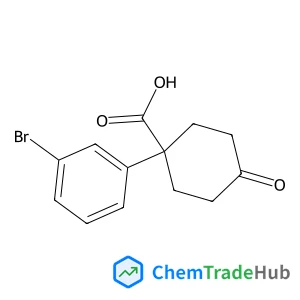
1-(3-Bromophenyl)-4-oxocyclohexanecarboxylic acid
CAS Number:
1385694-53-0
Molecular Formula:
C13H13BrO3
Wei-Feng Wang, Tao Liu, Yan-Liang Cheng, Qin-Hua Song
A method involving a metal-free visible-light-promoted synthesis was developed for the construction of difluoroalkylated oxindoles with N-phenylacrylamides and bromodifluoroacetamides as starting materials in the presence of N,N,N′,N′-tetramethylethylenediamine (TMEDA). Twenty-four examples of the photochemical reaction were successfully performed, with good yields (44–99%) and excellent substrate adaptability. Mechanistic studies showed that the visible-light-promoted reaction involved a radical addition to N-phenylacrylamide, intramolecular cyclization, dehydrogenation, and rearomatization. The difluoroacetamide radical was produced as a result of electron transfer to bromodifluoroacetamides from the electron donor TMEDA in their electron-donor–acceptor (EDA) complexes under visible light irradiation. This protocol is a promising photochemical method due to its advantages of mild conditions, simple operation, wide substrate scope and high yields. And the obtained products may have great potential in the field of medicine.
Ganesh Sunil More, Rajendra Srivastava
DOI: 10.1039/D0SE01912G
Maša Hren, Mojca Božič, Darinka Fakin
DOI: 10.1039/D0SE01373K
Linlin Qiu, Jiacheng Zou, Wei-Hsiang Chen, Lika Dong, Deqiang Mei, Jieqiong Wang, Pei-Cheng Jiang
DOI: 10.1039/D0SE01498B
Keshavananda Prabhu CP, Shambhulinga Aralekallu, Veeresh A. Sajjan, Manjunatha Palanna, Sharath Kumar, Lokesh Koodlur Sannegowda
DOI: 10.1039/D0SE01829E
Kalliopi Ladomenou, Georgios Landrou, Georgios Charalambidis, Emmanouil Nikoloudakis, Athanassios G. Coutsolelos
DOI: 10.1039/D0SE01630F
DOI: 10.1039/D0SE00814A
Elyas M. Moghaddam, Avishek Goel, Marcin Siedlecki, Karin Michalska, Onursal Yakaboylu, Wiebren de Jong
DOI: 10.1039/D0SE01635G
Guiyun Lin, Long Sun, Guocheng Huang, Qiaoshan Chen, Shengqiong Fang, Ling Wu
DOI: 10.1039/D0SE01504K
Ashish Gaur, Parrydeep K. Sachdeva, Rajinder Kumar, Takahiro Maruyama, Chandan Bera, Vivek Bagchi
DOI: 10.1039/D0SE01543A
Fengming Chu, Guozhen Xiao, Guoan Yang
DOI: 10.1039/D0SE01251C
4-Amino-3-bromophenol (CAS: 74440-80-5) falls under the classification of a haza...
(17beta)-3-Oxoestr-4-en-17-yl acetate should be stored in a cool, dry place away...
2-[(2,2-Diethoxyethyl)disulfanyl]-1,1-diethoxyethane (CAS: 76505-71-0) is a colo...
The market and research for 1-(β-D-ribofuranosyl)-1H-imidazo[4,5-c]pyridin-4-ami...
Waste containing Conjugated Estrogen (CAS: 12126-59-9) should be collected and d...
The market for Bis(2,2,2-trifluoroethyl) (methoxycarbonylmethyl)phosphonate (CAS...
There are several alternatives to 3,4'-Di-O-methylellagic acid (CAS: 57499-59-9)...
2-Chloro-N,N-dimethylpyridin-4-amine (CAS: 59047-70-0) is regulated under the Gl...
Cerium(3+);oxygen(2-);vanadium(5+) (CAS: 13597-19-8) is a complex inorganic comp...
7-Chloro-1-iodoisoquinoline (CAS: 1203579-27-4) is generally considered safe whe...

Organic & Biomolecular Chemistry (OBC) publishes original and high impact research and reviews in organic chemistry. We welcome research that shows new or significantly improved protocols or methodologies in total synthesis, synthetic methodology or physical and theoretical organic chemistry as well as research that shows a significant advance in the organic chemistry or molecular design aspects of chemical biology, catalysis, supramolecular and macromolecular chemistry, theoretical chemistry, mechanism-oriented physical organic chemistry, medicinal chemistry or natural products. Articles published in the journal should report new work which makes a highly-significant impact in the field. Routine and incremental work is generally not suitable for publication in the journal. More details about key areas of our scope are below. In all cases authors should include in their article clear rationale for why their research has been carried out.
![2-[1-(4-Chlorobenzyl)-1H-indol-3-yl]-2-oxo-N-(6-quinolinyl)acetamide structure](https://static.chemtradehub.com/structs/501/501921-61-5-756a.webp "2-[1-(4-Chlorobenzyl)-1H-indol-3-yl]-2-oxo-N-(6-quinolinyl)acetamide structure")