













The importance of phase in the radical-initiated oxidation of model organic aerosols: reactions of solid and liquid brassidic acid particles
Literature Information
Publication Date
2009-02-12
DOI
10.1039/B816799K
Impact Factor
3.676
Authors
Lindsay H. Renbaum, Geoffrey D. Smith
View Original
Abstract
Using a flow tube reactor coupled to a chemical ionization mass spectrometer, the Cl-initiated oxidation of solid and supercooled liquid brassidic acid (BA, trans-13-docosenoic acid) particles was investigated at 293 K. For the first time radical-initiated oxidation reactions of liquid and solid organic particles of identical chemical composition were performed making it possible to probe the effect of phase. Despite the fact that solubility and/or diffusion in the solid particles is expected to be reduced dramatically, it was observed that the BA in those particles still reacted at 70% of the rate in liquid droplets. The lack of significant slowing upon solidification suggests that the surface is continuously renewed, perhaps by evaporation of volatile products or mixing of underlying solid BA at a surface melt layer. The initial oxidation products were found to be the keto-acid and the alcohol-acid for both solid and liquid, and they account for as much as two thirds of the reacted BA. The distribution of other products, however, was found to be quite different in the two phases. For equivalent Cl concentrations and reaction times more multiply-oxidized species as well as low-molecular-weight species were created from the oxidation of solid particles. Furthermore, the mean mobility diameter of both liquid and solid particles, as determined from a scanning mobility particle sizer, decreased after reaction with larger decreases for the solid particles. These observations are consistent with a loss of mass through evaporation of small, volatile oxidation products. The findings from this study suggest that slower diffusion of the oxidation products in solid particles confines them to the surface where they continue to react with Cl radicals producing more-highly-functionalized products which may decompose more readily. Thus, the solid particles react nearly as efficiently as the liquid ones, but the manner in which they “age” chemically is substantially different. These experiments with this model system indicate that particle phase could be important in determining how organic aerosols evolve chemically through radical-initiated oxidation in the atmosphere, and future work will try to assess how general the effect of phase is.
Related Literature
Theoretical investigation of tautomerism of 2- and 4-pyridones: origin, substituent and solvent effects
Marija Baranac-Stojanović, Jovana Aleksić, Milovan Stojanović
2023-11-29
Paper
DOI: 10.1039/D3OB01588B
Polycyclic pyrroloindoline-containing natural products with a unique 3-heptyl-2a,4a-diazapentaleno[1,6-ab]indene core isolated from Alstonia scholaris
Guanqun Zhan, Fuxin Zhang, Kailing Yang, Tao Yang, Ruixi Zhou, Xueqing Ma, Nan Wang, Zengjun Guo
2023-11-28
Paper
DOI: 10.1039/D3OB01637D
TADDOL-based P,S-bidentate phosphoramidite ligands in palladium-catalyzed asymmetric allylic substitution
Konstantin N. Gavrilov, Ilya V. Chuchelkin, Ilya D. Firsin, Valeria M. Trunina, Vladislav K. Gavrilov, Sergey V. Zheglov, Denis A. Fedorov, Victor A. Tafeenko, Ilya A. Zamilatskov
2023-12-13
Paper
DOI: 10.1039/D3OB01891A
Selective S-arylation of thiols with o-OTf-substituted diaryliodonium salts toward diarylsulfides
Yuxuan Zhang, Yu Wang, Limin Wang, Jianwei Han
2023-12-13
Communication
DOI: 10.1039/D3OB01922E
Efficient amidation of weak amines: synthesis, chiral separation by SFC, and antimicrobial activity of N-(9,10-dioxo-9,10-dihydroanthracen-1-yl) carboxamide
A. Zahir Hussain, Andivelu Ilangovan
2023-12-06
Paper
DOI: 10.1039/D3OB01774E
Increasing the versatility of the biphenyl-fused-dioxacyclodecyne class of strained alkynes
Sam Forshaw, Jeremy S. Parker, Neelam Tiwari, Samson M. Oladeji, Andrew C. Stevens, Jami Reber, Guy J. Clarkson, Mohan K. Balasubramanian, Martin Wills
2023-12-13
Paper
DOI: 10.1039/D3OB01712E
Substituent-controlled regioselective arylation of carbazoles using dual catalysis
M. Shahid, Perumal Muthuraja, Purushothaman Gopinath
2023-12-20
Paper
DOI: 10.1039/D3OB01827J
Green imine synthesis from amines using transition metal and micellar catalysis
2023-11-24
Review Article
DOI: 10.1039/D3OB01730C
α-Alkylation of ketones with primary alcohols by an active non-noble metal Cu/CuOx catalyst
Hongli Wang, Chun-Ran Chang
2023-12-23
Paper
DOI: 10.1039/D3OB01836A
You might also like
Compound Q&A
What regulatory guidelines apply to 4-Amino-3-bromophenol (CAS: 74440-80-5)?
4-Amino-3-bromophenol (CAS: 74440-80-5) falls under the classification of a haza...
74440-80-54-Amino-3-bromopheno...
Compound Q&A
How should (17beta)-3-Oxoestr-4-en-17-yl acetate (CAS: 1425-10-1) be stored?
(17beta)-3-Oxoestr-4-en-17-yl acetate should be stored in a cool, dry place away...
1425-10-1(17beta)-3-Oxoestr-4...
Compound Q&A
What are the physical and chemical properties of 2-[(2,2-Diethoxyethyl)disulfanyl]-1,1-diethoxyethane (CAS: 76505-71-0)?
2-[(2,2-Diethoxyethyl)disulfanyl]-1,1-diethoxyethane (CAS: 76505-71-0) is a colo...
76505-71-02-[(2,2-Diethoxyethy...
Compound Q&A
What is the market or research trend for 1-(β-D-ribofuranosyl)-1H-imidazo[4,5-c]pyridin-4-amine?
The market and research for 1-(β-D-ribofuranosyl)-1H-imidazo[4,5-c]pyridin-4-ami...
6736-58-91-(beta-D-Ribofurano...
Compound Q&A
How should waste containing Conjugated Estrogen (CAS: 12126-59-9) be handled?
Waste containing Conjugated Estrogen (CAS: 12126-59-9) should be collected and d...
12126-59-9Conjugated Estrogen
Compound Q&A
What is the market or research trend for Bis(2,2,2-trifluoroethyl) (methoxycarbonylmethyl)phosphonate?
The market for Bis(2,2,2-trifluoroethyl) (methoxycarbonylmethyl)phosphonate (CAS...
88738-78-7Bis(2,2,2-trifluoroe...
Compound Q&A
Are there alternatives to 3,4'-Di-O-methylellagic acid (CAS: 57499-59-9) in synthesis?
There are several alternatives to 3,4'-Di-O-methylellagic acid (CAS: 57499-59-9)...
57499-59-93,4'-Di-O-methylella...
Compound Q&A
What regulatory guidelines apply to 2-Chloro-N,N-dimethylpyridin-4-amine (CAS: 59047-70-0)?
2-Chloro-N,N-dimethylpyridin-4-amine (CAS: 59047-70-0) is regulated under the Gl...
59047-70-02-Chloro-N,N-dimethy...
Compound Q&A
What is cerium(3+);oxygen(2-);vanadium(5+) (CAS: 13597-19-8)?
Cerium(3+);oxygen(2-);vanadium(5+) (CAS: 13597-19-8) is a complex inorganic comp...
13597-19-8cerium(3+);oxygen(2-...
Compound Q&A
Is 7-Chloro-1-iodoisoquinoline (CAS: 1203579-27-4) safe?
7-Chloro-1-iodoisoquinoline (CAS: 1203579-27-4) is generally considered safe whe...
1203579-27-47-Chloro-1-iodoisoqu...
Source Journal
Physical Chemistry Chemical Physics

CiteScore:
5.5
Self-citation Rate:
10.3%
Articles per Year:
3036
Physical Chemistry Chemical Physics (PCCP) is an international journal co-owned by 19 physical chemistry and physics societies from around the world. This journal publishes original, cutting-edge research in physical chemistry, chemical physics and biophysical chemistry. To be suitable for publication in PCCP, articles must include significant innovation and/or insight into physical chemistry; this is the most important criterion that reviewers and Editors will judge against when evaluating submissions. The journal has a broad scope and welcomes contributions spanning experiment, theory, computation and data science. Topical coverage includes spectroscopy, dynamics, kinetics, statistical mechanics, thermodynamics, electrochemistry, catalysis, surface science, quantum mechanics, quantum computing and machine learning. Interdisciplinary research areas such as polymers and soft matter, materials, nanoscience, energy, surfaces/interfaces, and biophysical chemistry are welcomed if they demonstrate significant innovation and/or insight into physical chemistry. Joined experimental/theoretical studies are particularly appreciated when complementary and based on up-to-date approaches.
Recommended Compounds
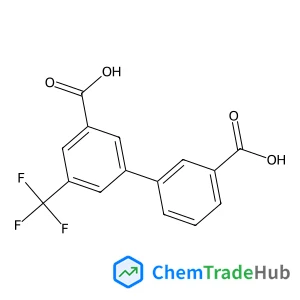
3-(3-Carboxyphenyl)-5-(trifluoromethyl)benzoic acid
CAS Number:
1261930-96-4
Molecular Formula:
C15H9F3O4
Recommended Suppliers







Disclaimer
This page provides academic journal information for reference and research purposes only. We are not affiliated with any journal publishers and do not handle publication submissions. For publication-related inquiries, please contact the respective journal publishers directly.
If you notice any inaccuracies in the information displayed, please contact us at support@chemtradehub.com. We will promptly review and address your concerns.