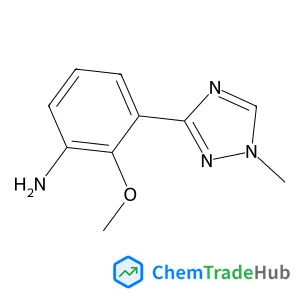
2-Methoxy-3-(1-methyl-1H-1,2,4-triazol-3-yl)aniline
CAS Number:
1609394-10-6
Molecular Formula:
C10H12N4O
Yoshio Nosaka, Masatsugu Nakamura, Tsutomu Hirakawa
A luminol chemiluminescence (CL) probe method was successfully applied to the investigation of the superoxide radical (O2−˙) formed on photoirradiated TiO2 powders. For several kinds of commercially available TiO2 photocatalysts and their calcined samples, the amount of O2−˙ produced at the steady state was measured and found to increase with the secondary particle size or the degree of aggregation. The decay of O2−˙ for the non-calcined samples was as long as several hundred seconds and obeyed second order kinetics, indicating that disproportionation is the main deactivation pathway. For some TiO2 photocatalysts, oxidative species such as OH˙ radicals are suggested to exist for 1 s after irradiation. On the other hand, reductive photoinduced electrons may remain for several seconds after irradiation since the decay of O2−˙ starts after a delay of more than 1 s. On calcination at temperatures up to 1173 K, O2−˙ decays by a mechanism other than disproportionation, suggesting the prolonged lifetime of an oxidative species that can react with O2−˙.

Nature Medicine

Russian Chemical Bulletin

Russian Journal of General Chemistry

Russian Journal of Organic Chemistry

Chemical Communications

Journal of Saudi Chemical Society

Crystallography Reports

Russian Journal of Applied Chemistry

Current Opinion in Solid State & Materials Science

Chemistry Education Research and Practice
Raju Jannapu Reddy, Md. Waheed, Gamidi Rama Krishna
DOI: 10.1039/D0OB00442A
Tamsyn Montagnon, Dimitris Kalaitzakis, Manolis Sofiadis, Georgios Vassilikogiannakis
DOI: 10.1039/C9OB02471A
Nicolo Tonali, Isabelle Correia, Jacopo Lesma, Guillaume Bernadat, Sandrine Ongeri, Olivier Lequin
DOI: 10.1039/C9OB02654A
Yi Ning, Xinwei He, Youpeng Zuo, Jian Wang, Qiang Tang, Mengqing Xie, Ruxue Li, Yongjia Shang
DOI: 10.1039/D0OB00382D
Harriet S. Chidwick, Martin A. Fascione
DOI: 10.1039/C9OB02433F
Juha H. Siitonen, Sherlin Lira, Muhammed Yousufuddin, László Kürti
DOI: 10.1039/D0OB00270D
Karlos Eduardo Pianoski, Julia Poletto, Michael Jackson Vieira da Silva, Jeniffer Nascimento Ascencio Camargo, Andrey Petita Jacomini, Davana Silva Gonçalves, Davi Fernando Back, Sidnei Moura, Fernanda Andreia Rosa
DOI: 10.1039/D0OB00319K
Amit Bhowmik, Mahesh Yadav, Rodney A. Fernandes
DOI: 10.1039/D0OB00244E
Mintao Chen, Wenqing Zang, Yin Wei, Min Shi
DOI: 10.1039/C9OB02520K
Yue Qi, Fang Zhang, Lin Wang, Aili Feng, Rongxiu Zhu, Shutao Sun, Wei Li, Lei Liu
DOI: 10.1039/D0OB00551G
6-Bromo-2-methylimidazo[1,2-a]pyrimidine (CAS: 1111638-05-1) falls under various...
While there are no direct alternatives, similar compounds like 1-Pyrrolidineetha...
4-Methyl-2,6-bis(2-methyl-2-propanyl)phenyl methylcarbamate (CAS: 1918-11-2) is ...
2-(3-Bromo-4-fluorophenyl)-1,3-dioxolane (CAS: 77771-04-1) should be stored in a...
4,5,6,7-Tetrahydro-1H-indazole hydrochloride is a white crystalline solid with a...
(2R)-1-Methoxy-3-phenyl-2-propanamine is a chiral organic compound with the CAS ...
Ethyl 1-(1-phenylethyl)-1H-imidazole-5-carboxylate is used in various industries...
4-[(1E,3S)-1-(4-Hydroxyphenyl)-1,4-pentadien-3-yl]phenol (CAS: 17676-24-3) falls...
(S)-3-Amino-5-phenylpentanoic acid hydrochloride is primarily used in the pharma...
7-Methoxy-1-benzothiophene-2-carboxylic acid is typically synthesized by reactin...

Physical Chemistry Chemical Physics (PCCP) is an international journal co-owned by 19 physical chemistry and physics societies from around the world. This journal publishes original, cutting-edge research in physical chemistry, chemical physics and biophysical chemistry. To be suitable for publication in PCCP, articles must include significant innovation and/or insight into physical chemistry; this is the most important criterion that reviewers and Editors will judge against when evaluating submissions. The journal has a broad scope and welcomes contributions spanning experiment, theory, computation and data science. Topical coverage includes spectroscopy, dynamics, kinetics, statistical mechanics, thermodynamics, electrochemistry, catalysis, surface science, quantum mechanics, quantum computing and machine learning. Interdisciplinary research areas such as polymers and soft matter, materials, nanoscience, energy, surfaces/interfaces, and biophysical chemistry are welcomed if they demonstrate significant innovation and/or insight into physical chemistry. Joined experimental/theoretical studies are particularly appreciated when complementary and based on up-to-date approaches.
![(3aS,6aS)-1-Methyloctahydropyrrolo[3,4-b]pyrrole structure](https://static.chemtradehub.com/structs/877/877212-98-1-9157.webp "(3aS,6aS)-1-Methyloctahydropyrrolo[3,4-b]pyrrole structure")