












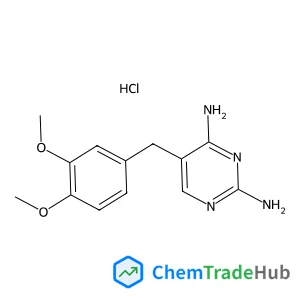
5-(3,4-Dimethoxybenzyl)-2,4-pyrimidinediamine hydrochloride (1:1)
CAS Number:
2507-23-5
Molecular Formula:
C13H17ClN4O2
Dmitry Shcherbin, Andreas J. Thorvaldsen, Kenneth Ruud, Sonia Coriani, Antonio Rizzo
We present the results of the first gauge-origin independent calculations, carried out at Hartree–Fock level, of the molecular parameters that describe the electric-field-induced linear birefringence, also known as Buckingham birefringence. Focus is in particular on the temperature-independent contribution to the observable. We employ a recently developed analytical scheme for calculating frequency-dependent molecular properties of arbitrary order for self-consistent field methods using basis sets that depend explicitly on the frequency and on the external perturbations. The method is applied to naphthalene, fluorobenzene and furan, three systems for which the Buckingham birefringence has been studied experimentally. It is demonstrated that LAOs lead to significant improvements in the basis set convergence of the temperature-independent contribution to the Buckingham birefringence, and that the results obtained on the basis of aug-cc-pVDZ quality London atomic orbital calculations are closer to the basis set limit than the results obtained on the basis of conventional aug-cc-pVQZ quality calculations. The computed values can be used to correct for the neglect of the temperature-independent higher-order contribution often implied in the derivation of the effective quadrupole moments from experimental measurements of the induced birefringence at a single temperature.
Pucheng Wang, Jingwen Dai, Lei Liu, Qibao Dong, Hu Wang, Ruke Bai
DOI: 10.1039/C4PY00902A
X. Zhang, T. Higashihara, M. Ueda, L. Wang
DOI: 10.1039/C4PY00898G
L. Magerusan, R. Turcu
DOI: 10.1039/C4PY00670D
Zhijun Ruan, Wenhui Rong, Xuejun Zhan, Qianqian Li, Zhen Li
DOI: 10.1039/C4PY00555D
Yun Yu, Jiong Zou, Chong Cheng
DOI: 10.1039/C4PY00667D
Linlin Liu, Hongcheng Gao, Yupeng Li, Muddasir Hanif, Chuan Li, Yu Gao, Bing Yang, Zengqi Xie, Yuguang Ma
DOI: 10.1039/C6PY00180G
When considering alternatives to 1-(4-Chlorophenyl)-N-hydroxymethanimine (CAS: 3...
This compound should be stored in a cool, dry place away from direct sunlight. I...
3-(4-Bromophenyl)-5-(2-fluorophenyl)-1,2,4-oxadiazole is synthesized through a m...
5-Chloro-2-(4-chlorophenyl)-4-methyl-6-[3-(1-piperidinyl)propoxy]pyrimidine (CAS...
2-Chloro-4-(difluoromethoxy)pyridine is used in the pharmaceutical industry for ...
3-Chloro-6-methylpyridazine (CAS: 1121-79-5) is classified under the Globally Ha...
Several alternatives can be used in the synthesis of Methyl 4,5-dimethyl-2-nitro...
Alternatives to (2E,2'E)-3,3'-(1,4-Phenylene)bisacrylaldehyde include other acry...
3-Amino-5-chloropyridin-2-ol hydrochloride is an organic compound with the CAS n...
When handling 6,7-Difluoro-2,3-dihydro-4H-chromen-4-one, it is essential to wear...

Physical Chemistry Chemical Physics (PCCP) is an international journal co-owned by 19 physical chemistry and physics societies from around the world. This journal publishes original, cutting-edge research in physical chemistry, chemical physics and biophysical chemistry. To be suitable for publication in PCCP, articles must include significant innovation and/or insight into physical chemistry; this is the most important criterion that reviewers and Editors will judge against when evaluating submissions. The journal has a broad scope and welcomes contributions spanning experiment, theory, computation and data science. Topical coverage includes spectroscopy, dynamics, kinetics, statistical mechanics, thermodynamics, electrochemistry, catalysis, surface science, quantum mechanics, quantum computing and machine learning. Interdisciplinary research areas such as polymers and soft matter, materials, nanoscience, energy, surfaces/interfaces, and biophysical chemistry are welcomed if they demonstrate significant innovation and/or insight into physical chemistry. Joined experimental/theoretical studies are particularly appreciated when complementary and based on up-to-date approaches.
![(2S)-2-{[(9H-Fluoren-9-ylmethoxy)carbonyl]amino}-4-(methylselanyl)butanoic acid structure](https://static.chemtradehub.com/structs/121/1217852-49-7-f252.webp "(2S)-2-{[(9H-Fluoren-9-ylmethoxy)carbonyl]amino}-4-(methylselanyl)butanoic acid structure")




