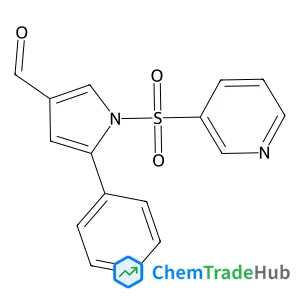
5-Phenyl-1-(pyridin-3-ylsulfonyl)-1H-pyrrole-3-carbaldehyde
CAS Number:
881676-90-0
Molecular Formula:
C16H12N2O3S
Sune D. Ebbesen, Barbara L. Mojet, Leon Lefferts
Adsorption and oxidation of carbon monoxide over a Pd/Al2O3catalyst layer was investigated both in gas phase and water. Both adsorption and oxidation of CO are significantly affected by the presence of liquid water. Water influences the potential of the metal particles as well as the dipole moment of the adsorbed CO molecule directly, which is reflected both in large red shifts and a higher infrared intensity when experiments are carried out in water. Furthermore, the rate of CO oxidation increases significantly by both the presence of water and by increasing the pH. Enhancement of the oxidation rate is attributed to a weakening of the CO bond by increasing potential of the metal particle, similar to CO oxidation over Pt/Al2O3 as recently published [S. D. Ebbesen et al., J. Catal., 2007, 246, 66]. However, on Pd/Al2O3 the oxidation of palladium is clearly promoted at increasing pH, further enhancing the oxidation of CO over Pd/Al2O3.

Israel Journal of Chemistry

Molecular Pharmacology

Planta Medica

Journal of Medicinal Chemistry

Journal of Organometallic Chemistry

Journal of Heterocyclic Chemistry

Helvetica Chimica Acta

Proceedings of the National Academy of Sciences of the United States of America

Journal of Physics and Chemistry of Solids

Kinetics and Catalysis
Laura Zepeda-Velazquez, Benjamin Macphail, Michael A. Brook
DOI: 10.1039/C6PY00492J
Saswati Ghosh Roy, Priyadarsi De
DOI: 10.1039/C4PY00766B
Arumugam Balasubramanian, Ting-Chia Ku, Hong-Pin Shih, Alishetty Suman, Huang-Jyun Lin, Ting-Wen Shih, Chien-Chung Han
DOI: 10.1039/C4PY00521J
Lichao Sun, Jinchuan Liu, Hanying Zhao
DOI: 10.1039/C4PY00938J
H. Salmi, X. Allonas, C. Ley, A. Defoin, A. Ak
DOI: 10.1039/C4PY00927D
Shotaro Ito, Raita Goseki, Takashi Ishizone
DOI: 10.1039/C4PY00584H
When considering alternatives to 1-(4-Chlorophenyl)-N-hydroxymethanimine (CAS: 3...
This compound should be stored in a cool, dry place away from direct sunlight. I...
3-(4-Bromophenyl)-5-(2-fluorophenyl)-1,2,4-oxadiazole is synthesized through a m...
5-Chloro-2-(4-chlorophenyl)-4-methyl-6-[3-(1-piperidinyl)propoxy]pyrimidine (CAS...
2-Chloro-4-(difluoromethoxy)pyridine is used in the pharmaceutical industry for ...
3-Chloro-6-methylpyridazine (CAS: 1121-79-5) is classified under the Globally Ha...
Several alternatives can be used in the synthesis of Methyl 4,5-dimethyl-2-nitro...
Alternatives to (2E,2'E)-3,3'-(1,4-Phenylene)bisacrylaldehyde include other acry...
3-Amino-5-chloropyridin-2-ol hydrochloride is an organic compound with the CAS n...
When handling 6,7-Difluoro-2,3-dihydro-4H-chromen-4-one, it is essential to wear...

Physical Chemistry Chemical Physics (PCCP) is an international journal co-owned by 19 physical chemistry and physics societies from around the world. This journal publishes original, cutting-edge research in physical chemistry, chemical physics and biophysical chemistry. To be suitable for publication in PCCP, articles must include significant innovation and/or insight into physical chemistry; this is the most important criterion that reviewers and Editors will judge against when evaluating submissions. The journal has a broad scope and welcomes contributions spanning experiment, theory, computation and data science. Topical coverage includes spectroscopy, dynamics, kinetics, statistical mechanics, thermodynamics, electrochemistry, catalysis, surface science, quantum mechanics, quantum computing and machine learning. Interdisciplinary research areas such as polymers and soft matter, materials, nanoscience, energy, surfaces/interfaces, and biophysical chemistry are welcomed if they demonstrate significant innovation and/or insight into physical chemistry. Joined experimental/theoretical studies are particularly appreciated when complementary and based on up-to-date approaches.