


Optimization and evaluation of networked single-wall carbon nanotubes as a NO2 gas sensing material
Literature Information
Publication Date
2008-11-03
DOI
10.1039/B813073F
Impact Factor
4.616
Authors
Isao Sasaki, Nobutsugu Minami, Annamalai Karthigeyan, Konstantin Iakoubovskii
View Original
Abstract
We have prepared conductometric NO2 gas sensors based on single-wall carbon nanotube (SWNT) networks. The SWNT properties are modified systematically by varying the annealing temperature between 350 to 550 °C under vacuum. Thermal annealing is not only necessary to remove dispersant used for nanotube dispersion but also plays an important role in optimizing the gas sensing abilities. In this paper, the sensing performance is evaluated through three crucial sensing characteristics: sensitivity to NO2, humidity interfering effect, and sensor stability over repeated use, all examined at room temperature. The sensor annealed at 400 °C shows the highest NO2 sensitivity because of the structural properties, i.e., high specific surface area and the molecular geometry of having all carbon atoms at the tube-surface. The sensor also shows negligible humidity interfering effect and high sensor stability, originating from the hydrophobicity and chemical stability of the material, respectively. In contrast, annealing temperatures higher than 400 °C lead to structural defects in SWNTs and thus lower the sensing performance. We experimentally confirm that these SWNT characteristics make SWNTs a suitable gas sensing material from a practical perspective.
Recommended Journals

Physical Chemistry Chemical Physics

Molecules

Current Pharmaceutical Biotechnology

Journal of Enzyme inhibition and Medicinal Chemistry

Angewandte Chemie International Edition

Journal of Medical Biochemistry

Mini-Reviews in Medicinal Chemistry

Nature Reviews Drug Discovery

European Journal of Organic Chemistry

Environmental Toxicology and Pharmacology
Related Literature
A molecular level study of complex formation between putidaredoxin and cytochrome P450 by scanning tunnelling microscopy
R. Mukhopadhyay, L. L. Wong, K. K. Lo, T. Pochapsky, H. A. O. Hill
2002-01-17
Paper
DOI: 10.1039/B108107A
Characteristic cyclic voltammograms of alkyl viologens at single crystal gold electrodes
Kazuki Arihara, Takeo Ohsaka, Fusao Kitamura
2002-02-13
Communication
DOI: 10.1039/B109879A
Infrared and Raman spectra, conformational stability, vibrational assignment, ab initio calculations and r0 structural parameters for N-methylpropargyl amine
Gamil A. Guirgis, Stephen Bell, Chao Zheng, James R. Durig
2002-03-19
Paper
DOI: 10.1039/B109222G
A generalized “reaction–diffusion” model to describe spatio-temporal patterns in the catalytic CO oxidation on Pt(110)
Pierre Borckmans, Guy Dewel
2002-03-19
Paper
DOI: 10.1039/B109389B
Aqueous solutions at pressures up to 2 GPa: gas–gas equilibria, closed loops, high-pressure immiscibility, salt effects and related phenomena
2002-02-12
Paper
DOI: 10.1039/B109277B
New phase phenomena in ternary systems at high pressures – Cosolvency and miscibility windows up to 100 MPa
Arndt L. Scheidgen, Gerhard M. Schneider
2002-02-12
Paper
DOI: 10.1039/B109224N
Predissociation dynamics in the A 3Π state of PH: An experimental and ab initio investigation
James A. J. Fitzpatrick, Oleg V. Chekhlov, David R. Morgan, Robert W. Burrows, Colin M. Western
2002-02-27
Paper
DOI: 10.1039/B111198C
The influence of concentration-dependent diffusivities on wave stability
Marc R. Roussel, Jichang Wang
2002-03-14
Paper
DOI: 10.1039/B109310J
Analysis of the effect of changing the a0 parameter of the Becke3-LYP hybrid functional on the transition state geometries and energy barriers in a series of prototypical reactions
Jordi Poater, Miquel Solà, Miquel Duran, Juvencio Robles
2002-01-31
Paper
DOI: 10.1039/B108910M
Surface freezing in liquid Ga–Bi alloys: optical second harmonic and plasma generation study
2002-01-18
Paper
DOI: 10.1039/B107478B
You might also like
Compound Q&A
What regulatory guidelines apply to 6-Bromo-2-methylimidazo[1,2-a]pyrimidine (CAS: 1111638-05-1)?
6-Bromo-2-methylimidazo[1,2-a]pyrimidine (CAS: 1111638-05-1) falls under various...
1111638-05-16-Bromo-2-methylimid...
Compound Q&A
Are there alternatives to 1-Pyrrolidineethanol, β-methyl-α-phenyl-, (αS,βR) (CAS: 123620-80-4) in synthesis?
While there are no direct alternatives, similar compounds like 1-Pyrrolidineetha...
123620-80-41-Pyrrolidineethanol...
Compound Q&A
Is 4-Methyl-2,6-bis(2-methyl-2-propanyl)phenyl methylcarbamate (CAS: 1918-11-2) safe?
4-Methyl-2,6-bis(2-methyl-2-propanyl)phenyl methylcarbamate (CAS: 1918-11-2) is ...
1918-11-24-Methyl-2,6-bis(2-m...
Compound Q&A
How should 2-(3-Bromo-4-fluorophenyl)-1,3-dioxolane (CAS: 77771-04-1) be stored?
2-(3-Bromo-4-fluorophenyl)-1,3-dioxolane (CAS: 77771-04-1) should be stored in a...
77771-04-12-(3-Bromo-4-fluorop...
Compound Q&A
What are the physical and chemical properties of 4,5,6,7-Tetrahydro-1H-indazole hydrochloride (CAS: 18161-11-0)?
4,5,6,7-Tetrahydro-1H-indazole hydrochloride is a white crystalline solid with a...
18161-11-04,5,6,7-Tetrahydro-1...
Compound Q&A
What is (2R)-1-Methoxy-3-phenyl-2-propanamine (CAS: 59919-07-2)?
(2R)-1-Methoxy-3-phenyl-2-propanamine is a chiral organic compound with the CAS ...
59919-07-2(2R)-1-Methoxy-3-phe...
Compound Q&A
What industries use Ethyl 1-(1-phenylethyl)-1H-imidazole-5-carboxylate (CAS: 56649-47-9)?
Ethyl 1-(1-phenylethyl)-1H-imidazole-5-carboxylate is used in various industries...
56649-47-9Ethyl 1-(1-phenyleth...
Compound Q&A
What regulatory guidelines apply to 4-[(1E,3S)-1-(4-Hydroxyphenyl)-1,4-pentadien-3-yl]phenol (CAS: 17676-24-3)?
4-[(1E,3S)-1-(4-Hydroxyphenyl)-1,4-pentadien-3-yl]phenol (CAS: 17676-24-3) falls...
17676-24-34-[(1E,3S)-1-(4-Hydr...
Compound Q&A
What industries use (S)-3-Amino-5-phenylpentanoic acid hydrochloride (CAS: 331846-97-0)?
(S)-3-Amino-5-phenylpentanoic acid hydrochloride is primarily used in the pharma...
331846-97-0(S)-3-Amino-5-phenyl...
Compound Q&A
How is 7-methoxy-1-benzothiophene-2-carboxylic acid (CAS: 88791-07-5) typically synthesized?
7-Methoxy-1-benzothiophene-2-carboxylic acid is typically synthesized by reactin...
88791-07-57-methoxy-1-benzothi...
Source Journal
Analyst

CiteScore:
7.8
Self-citation Rate:
5.6%
Articles per Year:
653
Analyst publishes analytical and bioanalytical research that reports premier fundamental discoveries and inventions, and the applications of those discoveries, unconfined by traditional discipline barriers.
Recommended Compounds
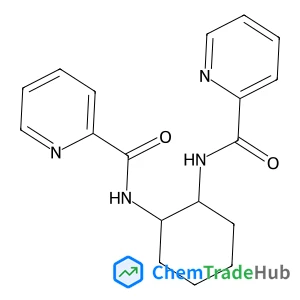
N,N'-(1R,2R)-1,2-Cyclohexanediyldi(2-pyridinecarboxamide)
CAS Number:
218290-24-5
Molecular Formula:
C18H20N4O2
Recommended Suppliers






Disclaimer
This page provides academic journal information for reference and research purposes only. We are not affiliated with any journal publishers and do not handle publication submissions. For publication-related inquiries, please contact the respective journal publishers directly.
If you notice any inaccuracies in the information displayed, please contact us at support@chemtradehub.com. We will promptly review and address your concerns.