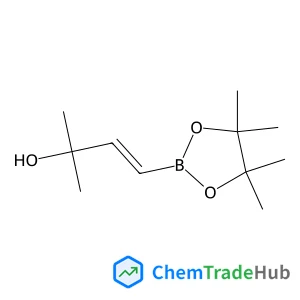
(E)-2-methyl-4-(4,4,5,5-tetramethyl-1,3,2-dioxaborolan-2-yl)but-3-en-2-ol
CAS Number:
581802-26-8
Molecular Formula:
C11H21BO3
James Highfield, Tao Liu, Yook Si Loo, Benjamin Grushko, Armando Borgna
The Ru/Cu system is of historical significance in catalysis. The early development and application of X-ray absorption spectroscopy (XAS) led to the original ‘bimetallic cluster” concept for highly-immiscible systems. This work explores alkali leaching of Al-based ternary crystalline and quasicrystalline precursors as a potential route to bulk Ru/Cu alloys. Single-phase ternary alloys at 3 trial compositions; Al71Ru22Cu7, Al70.5Ru17Cu12.5, and Al70Ru10Cu20, were prepared by arc melting of the pure metal components. After leaching, the bimetallic residues were characterized principally by transmission XAS, “as-leached” and after annealing in H2 (and passivation) in a thermobalance. XRD and BET revealed a nanocrystalline product with a native structure of hexagonal Ru. XPS surface analysis of Ru22Cu7 and Ru17Cu12.5 found only slight enrichment by Cu in the as-leached forms, with little change upon annealing. Ru10Cu20 was highly segregated as-leached. XANES data showed preferential oxidation of Cu in Ru22Cu7, implying that it exists as an encapsulating layer. TG data supports this view since it does not show the distinct two-stage O2 uptake characteristic of skeletal Ru. Cu K-edge EXAFS data for Ru22Cu7 were unique in showing a high proportion of Ru neighbours. The spacing, dCuRu = 2.65 Å, was that expected from a hypothetical (ideal) solid solution at this composition, but this is unlikely in such a bulk-immiscible system and Ru K-edge EXAFS failed to confirm bulk alloying. Furthermore its invariance under annealing was more indicative of an interfacial bond between bulk components, although partial alloying with retention of local order cannot entirely be ruled out. The XAS and XPS data were reconciled in a model involving surface and bulk segregation, Cu being present at both the grain exterior and in ultra-fine internal pores. This structure can be considered as the 3-dimensional analogue of the classical type. Preliminary studies in CO and H2 oxidation were made in a DRIFTS flow reactor with on-line MS, and their activities and selectivities were compared against skeletal Ru and Cu controls, Ru/Al2O3, and Au/Fe2O3. All samples were active in CO oxidation above ∼50 °C, showing light-off temperatures in the range 60–70 °C. Ru22Cu7 and Ru17Cu12.5 also showed good selectivities (vs. H2 oxidation), attributed tentatively to Ru-modified Cu surfaces of varying thickness. These compositions are promising candidates to test in a (PROX) fuel processor to supply purified (CO-free) H2 to a PEM fuel cell.
Hui-Hsuan Hsieh, You-Cheng Hseu, Ko-Shao Chen, Gou-Jen Wang, Yi-Syuan Wei, Ko Hsin Chang, Yeu-Wei Harn
DOI: 10.1039/C3CP50956G
Anita Gollmer, Johannes Regensburger, Tim Maisch, Wolfgang Bäumler
DOI: 10.1039/C3CP50841B
Mengjiao Cheng, Chao Jiang, Zhiyi Ding, Yajun Zhang, Yu Fu, Feng Shi
DOI: 10.1039/C3CP52217B
Daniel R. Albert, H. Floyd Davis
DOI: 10.1039/C3CP51930A
Je Hyun Bae, Yang-Rae Kim, R. Soyoung Kim, Taek Dong Chung
DOI: 10.1039/C3CP50175B
Imre Bakó, Ákos Bencsura, Kersti Hermannson, Szabolcs Bálint, Tamás Grósz, Julianna Oláh
DOI: 10.1039/C3CP52271G
DOI: 10.1039/C3CP50907A
Muruganathan Ramanathan, Lok Kumar Shrestha, Qingmin Ji
DOI: 10.1039/C3CP50620G
George Y. Margulis, Bogyu Lim, Brian E. Hardin, Eva L. Unger, Jun-Ho Yum, Johann M. Feckl, Dina Fattakhova-Rohlfing, Thomas Bein, Michael Grätzel, Alan Sellinger, Michael D. McGehee
DOI: 10.1039/C3CP51018B
Chuanlang Zhan, Xunlei Ding, Shanlin Zhang, Xin Zhang, Huiying Liu, Lili Chen, Yishi Wu, Hongbing Fu, Shenggui He, Yan Huang, Jiannian Yao
DOI: 10.1039/C3CP51268A
When considering alternatives to 1-(4-Chlorophenyl)-N-hydroxymethanimine (CAS: 3...
This compound should be stored in a cool, dry place away from direct sunlight. I...
3-(4-Bromophenyl)-5-(2-fluorophenyl)-1,2,4-oxadiazole is synthesized through a m...
5-Chloro-2-(4-chlorophenyl)-4-methyl-6-[3-(1-piperidinyl)propoxy]pyrimidine (CAS...
2-Chloro-4-(difluoromethoxy)pyridine is used in the pharmaceutical industry for ...
3-Chloro-6-methylpyridazine (CAS: 1121-79-5) is classified under the Globally Ha...
Several alternatives can be used in the synthesis of Methyl 4,5-dimethyl-2-nitro...
Alternatives to (2E,2'E)-3,3'-(1,4-Phenylene)bisacrylaldehyde include other acry...
3-Amino-5-chloropyridin-2-ol hydrochloride is an organic compound with the CAS n...
When handling 6,7-Difluoro-2,3-dihydro-4H-chromen-4-one, it is essential to wear...

Physical Chemistry Chemical Physics (PCCP) is an international journal co-owned by 19 physical chemistry and physics societies from around the world. This journal publishes original, cutting-edge research in physical chemistry, chemical physics and biophysical chemistry. To be suitable for publication in PCCP, articles must include significant innovation and/or insight into physical chemistry; this is the most important criterion that reviewers and Editors will judge against when evaluating submissions. The journal has a broad scope and welcomes contributions spanning experiment, theory, computation and data science. Topical coverage includes spectroscopy, dynamics, kinetics, statistical mechanics, thermodynamics, electrochemistry, catalysis, surface science, quantum mechanics, quantum computing and machine learning. Interdisciplinary research areas such as polymers and soft matter, materials, nanoscience, energy, surfaces/interfaces, and biophysical chemistry are welcomed if they demonstrate significant innovation and/or insight into physical chemistry. Joined experimental/theoretical studies are particularly appreciated when complementary and based on up-to-date approaches.