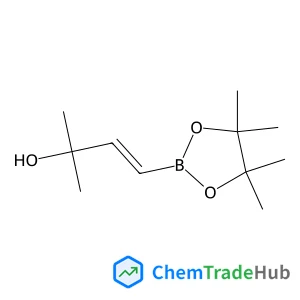
(E)-2-methyl-4-(4,4,5,5-tetramethyl-1,3,2-dioxaborolan-2-yl)but-3-en-2-ol
CAS Number:
581802-26-8
Molecular Formula:
C11H21BO3
We have performed relativistic effective core potential calculations with and without spin–orbit coupling term in the framework of the density functional theory and investigated the geometry and binding energy of different isomers of free platinum clusters Ptn (n = 4–6) for the spin multiplicities from singlet to nonet. The spin–orbit coupling effect has been discussed for the minimum-energy structures, relative stabilities, vibrational frequencies, magnetic moments, and the highest occupied and lowest unoccupied molecular-orbital gaps. It is found in contrast to some of the previous calculations that 3-D configurations are still lowest energy structures of these clusters, although spin–orbit effect makes some planar or quasi-planar geometries more stable than some other 3-D isomers. Spin–orbit coupling effects change the relative stability of various isomers.
João Pina, J. Seixas de Melo, D. Breusov, Ullrich Scherf
DOI: 10.1039/C3CP52056K
Chunlei Wang, Fanning Meng, Mingxing Wu, Xiao Lin, Tonghua Wang, Jieshan Qiu, Tingli Ma
DOI: 10.1039/C3CP52525B
Dae Sung Chung, Il Kang, Yun-Hi Kim, Soon-Ki Kwon
DOI: 10.1039/C3CP52422A
Makoto Uchida, Young-Chul Park, Katsuyoshi Kakinuma, Hiroshi Yano, Donald A. Tryk, Takeo Kamino, Hiroyuki Uchida, Masahiro Watanabe
DOI: 10.1039/C3CP51801A
Muruganathan Ramanathan, Lok Kumar Shrestha, Qingmin Ji
DOI: 10.1039/C3CP50620G
Joshua J. Melko, Shaun G. Ard, Joseph A. Fournier, Jun Li, Nicholas S. Shuman, Hua Guo, Albert A. Viggiano
DOI: 10.1039/C3CP50335F
S. Ramakumar, L. Satyanarayana, Sunkara V. Manorama, Ramaswamy Murugan
DOI: 10.1039/C3CP50991E
Z. Liu, M. S. Ghazvini, F. Endres
DOI: 10.1039/C3CP51325D
When considering alternatives to 1-(4-Chlorophenyl)-N-hydroxymethanimine (CAS: 3...
This compound should be stored in a cool, dry place away from direct sunlight. I...
3-(4-Bromophenyl)-5-(2-fluorophenyl)-1,2,4-oxadiazole is synthesized through a m...
5-Chloro-2-(4-chlorophenyl)-4-methyl-6-[3-(1-piperidinyl)propoxy]pyrimidine (CAS...
2-Chloro-4-(difluoromethoxy)pyridine is used in the pharmaceutical industry for ...
3-Chloro-6-methylpyridazine (CAS: 1121-79-5) is classified under the Globally Ha...
Several alternatives can be used in the synthesis of Methyl 4,5-dimethyl-2-nitro...
Alternatives to (2E,2'E)-3,3'-(1,4-Phenylene)bisacrylaldehyde include other acry...
3-Amino-5-chloropyridin-2-ol hydrochloride is an organic compound with the CAS n...
When handling 6,7-Difluoro-2,3-dihydro-4H-chromen-4-one, it is essential to wear...

Physical Chemistry Chemical Physics (PCCP) is an international journal co-owned by 19 physical chemistry and physics societies from around the world. This journal publishes original, cutting-edge research in physical chemistry, chemical physics and biophysical chemistry. To be suitable for publication in PCCP, articles must include significant innovation and/or insight into physical chemistry; this is the most important criterion that reviewers and Editors will judge against when evaluating submissions. The journal has a broad scope and welcomes contributions spanning experiment, theory, computation and data science. Topical coverage includes spectroscopy, dynamics, kinetics, statistical mechanics, thermodynamics, electrochemistry, catalysis, surface science, quantum mechanics, quantum computing and machine learning. Interdisciplinary research areas such as polymers and soft matter, materials, nanoscience, energy, surfaces/interfaces, and biophysical chemistry are welcomed if they demonstrate significant innovation and/or insight into physical chemistry. Joined experimental/theoretical studies are particularly appreciated when complementary and based on up-to-date approaches.