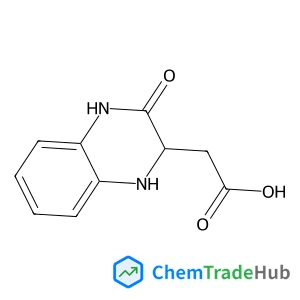
(3-Oxo-1,2,3,4-tetrahydro-2-quinoxalinyl)acetic acid
CAS Number:
136584-14-0
Molecular Formula:
C10H10N2O3
Barry R. Silver, Patrick R. Unwin
Enhanced and rapid growth of lysozyme crystals at the surface of a platinum electrode, using an applied current and a simplified crystallizing solution, is demonstrated.
Dan Shen, Peifeng Su, Wei Wu
DOI: 10.1039/C8CP05358H
Igor Marques, Pedro M. R. Costa, Margarida Q. Miranda, Nathalie Busschaert, Harriet J. Clarke, Cally J. E. Haynes, Isabelle L. Kirby, Ananda M. Rodilla, Ricardo Pérez-Tomás, Vítor Félix
DOI: 10.1039/C8CP02576B
Jian Wang
DOI: 10.1039/C8CP05046E
Cloé Azarias, Simon Pascal, Olivier Siri, Denis Jacquemin
DOI: 10.1039/C8CP03789B
Alberto Gutiérrez, Santiago Aparicio
DOI: 10.1039/C8CP05641B
Komsilp Kotmool, Suttichai Assabumrungrat
DOI: 10.1039/C7CP07293G
Shuanglong Chen, Zhen Yao, Hang Lv, Enlai Dong, Xibao Yang, Ran Liu, Bingbing Liu
DOI: 10.1039/C8CP04415E
Hui-Min Mu, Jin-Peng Li, Xiao-Chun Wang
DOI: 10.1039/C8CP04010A
Anaïs R. F. Hoffmann, Lucie Caillon, Lilian Shadai Salazar Vazquez, Pierre-Alexandre Spath, Ludovic Carlier, Lucie Khemtémourian, Olivier Lequin
DOI: 10.1039/C7CP07516B
Tian Cao, Rui You, Xuanyu Zhang, Shilong Chen, Dan Li, Zhenhua Zhang, Weixin Huang
DOI: 10.1039/C8CP00668G
This compound is mainly used as an intermediate in the synthesis of antipsychoti...
Waste containing 1-(D-Ribofuranosyl)-1,4-dihydro-3-pyridinecarboxamide (CAS: 191...
2-Methyl-2-propanyl 3-bromo-3-(hydroxymethyl)-1-azetidinecarboxylate (CAS: 20079...
N-(4-Chloro-2-pyridinyl)acetamide (CAS: 245056-66-0) is a chemical compound with...
5-Chloro-2-hydroxybenzoic acid, also known as 5-chlorosalicylic acid, is an arom...
When handling 1,1-Dichloro-1-fluoroethane (CAS: 1717-00-6), it is important to u...
Fmoc-(2S,3R)-3-phenylpyrrolidine-2-carboxylic acid is a white crystalline solid ...
4-Amino-5-bromo-2-pyridinecarboxylic acid is primarily used as a precursor in th...
Handling this compound should be done with personal protective equipment (PPE) i...
When handling 8-bromo-2,2-dimethyl-3,4-dihydro-2H-1,4-benzoxazin-3-one, use prop...

ChemComm publishes urgent research which is of outstanding significance and interest to experts in the field, while also appealing to the journal’s broad chemistry readership. Our communication format is ideally suited to short, urgent studies that are of such importance that they require accelerated publication. Our scope covers all topics in chemistry, and research at the interface of chemistry and other disciplines (such as materials science, nanoscience, physics, engineering and biology) where there is a significant novelty in the chemistry aspects. Major topic areas covered include: Analytical Chemistry Catalysis Chemical Biology and medicinal chemistry Computational Chemistry and Machine Learning Energy and sustainable chemistry Environmental Chemistry Green Chemistry Inorganic Chemistry Materials Chemistry Nanoscience Organic Chemistry Physical Chemistry Polymer Chemistry Supramolecular Chemistry
![6-Benzyl-4,5,6,7-tetrahydro-1H-pyrazolo[3,4-c]pyridin-3(2H)-one structure](https://static.chemtradehub.com/structs/909/909187-64-0-f54f.webp "6-Benzyl-4,5,6,7-tetrahydro-1H-pyrazolo[3,4-c]pyridin-3(2H)-one structure")