












Spectral relative standard deviation: a practical benchmark in metabolomics
Literature Information
Publication Date
2008-12-02
DOI
10.1039/B808986H
Impact Factor
4.616
Authors
Helen M. Parsons, Drew R. Ekman, Timothy W. Collette
View Original
Abstract
Metabolomics datasets, by definition, comprise of measurements of large numbers of metabolites. Both technical (analytical) and biological factors will induce variation within these measurements that is not consistent across all metabolites. Consequently, criteria are required to assess the reproducibility of metabolomics datasets that are derived from all the detected metabolites. Here we calculate spectrum-wide relative standard deviations (RSDs; also termed coefficient of variation, CV) for ten metabolomics datasets, spanning a variety of sample types from mammals, fish, invertebrates and a cell line, and display them succinctly as boxplots. We demonstrate multiple applications of spectral RSDs for characterising technical as well as inter-individual biological variation: for optimising metabolite extractions, comparing analytical techniques, investigating matrix effects, and comparing biofluids and tissue extracts from single and multiple species for optimising experimental design. Technical variation within metabolomics datasets, recorded using one- and two-dimensional NMR and mass spectrometry, ranges from 1.6 to 20.6% (reported as the median spectral RSD). Inter-individual biological variation is typically larger, ranging from as low as 7.2% for tissue extracts from laboratory-housed rats to 58.4% for fish plasma. In addition, for some of the datasets we confirm that the spectral RSD values are largely invariant across different spectral processing methods, such as baseline correction, normalisation and binning resolution. In conclusion, we propose spectral RSDs and their median values contained herein as practical benchmarks for metabolomics studies.
Related Literature
Kinetic, infrared, and X-ray absorption studies of adsorption, desorption, and reactions of thiophene on H-ZSM5 and Co/H-ZSM5
Sara Y. Yu, Javier Garcia-Martinez, Wei Li, George D. Meitzner, Enrique Iglesia
2002-02-22
Paper
DOI: 10.1039/B108640P
A full dimensional ab initio direct trajectory study on the ionization dynamics of SiH4
Hiroto Tachikawa
2002-02-22
Paper
DOI: 10.1039/B109641A
Temperature, pressure and density dependencies of the solubilities of low-volatility organic compounds in compressed gases Part 1. Solution energies from solubility data for disperse dyestuffs up to 20 MPa
Dirk Tuma, Björn Wagner, Gerhard M. Schneider
2002-02-14
Paper
DOI: 10.1039/B109521H
On the classification of generic phenomena in one-parameter families of thermodynamic binary mixtures
P. Valentin
2002-02-15
Paper
DOI: 10.1039/B109105K
Energetics of a model NH–π interaction: the gas phase benzene–NH3 complex
Michel Mons, Iliana Dimicoli, Benjamin Tardivel, François Piuzzi, Valérie Brenner, Philippe Millié
2002-01-15
Paper
DOI: 10.1039/B108146M
A comparison of metallophilic attraction in (X–M–PH3)2 (M = Cu, Ag, Au; X = H, Cl)
Lilia Magnko, Marcus Schweizer, Guntram Rauhut, Martin Schütz, Hermann Stoll, Hans-Joachim Werner
2002-02-14
Paper
DOI: 10.1039/B110624D
Theoretical study on mechanisms of the high-temperature reactions C2H3 + H2O and C2H4 + OH
Gui-xia Liu, Yi-hong Ding, Ze-sheng Li, Qiang Fu, Xu-ri Huang, Chia-chung Sun, Au-chin Tang
2002-02-15
Paper
DOI: 10.1039/B109758J
Solvation dynamics of Coumarin 490 in methanol and acetonitrile reverse micelles
Partha Hazra, Nilmoni Sarkar
Paper
DOI: 10.1039/B109447E
The influence of concentration-dependent diffusivities on wave stability
Marc R. Roussel, Jichang Wang
2002-03-14
Paper
DOI: 10.1039/B109310J
Ultrafast dynamics in the excited state of green fluorescent protein (wt) studied by frequency-resolved femtosecond pump-probe spectroscopy
Kathrin Winkler, Jörg Lindner, Vinod Subramaniam, Thomas M. Jovin, Peter Vöhringer
Paper
DOI: 10.1039/B108843B
You might also like
Compound Q&A
What regulatory guidelines apply to 6-Bromo-2-methylimidazo[1,2-a]pyrimidine (CAS: 1111638-05-1)?
6-Bromo-2-methylimidazo[1,2-a]pyrimidine (CAS: 1111638-05-1) falls under various...
1111638-05-16-Bromo-2-methylimid...
Compound Q&A
Are there alternatives to 1-Pyrrolidineethanol, β-methyl-α-phenyl-, (αS,βR) (CAS: 123620-80-4) in synthesis?
While there are no direct alternatives, similar compounds like 1-Pyrrolidineetha...
123620-80-41-Pyrrolidineethanol...
Compound Q&A
Is 4-Methyl-2,6-bis(2-methyl-2-propanyl)phenyl methylcarbamate (CAS: 1918-11-2) safe?
4-Methyl-2,6-bis(2-methyl-2-propanyl)phenyl methylcarbamate (CAS: 1918-11-2) is ...
1918-11-24-Methyl-2,6-bis(2-m...
Compound Q&A
How should 2-(3-Bromo-4-fluorophenyl)-1,3-dioxolane (CAS: 77771-04-1) be stored?
2-(3-Bromo-4-fluorophenyl)-1,3-dioxolane (CAS: 77771-04-1) should be stored in a...
77771-04-12-(3-Bromo-4-fluorop...
Compound Q&A
What are the physical and chemical properties of 4,5,6,7-Tetrahydro-1H-indazole hydrochloride (CAS: 18161-11-0)?
4,5,6,7-Tetrahydro-1H-indazole hydrochloride is a white crystalline solid with a...
18161-11-04,5,6,7-Tetrahydro-1...
Compound Q&A
What is (2R)-1-Methoxy-3-phenyl-2-propanamine (CAS: 59919-07-2)?
(2R)-1-Methoxy-3-phenyl-2-propanamine is a chiral organic compound with the CAS ...
59919-07-2(2R)-1-Methoxy-3-phe...
Compound Q&A
What industries use Ethyl 1-(1-phenylethyl)-1H-imidazole-5-carboxylate (CAS: 56649-47-9)?
Ethyl 1-(1-phenylethyl)-1H-imidazole-5-carboxylate is used in various industries...
56649-47-9Ethyl 1-(1-phenyleth...
Compound Q&A
What regulatory guidelines apply to 4-[(1E,3S)-1-(4-Hydroxyphenyl)-1,4-pentadien-3-yl]phenol (CAS: 17676-24-3)?
4-[(1E,3S)-1-(4-Hydroxyphenyl)-1,4-pentadien-3-yl]phenol (CAS: 17676-24-3) falls...
17676-24-34-[(1E,3S)-1-(4-Hydr...
Compound Q&A
What industries use (S)-3-Amino-5-phenylpentanoic acid hydrochloride (CAS: 331846-97-0)?
(S)-3-Amino-5-phenylpentanoic acid hydrochloride is primarily used in the pharma...
331846-97-0(S)-3-Amino-5-phenyl...
Compound Q&A
How is 7-methoxy-1-benzothiophene-2-carboxylic acid (CAS: 88791-07-5) typically synthesized?
7-Methoxy-1-benzothiophene-2-carboxylic acid is typically synthesized by reactin...
88791-07-57-methoxy-1-benzothi...
Source Journal
Analyst

CiteScore:
7.8
Self-citation Rate:
5.6%
Articles per Year:
653
Analyst publishes analytical and bioanalytical research that reports premier fundamental discoveries and inventions, and the applications of those discoveries, unconfined by traditional discipline barriers.
Recommended Compounds
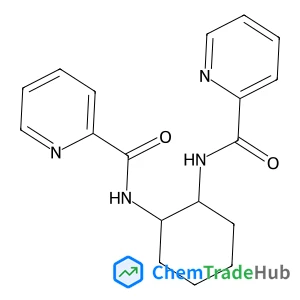
N,N'-(1R,2R)-1,2-Cyclohexanediyldi(2-pyridinecarboxamide)
CAS Number:
218290-24-5
Molecular Formula:
C18H20N4O2
Recommended Suppliers






Disclaimer
This page provides academic journal information for reference and research purposes only. We are not affiliated with any journal publishers and do not handle publication submissions. For publication-related inquiries, please contact the respective journal publishers directly.
If you notice any inaccuracies in the information displayed, please contact us at support@chemtradehub.com. We will promptly review and address your concerns.