












Temperature, pressure and density dependencies of the solubilities of low-volatility organic compounds in compressed gases Part 1. Solution energies from solubility data for disperse dyestuffs up to 20 MPa
Literature Information
Publication Date
2002-02-14
DOI
10.1039/B109521H
Impact Factor
3.676
Authors
Dirk Tuma, Björn Wagner, Gerhard M. Schneider
View Original
Abstract
A method is described to calculate molar solution energies from solubility data of a binary low-volatility organic compound + compressed carbon dioxide system. It has been applied to equilibrium measurements of the two anthraquinone derivatives 1,4-bis-(methylamino)-9,10-anthraquinone and 1,4-bis-(1-methylethylamino)-9,10-anthraquinone in CO2 within a p,T-range of 6.79–18.80 MPa and 299–345 K, respectively. Since solubility data do not exceed 0.135 g dm−3, the fluid phase can be regarded as infinitely dilute. The data have been analyzed in a way that from the two “derivative” plots logarithm of the solubility vs. the reciprocal temperature at constant pressure as well as constant density, two expressions for the molar solution energy, ΔsolEp and ΔsolEρ, have been derived and interpreted. We summarize our findings in four main statements: ΔsolEρ remains almost constant within a significant density range, here approximately between 400 and 800 kg m−3; ΔsolEp is drastically pressure (and density) dependent; both expressions are connected with each other via the isobaric expansion coefficient αp of the solvent; and finally for these two systems the ΔsolEp and ΔsolEρ values, respectively, are quite similar, whereas the solubilities differ by about a factor of ten.
Recommended Journals
Related Literature
Synthetic approaches towards avibactam and other diazabicyclooctane β-lactamase inhibitors
Laure Peilleron, Kevin Cariou
2020-01-13
Review Article
DOI: 10.1039/C9OB02605C
Examination of pinanediol–boronic acid ester formation in aqueous media: relevance to the relative stability of trigonal and tetrahedral boronate esters
Mayte A. Martínez-Aguirre, Marcos Flores-Alamo, Felipe Medrano, Anatoly K. Yatsimirsky
2020-03-18
Paper
DOI: 10.1039/D0OB00201A
Chemoselective photocatalytic oxidation of alcohols to aldehydes and ketones by nitromethane on titanium dioxide under violet 400 nm LED light irradiation
Azam Rahimi Niaraki, Mohammad Reza Saraee, Babak Kaboudin
2020-03-07
Paper
DOI: 10.1039/C9OB02183C
Exploring the relationship between structure and activity in BODIPYs designed for antimicrobial phototherapy
Burkhard Gitter, Keith J. Flanagan, Christopher J. Kingsbury, Mathias O. Senge
2020-03-06
Paper
DOI: 10.1039/D0OB00188K
Characterization of the promiscuous N-acyl CoA transferase, LgoC, in legonoxamine biosynthesis
Justine Renault, Laurent Trembleau, Catherine Victoria, Ming Him Tong, Shan Wang, Kwaku Kyeremeh, Hai Deng
2020-03-04
Communication
DOI: 10.1039/D0OB00320D
Correction: Base-catalyzed C-alkylation of potassium enolates with styrenes via a metal–ene reaction: a mechanistic study
Thierry N. J. Fouquet, Yasuo Norikane
2020-03-18
Correction
DOI: 10.1039/D0OB90032J
Mechanism and stereoselectivity of benzylic C–H hydroxylation by Ru–porphyrin: a computational study
Xiahe Chen, Qunmin Wang, Haimin Shen, Guijie Li, Yun-Fang Yang, Yuan-Bin She
2019-12-09
Paper
DOI: 10.1039/C9OB02415H
Introducing sequential aza-amino acids units induces repeated β-turns and helical conformations in peptides
Nicolo Tonali, Isabelle Correia, Jacopo Lesma, Guillaume Bernadat, Sandrine Ongeri, Olivier Lequin
2020-02-17
Communication
DOI: 10.1039/C9OB02654A
The impact of cation structure upon the acidity of triazolium salts in dimethyl sulfoxide
Nicholas Konstandaras, Michelle H. Dunn, Max S. Guerry, Christopher D. Barnett, Marcus L. Cole, Jason B. Harper
2019-11-14
Paper
DOI: 10.1039/C9OB02258A
You might also like
Compound Q&A
What regulatory guidelines apply to 6-Bromo-2-methylimidazo[1,2-a]pyrimidine (CAS: 1111638-05-1)?
6-Bromo-2-methylimidazo[1,2-a]pyrimidine (CAS: 1111638-05-1) falls under various...
1111638-05-16-Bromo-2-methylimid...
Compound Q&A
Are there alternatives to 1-Pyrrolidineethanol, β-methyl-α-phenyl-, (αS,βR) (CAS: 123620-80-4) in synthesis?
While there are no direct alternatives, similar compounds like 1-Pyrrolidineetha...
123620-80-41-Pyrrolidineethanol...
Compound Q&A
Is 4-Methyl-2,6-bis(2-methyl-2-propanyl)phenyl methylcarbamate (CAS: 1918-11-2) safe?
4-Methyl-2,6-bis(2-methyl-2-propanyl)phenyl methylcarbamate (CAS: 1918-11-2) is ...
1918-11-24-Methyl-2,6-bis(2-m...
Compound Q&A
How should 2-(3-Bromo-4-fluorophenyl)-1,3-dioxolane (CAS: 77771-04-1) be stored?
2-(3-Bromo-4-fluorophenyl)-1,3-dioxolane (CAS: 77771-04-1) should be stored in a...
77771-04-12-(3-Bromo-4-fluorop...
Compound Q&A
What are the physical and chemical properties of 4,5,6,7-Tetrahydro-1H-indazole hydrochloride (CAS: 18161-11-0)?
4,5,6,7-Tetrahydro-1H-indazole hydrochloride is a white crystalline solid with a...
18161-11-04,5,6,7-Tetrahydro-1...
Compound Q&A
What is (2R)-1-Methoxy-3-phenyl-2-propanamine (CAS: 59919-07-2)?
(2R)-1-Methoxy-3-phenyl-2-propanamine is a chiral organic compound with the CAS ...
59919-07-2(2R)-1-Methoxy-3-phe...
Compound Q&A
What industries use Ethyl 1-(1-phenylethyl)-1H-imidazole-5-carboxylate (CAS: 56649-47-9)?
Ethyl 1-(1-phenylethyl)-1H-imidazole-5-carboxylate is used in various industries...
56649-47-9Ethyl 1-(1-phenyleth...
Compound Q&A
What regulatory guidelines apply to 4-[(1E,3S)-1-(4-Hydroxyphenyl)-1,4-pentadien-3-yl]phenol (CAS: 17676-24-3)?
4-[(1E,3S)-1-(4-Hydroxyphenyl)-1,4-pentadien-3-yl]phenol (CAS: 17676-24-3) falls...
17676-24-34-[(1E,3S)-1-(4-Hydr...
Compound Q&A
What industries use (S)-3-Amino-5-phenylpentanoic acid hydrochloride (CAS: 331846-97-0)?
(S)-3-Amino-5-phenylpentanoic acid hydrochloride is primarily used in the pharma...
331846-97-0(S)-3-Amino-5-phenyl...
Compound Q&A
How is 7-methoxy-1-benzothiophene-2-carboxylic acid (CAS: 88791-07-5) typically synthesized?
7-Methoxy-1-benzothiophene-2-carboxylic acid is typically synthesized by reactin...
88791-07-57-methoxy-1-benzothi...
Source Journal
Physical Chemistry Chemical Physics

CiteScore:
5.5
Self-citation Rate:
10.3%
Articles per Year:
3036
Physical Chemistry Chemical Physics (PCCP) is an international journal co-owned by 19 physical chemistry and physics societies from around the world. This journal publishes original, cutting-edge research in physical chemistry, chemical physics and biophysical chemistry. To be suitable for publication in PCCP, articles must include significant innovation and/or insight into physical chemistry; this is the most important criterion that reviewers and Editors will judge against when evaluating submissions. The journal has a broad scope and welcomes contributions spanning experiment, theory, computation and data science. Topical coverage includes spectroscopy, dynamics, kinetics, statistical mechanics, thermodynamics, electrochemistry, catalysis, surface science, quantum mechanics, quantum computing and machine learning. Interdisciplinary research areas such as polymers and soft matter, materials, nanoscience, energy, surfaces/interfaces, and biophysical chemistry are welcomed if they demonstrate significant innovation and/or insight into physical chemistry. Joined experimental/theoretical studies are particularly appreciated when complementary and based on up-to-date approaches.
Recommended Compounds

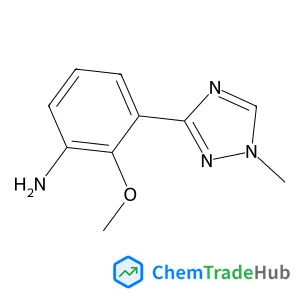
2-Methoxy-3-(1-methyl-1H-1,2,4-triazol-3-yl)aniline
CAS Number:
1609394-10-6
Molecular Formula:
C10H12N4O
Recommended Suppliers






Disclaimer
This page provides academic journal information for reference and research purposes only. We are not affiliated with any journal publishers and do not handle publication submissions. For publication-related inquiries, please contact the respective journal publishers directly.
If you notice any inaccuracies in the information displayed, please contact us at support@chemtradehub.com. We will promptly review and address your concerns.