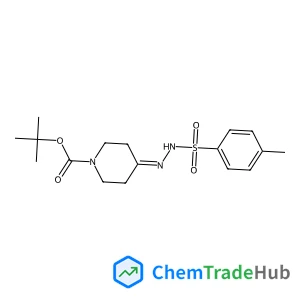
tert-Butyl 4-(2-(p-Tolylsulfonyl)hydrazono)piperidine-1-carboxylate
CAS Number:
1046478-89-0
Molecular Formula:
C17H25N3O4S
Jacob Goldsmith, Craig C. Martens
This paper describes nonequilibrium molecular dynamics simulations of pressure induced transport of liquid water through model nanopores. We consider a simple model for a porous membrane consisting of a slab of water molecules held in a rigid ice structure and penetrated by a pore of nanometer scale dimensions. Both hydrophilic membranes composed of conventional TIP3P water and hydrophobic membranes consisting of modified water with the model partial charges set to zero are treated. Molecular dynamics simulation is employed to investigate the rate of water flow through the pore induced by a pressure difference across the membrane. The results are compared with the predictions of continuum hydrodynamics. We find that the flow rate of water through hydrophilic pores is much less than the continuum predictions, while the flux through hydrophobic pores can significantly exceed the continuum theory. Finally, we show asymmetric behavior in the flux vs. pressure difference for a conical nanopore, which thus acts as a Brownian ratchet.
G. Ramos-Sanchez, P. B. Balbuena
DOI: 10.1039/C3CP51791H
João Pina, J. Seixas de Melo, D. Breusov, Ullrich Scherf
DOI: 10.1039/C3CP52056K
Esther Rebollar, Javier R. Vázquez de Aldana, Ignacio Martín-Fabiani, Margarita Hernández, Daniel R. Rueda, Tiberio A. Ezquerra, Concepción Domingo, Pablo Moreno, Marta Castillejo
DOI: 10.1039/C3CP51523K
Dae Sung Chung, Il Kang, Yun-Hi Kim, Soon-Ki Kwon
DOI: 10.1039/C3CP52422A
Martin J. Hollamby
DOI: 10.1039/C3CP50293G
DOI: 10.1039/C3CP50191D
DOI: 10.1039/C3CP51743H
Dongyang Chen, Michael A. Hickner
DOI: 10.1039/C3CP52035H
Devin T. Edwards, Zhidong Ma, Daniella Goldfarb
DOI: 10.1039/C3CP43787F
When considering alternatives to 1-(4-Chlorophenyl)-N-hydroxymethanimine (CAS: 3...
This compound should be stored in a cool, dry place away from direct sunlight. I...
3-(4-Bromophenyl)-5-(2-fluorophenyl)-1,2,4-oxadiazole is synthesized through a m...
5-Chloro-2-(4-chlorophenyl)-4-methyl-6-[3-(1-piperidinyl)propoxy]pyrimidine (CAS...
2-Chloro-4-(difluoromethoxy)pyridine is used in the pharmaceutical industry for ...
3-Chloro-6-methylpyridazine (CAS: 1121-79-5) is classified under the Globally Ha...
Several alternatives can be used in the synthesis of Methyl 4,5-dimethyl-2-nitro...
Alternatives to (2E,2'E)-3,3'-(1,4-Phenylene)bisacrylaldehyde include other acry...
3-Amino-5-chloropyridin-2-ol hydrochloride is an organic compound with the CAS n...
When handling 6,7-Difluoro-2,3-dihydro-4H-chromen-4-one, it is essential to wear...

Physical Chemistry Chemical Physics (PCCP) is an international journal co-owned by 19 physical chemistry and physics societies from around the world. This journal publishes original, cutting-edge research in physical chemistry, chemical physics and biophysical chemistry. To be suitable for publication in PCCP, articles must include significant innovation and/or insight into physical chemistry; this is the most important criterion that reviewers and Editors will judge against when evaluating submissions. The journal has a broad scope and welcomes contributions spanning experiment, theory, computation and data science. Topical coverage includes spectroscopy, dynamics, kinetics, statistical mechanics, thermodynamics, electrochemistry, catalysis, surface science, quantum mechanics, quantum computing and machine learning. Interdisciplinary research areas such as polymers and soft matter, materials, nanoscience, energy, surfaces/interfaces, and biophysical chemistry are welcomed if they demonstrate significant innovation and/or insight into physical chemistry. Joined experimental/theoretical studies are particularly appreciated when complementary and based on up-to-date approaches.
![6-Bromo-2,3-dihydro-1H-pyrido[2,3-b][1,4]oxazine structure](https://static.chemtradehub.com/structs/120/1203499-17-5-b4d1.webp "6-Bromo-2,3-dihydro-1H-pyrido[2,3-b][1,4]oxazine structure")