












Enhanced long-wavelength transient photoresponsiveness of WO3 induced by tellurium doping
Literature Information
Publication Date
2008-07-29
DOI
10.1039/B807629D
Impact Factor
6.222
Authors
View Original
Abstract
Tungsten trioxide (WO3) films doped with 0.25 atom% tellurium synthesised by a sol–gel route, show strong transient photocurrents under chopped sub-bandgap illumination (hν = 1.8 eV < Eg) at low bias potentials from 0.2 to 0.7 V; such effects are ascribed to the presence of a localized narrow band (NB) between the VB and the CB in this material.
Related Literature
X-Ray scattering and physicochemical studies of trialkylamine/carboxylic acid mixtures: nanoscale structure in pseudoprotic ionic liquids and related solutions
Kevin G. Yager
2018-06-25
Paper
DOI: 10.1039/C8CP02854K
What's in a name? ‘Coinage-metal’ non-covalent bonds and their definition
Anthony C. Legon, Nicholas R. Walker
2018-07-02
Perspective
DOI: 10.1039/C8CP03432J
Controlling ion transport through nanopores: modeling transistor behavior
Eszter Mádai, Bartłomiej Matejczyk, András Dallos, Mónika Valiskó
2018-08-31
Paper
DOI: 10.1039/C8CP03918F
High-yield graphene produced from the synergistic effect of inflated temperature and gelatin offers high stability and cellular compatibility
Pranav Tiwari, Navpreet Kaur, Vinay Sharma
2018-07-04
Paper
DOI: 10.1039/C8CP02263A
DFT investigation on the adsorption of munition compounds on α-Fe2O3: similarity and differences with α-Al2O3
Glen R. Jenness, Jennifer Seiter, Manoj K. Shukla
2018-06-27
Paper
DOI: 10.1039/C8CP02590H
Effect of Hartree–Fock pseudopotentials on local density functional theory calculations
Hengxin Tan, Yuanchang Li
2018-06-25
Paper
DOI: 10.1039/C8CP00990B
Estimation of diffusive states from single-particle trajectory in heterogeneous medium using machine-learning methods
Yu Matsuda, Itsuo Hanasaki, Ryo Iwao, Hiroki Yamaguchi, Tomohide Niimi
2018-09-11
Paper
DOI: 10.1039/C8CP02566E
Thermally induced carbonation of Ca(OH)2 in a CO2 atmosphere: kinetic simulation of overlapping mass-loss and mass-gain processes in a solid–gas system
Nobuyoshi Koga, Satoki Kodani
2018-10-03
Paper
DOI: 10.1039/C8CP05701J
Suppression of surfaces states at cubic perovskite (001) surfaces by CO2 adsorption
Kostiantyn V. Sopiha, Oleksandr I. Malyi, Clas Persson, Ping Wu
2018-06-19
Paper
DOI: 10.1039/C8CP02535E
You might also like
Compound Q&A
What precautions should be taken when handling 4-(2-Furylmethyl)thiomorpholine 1,1-dioxide (CAS: 79206-94-3)?
When handling 4-(2-Furylmethyl)thiomorpholine 1,1-dioxide (CAS: 79206-94-3), it ...
79206-94-34-(2-Furylmethyl)thi...
Compound Q&A
What precautions should be taken when handling 4-Chloro-N-[2-(4-morpholinyl)ethyl]benzamide (CAS: 71320-77-9)?
When handling 4-Chloro-N-[2-(4-morpholinyl)ethyl]benzamide (CAS: 71320-77-9), it...
71320-77-94-Chloro-N-[2-(4-mor...
Compound Q&A
How should waste containing 2-[2-(2-Methoxyethoxy)ethoxy]ethyl 4-methylbenzenesulfonate (CAS: 62921-74-8) be handled?
Waste containing this compound (CAS: 62921-74-8) should be handled according to ...
62921-74-82-[2-(2-Methoxyethox...
Compound Q&A
How should waste containing (S)-Methyl 2-amino-3-cyclohexylpropanoate be handled?
Waste containing (S)-Methyl 2-amino-3-cyclohexylpropanoate should be collected i...
40056-18-6(S)-Methyl 2-amino-3...
Compound Q&A
How is 5-({4-[(2S,4R)-4-Hydroxy-2-methyltetrahydro-2H-pyran-4-yl]-2-thienyl}sulfanyl)-1-methyl-1,3-dihydro-2H-indol-2-one (CAS: 166882-70-8) typically synthesized?
This compound can be synthesized using a multi-step process involving the conjug...
166882-70-85-({4-[(2S,4R)-4-Hyd...
Compound Q&A
Are there alternatives to (2E)-3-(3,4-Dichlorophenyl)acrylic acid (CAS: 7312-27-8) in synthesis?
There are several alternatives to (2E)-3-(3,4-Dichlorophenyl)acrylic acid in syn...
7312-27-8(2E)-3-(3,4-Dichloro...
Compound Q&A
How should Ethyl 6-(2-nitrophenyl)imidazo[2,1-b][1,3]thiazole-3-carboxylate (CAS: 925437-84-9) be stored?
Ethyl 6-(2-nitrophenyl)imidazo[2,1-b][1,3]thiazole-3-carboxylate (CAS: 925437-84...
925437-84-9Ethyl 6-(2-nitrophen...
Compound Q&A
How should waste containing 2-(1,3-Thiazol-2-yl)ethanamine (CAS: 18453-07-1) be handled?
Waste containing 2-(1,3-Thiazol-2-yl)ethanamine (CAS: 18453-07-1) should be coll...
18453-07-12-(1,3-Thiazol-2-yl)...
Compound Q&A
How is Methyl 5-iodo-2-methylbenzoate (CAS: 103440-54-6) typically synthesized?
Methyl 5-iodo-2-methylbenzoate can be synthesized through the iodination of meth...
103440-54-6Methyl 5-iodo-2-meth...
Compound Q&A
How is 5-Chloro[1,2,4]triazolo[1,5-a]pyridine (CAS: 1427399-34-5) typically synthesized?
5-Chloro[1,2,4]triazolo[1,5-a]pyridine is commonly synthesized via the condensat...
1427399-34-55-Chloro[1,2,4]triaz...
Source Journal
Chemical Communications

CiteScore:
8.6
Self-citation Rate:
4.7%
Articles per Year:
2458
ChemComm publishes urgent research which is of outstanding significance and interest to experts in the field, while also appealing to the journal’s broad chemistry readership. Our communication format is ideally suited to short, urgent studies that are of such importance that they require accelerated publication. Our scope covers all topics in chemistry, and research at the interface of chemistry and other disciplines (such as materials science, nanoscience, physics, engineering and biology) where there is a significant novelty in the chemistry aspects. Major topic areas covered include: Analytical Chemistry Catalysis Chemical Biology and medicinal chemistry Computational Chemistry and Machine Learning Energy and sustainable chemistry Environmental Chemistry Green Chemistry Inorganic Chemistry Materials Chemistry Nanoscience Organic Chemistry Physical Chemistry Polymer Chemistry Supramolecular Chemistry
Recommended Compounds
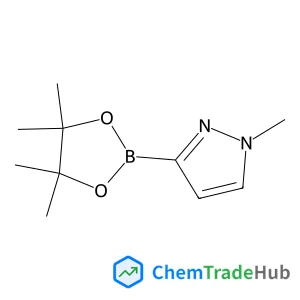
1-Methyl-3-(4,4,5,5-tetramethyl-1,3,2-dioxaborolan-2-yl)-1H-pyrazole
CAS Number:
1020174-04-2
Molecular Formula:
C10H17BN2O2
![[4-Amino-2-(methylsulfanyl)-5-pyrimidinyl]methanol structure](https://static.chemtradehub.com/structs/588/588-36-3-fc73.webp "[4-Amino-2-(methylsulfanyl)-5-pyrimidinyl]methanol structure")
Recommended Suppliers




Disclaimer
This page provides academic journal information for reference and research purposes only. We are not affiliated with any journal publishers and do not handle publication submissions. For publication-related inquiries, please contact the respective journal publishers directly.
If you notice any inaccuracies in the information displayed, please contact us at support@chemtradehub.com. We will promptly review and address your concerns.