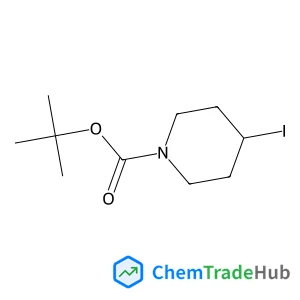
2-Methyl-2-propanyl 4-iodo-1-piperidinecarboxylate
CAS Number:
301673-14-3
Molecular Formula:
C10H18INO2
Kadir Aslan, Stuart N. Malyn, Chris D. Geddes
We describe an exciting opportunity for Metal-Enhanced Fluorescence (MEF)-based surface assays using an angular-ratiometric approach to the observed enhanced emission from fluorophores in close proximity to silver colloids deposited on glass substrates. This approach utilizes the radiationless energy transfer (coupling) between the excited states of the fluorophore and the induced surface plasmons of the silver colloids, and the subsequent angular-dependent fluorescence emission from the fluorophore–silver colloid system. Since MEF is related to surface plasmons' ability to scatter light, angular-dependent light scattering from three different silvered surfaces and glass substrates were investigated using two common excitation angles, 45 and 90°. The scattered light from silvered surfaces with a high loading was observed at wider angles on both sides of the glass substrates, while forward scattering (from the back of the glass) was dominant for the silvered surfaces with low loading, as explained by both Mie and Rayleigh theories. When silver colloids were placed between the fluorophore and glass interface, the coupled fluorescence emission through the higher refractive index glass (and in air), increased in an angular-dependent fashion, following closely the angular-dependent light scattering pattern of the silver colloids themselves. Similar observations for fluorescence emission from fluorophores deposited onto glass surfaces alone were made, but at much narrower angles on both sides of the fluorophore–glass interface and were simply explained by Lambert's cosine law. As the loading of silver on glass was increased, the enhanced fluorescence emission was observed at wider angles (towards 0 and 180°) at both sides of the silvered surfaces. Glass surfaces without silver colloids were used as control samples to demonstrate the benefits of MEF for enhancing fluorescence signatures in an elegant, angular-dependent fashion. Finally, the utility of the angular-dependent MEF phenomenon for intensity-based angular-ratiometric surface assays is demonstrated.
Hanghang Wang, John Michael O. Cue, Erika L. Calubaquib, Ruvanthi N. Kularatne, Somayeh Taslimy, Justin T. Miller, Mihaela C. Stefan
DOI: 10.1039/D1PY01270C
DOI: 10.1039/A907015J
J. M. C. Marques, A. J. C. Varandas
DOI: 10.1039/B102984N
R. Becerra, J. P. Cannady, R. Walsh
DOI: 10.1039/B009600H
DOI: 10.1039/B100168J
Venukrishnan Komanduri, Yurachat Janpatompong, Raymundo Marcial-Hernandez, Daniel J. Tate, Michael L. Turner
DOI: 10.1039/D1PY01202A
Tochukwu Nwoko, Nethmi De Alwis Watuthanthrige, Bryan Parnitzke, Kevin Yehl, Dominik Konkolewicz
DOI: 10.1039/D1PY01129D
DOI: 10.1039/A906537G
Waste containing (6-Bromo-2-naphthyl)oxy](dimethyl)(2-methyl-2-propanyl)silane (...
7-Fluoro-4-isoquinolinecarboxylic acid can be synthesized via a multi-step proce...
2,3,5,6-Tetrabromothieno[3,2-b]thiophene is a crystalline compound with a high m...
1-[4-(Benzylamino)-7,8-dihydro-5H-pyrano[4,3-d]pyrimidin-2-yl]-2-methyl-1H-indol...
The market for imidazo[5,1-d]-1,2,3,5-tetrazine-8-carboxylic acid, 3,4-dihydro-3...
3-(Triisopropylsilyl)propiolaldehyde is a synthetic organic compound with the CA...
6-Nitro-2H-1,4-benzoxazin-3(4H)-one (CAS: 81721-87-1) is subject to various regu...
Waste containing (3-Fluorophenyl)(4-{[(2-methyl-2-propanyl)oxy]carbonyl}-1-piper...
N,N'-4,4'-Biphenyldiyldiisonicotinamide is a white crystalline solid with a mole...
6-Bromo-8-fluoro-2-quinazolinol is primarily used in the pharmaceutical industry...

Analyst publishes analytical and bioanalytical research that reports premier fundamental discoveries and inventions, and the applications of those discoveries, unconfined by traditional discipline barriers.