












Folding-induced CO2-soluble peptides
Literature Information
Publication Date
2007-08-13
DOI
10.1039/B709162A
Impact Factor
6.222
Authors
Sarah E. Kiehna, Zachary R. Laughrey, Marcey L. Waters
View Original
Abstract
The first CO2- and water-soluble peptide is reported, in which folding facilitates its solubility in CO2.
Recommended Journals
Related Literature
Alteration of room temperature phosphorescence lifetimes of quinine and quinidine by chiral additives
Yanli Wei, Wing-Hong Chan, Albert W. M. Lee, Carmen W. Huie
2003-12-18
Communication
DOI: 10.1039/B311667K
High quality CdSeS nanocrystals synthesized by facile single injection process and their electroluminescence
Eunjoo Jang, Shinae Jun, Lyongsun Pu
2003-11-07
Communication
DOI: 10.1039/B310853H
Nucleic acid binding properties of thyminyl and adeninyl pyrrolidine-amideoligonucleotide mimics (POM)
T. H. Samuel Tan, David T. Hickman, Jordi Morral, Ian G. Beadham, Jason Micklefield
2004-01-28
Communication
DOI: 10.1039/B315768G
NMR and computational studies of the chemical reduction of [2.2]paracyclophane: formation of dianionic p-xylenyl oligomers
Ilya D. Gridnev, Fabio Pichierri
2003-11-26
Communication
DOI: 10.1039/B311885A
Mesocellular polymer foams with unprecedented uniform large mesopores and high surface areas
Jinwoo Lee, Jaeyun Kim, Sang-Wook Kim, Chae-Ho Shin, Taeghwan Hyeon
2004-02-06
Communication
DOI: 10.1039/B310713B
A powerful route to C-functionalised tetraazamacrocycles
Frédéric Boschetti, Franck Denat, Enrique Espinosa, Jean-Marie Lagrange, Roger Guilard
2004-02-03
Communication
DOI: 10.1039/B315285E
Surface energy and surface area measurements by 19F MAS NMR of adsorbed trifluoroacetic acid
Vitaliy L. Budarin, James H. Clark, Stewart J. Tavener
2004-02-05
Communication
DOI: 10.1039/B315005D
Novel imprinted soluble microgels with hydrolytic catalytic activity
Stacey C. Maddock, Pamela Pasetto, Marina Resmini
2004-02-06
Communication
DOI: 10.1039/B312631E
Metal organic chemical vapour deposition (MOCVD) of bone mineral like carbonated hydroxyapatite coatings
J. A. Darr, Z. X. Guo, V. Raman, M. Bououdina, I. U. Rehman
2004-02-13
Communication
DOI: 10.1039/B312855P
VIII(OH){O2C–C6H4–CO2}.(HO2C–C6H4–CO2H)x(DMF)y(H2O)z (or MIL-68), a new vanadocarboxylate with a large pore hybrid topology : reticular synthesis with infinite inorganic building blocks?
K. Barthelet, J. Marrot, G. Férey, D. Riou
2004-02-05
Communication
DOI: 10.1039/B312589K
You might also like
Compound Q&A
How should waste containing 2-Ethyl-4-Methyl-1H-Imidazole-5-Carbaldehyde (CAS: 88634-80-4) be handled?
Waste containing 2-Ethyl-4-Methyl-1H-Imidazole-5-Carbaldehyde (CAS: 88634-80-4) ...
88634-80-42-Ethyl-4-Methyl-1H-...
Compound Q&A
What industries use Triethoxy(octyl)silane (CAS: 1385031-14-0)?
Triethoxy(octyl)silane (CAS: 1385031-14-0) is widely used in the pharmaceuticals...
1385031-14-0Triethoxy(octyl)sila...
Compound Q&A
Are there alternatives to 3-iodo-7-nitro-1H-indazole (CAS: 864724-64-1) in synthesis?
Several alternatives to 3-iodo-7-nitro-1H-indazole (CAS: 864724-64-1) exist in t...
864724-64-13-iodo-7-nitro-1H-in...
Compound Q&A
Are there alternatives to Benzene, bis[(trimethoxysilyl)ethyl] (CAS: 266317-71-9) in synthesis?
Yes, there are alternatives to Benzene, bis[(trimethoxysilyl)ethyl] (CAS: 266317...
266317-71-9Benzene, bis[(trimet...
Compound Q&A
Is Isothiazole-3-carbonitrile (CAS: 1452-17-1) safe?
Isothiazole-3-carbonitrile (CAS: 1452-17-1) is generally considered safe when us...
1452-17-1Isothiazole-3-carbon...
Compound Q&A
Is (3-Chlorophenyl)methanol (CAS: 873-63-2) safe?
(3-Chlorophenyl)methanol (CAS: 873-63-2) is considered low to moderately toxic. ...
873-63-2(3-Chlorophenyl)meth...
Compound Q&A
How is (2S,3S)-2-Hydroxy-3-({[(2-methyl-2-propanyl)oxy]carbonyl}amino)-3-(2-naphthyl)propanoic acid (CAS: 959583-98-3) typically synthesized?
(2S,3S)-2-Hydroxy-3-({[(2-methyl-2-propanyl)oxy]carbonyl}amino)-3-(2-naphthyl)pr...
959583-98-3(2S,3S)-2-Hydroxy-3-...
Compound Q&A
What precautions should be taken when handling Methyl 2-(bromomethyl)-5-methoxybenzoate (CAS: 788081-99-2)?
Proper handling of methyl 2-(bromomethyl)-5-methoxybenzoate requires the use of ...
788081-99-2Methyl 2-(bromomethy...
Compound Q&A
What is 6,8-Dibromoimidazo[1,2-a]pyridine-2-carboxylic acid (CAS: 904805-36-3)?
6,8-Dibromoimidazo[1,2-a]pyridine-2-carboxylic acid (CAS: 904805-36-3) is an aro...
904805-36-36,8-Dibromoimidazo[1...
Compound Q&A
Is 3-Amino-5-bromo-2-pyridinecarbonitrile (CAS: 573675-27-1) safe?
3-Amino-5-bromo-2-pyridinecarbonitrile is considered safe when handled under pro...
573675-27-13-Amino-5-bromo-2-py...
Source Journal
Chemical Communications

CiteScore:
8.6
Self-citation Rate:
4.7%
Articles per Year:
2458
ChemComm publishes urgent research which is of outstanding significance and interest to experts in the field, while also appealing to the journal’s broad chemistry readership. Our communication format is ideally suited to short, urgent studies that are of such importance that they require accelerated publication. Our scope covers all topics in chemistry, and research at the interface of chemistry and other disciplines (such as materials science, nanoscience, physics, engineering and biology) where there is a significant novelty in the chemistry aspects. Major topic areas covered include: Analytical Chemistry Catalysis Chemical Biology and medicinal chemistry Computational Chemistry and Machine Learning Energy and sustainable chemistry Environmental Chemistry Green Chemistry Inorganic Chemistry Materials Chemistry Nanoscience Organic Chemistry Physical Chemistry Polymer Chemistry Supramolecular Chemistry
Recommended Compounds
![4,4'-[2,5-Biphenyldiylbis(oxy)]dianiline structure](https://static.chemtradehub.com/structs/941/94148-67-1-24c6.webp "4,4'-[2,5-Biphenyldiylbis(oxy)]dianiline structure")
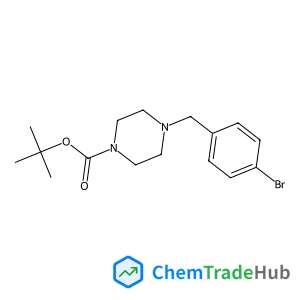
2-Methyl-2-propanyl 4-(4-bromobenzyl)-1-piperazinecarboxylate
CAS Number:
844891-10-7
Molecular Formula:
C16H23BrN2O2

Recommended Suppliers





Disclaimer
This page provides academic journal information for reference and research purposes only. We are not affiliated with any journal publishers and do not handle publication submissions. For publication-related inquiries, please contact the respective journal publishers directly.
If you notice any inaccuracies in the information displayed, please contact us at support@chemtradehub.com. We will promptly review and address your concerns.