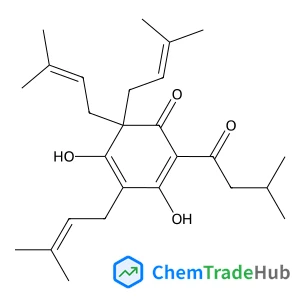
3,5-Dihydroxy-4-(3-methylbutanoyl)-2,6,6-tris(3-methyl-2-buten-1-yl)-2,4-cyclohexadien-1-one
CAS Number:
468-28-0
Molecular Formula:
C26H38O4
Caroline Marchi-Delapierre, Adeline Jorge-Robin, Aurore Thibon, Stéphane Ménage
The dinuclear chiral complex Fe2O(bisPB)4(X)2(ClO4)4 (X = H2O or CH3CN) catalyzes with high efficiency (up to 850 TON) and moderate enantioselectivity (63%) the epoxidation of electron deficient alkenes at 0 °C by a peracid.
Manfred Martin
DOI: 10.1039/B900162J
Igor V. Shishkovskiy, Yury G. Morozov, Maxim V. Kuznetsov, Ivan P. Parkin
DOI: 10.1039/B819810A
R. Busselez, R. Lefort, Q. Ji, F. Affouard, D. Morineau
DOI: 10.1039/B911859D
Mark A. Blitz, Paul W. Seakins, Ian W. M. Smith
DOI: 10.1039/B917734E
Thomas Schmierer, Wolfgang J. Schreier, Florian O. Koller, Tobias E. Schrader
DOI: 10.1039/B915451E
Shiro Seki, Kikuko Hayamizu, Seiji Tsuzuki, Kenta Fujii, Yasuhiro Umebayashi, Takushi Mitsugi, Takeshi Kobayashi, Yasutaka Ohno, Yo Kobayashi, Yuichi Mita, Hajime Miyashiro, Shin-ichi Ishiguro
DOI: 10.1039/B820343A
P. Träskelin, T. L. Kuhl, R. Faller
DOI: 10.1039/B911311H
Giovanna Dellepiane, Carla Cuniberti, Marina Alloisio, Anna Demartini
DOI: 10.1039/B912921A
Helena Meresman, Jon B. Wills, Michael Summers, David McGloin, Jonathan P. Reid
DOI: 10.1039/B914165K
When handling 2-Chloro-1,2-bis(4-methylphenyl)ethanone (CAS: 71193-32-3), it is ...
4-Ethoxy-3-(5-methyl-4-oxo-7-propyl-1,4-dihydroimidazo[5,1-f][1,2,4]triazin-2-yl...
Methyl 3-Oxo-4-Androsten-17-Carboxylate (CAS: 2681-55-2) should be stored in a c...
(R)-3-Amino-4-(3-hexylphenylamino)-4-oxobutylphosphonic acid is primarily used i...
2-Methyl-2-propanyl 3-amino-3-carbamoyl-1-azetidinecarboxylate (CAS: 1254120-14-...
There are alternative reagents that can be used in synthesis instead of (E)-4-(t...
[2-(3-Chlorophenyl)-1,3-thiazol-4-yl]methanol (CAS: 121202-20-8) is a crystallin...
The market and research trends for Methyl (2S)-[(4S)-2,2-dimethyl-1,3-dioxolan-4...
The market for 1-Bromo-2-isocyanatoethane (CAS: 42865-19-0) is driven by its use...
4-Nitro-D-phenylalanine hydrochloride (CAS: 147065-06-3) is primarily used in re...

ChemComm publishes urgent research which is of outstanding significance and interest to experts in the field, while also appealing to the journal’s broad chemistry readership. Our communication format is ideally suited to short, urgent studies that are of such importance that they require accelerated publication. Our scope covers all topics in chemistry, and research at the interface of chemistry and other disciplines (such as materials science, nanoscience, physics, engineering and biology) where there is a significant novelty in the chemistry aspects. Major topic areas covered include: Analytical Chemistry Catalysis Chemical Biology and medicinal chemistry Computational Chemistry and Machine Learning Energy and sustainable chemistry Environmental Chemistry Green Chemistry Inorganic Chemistry Materials Chemistry Nanoscience Organic Chemistry Physical Chemistry Polymer Chemistry Supramolecular Chemistry