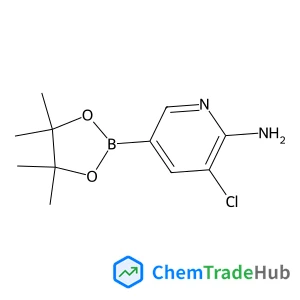
3-Chloro-5-(4,4,5,5-tetramethyl-1,3,2-dioxaborolan-2-yl)-2-pyridinamine
CAS Number:
1032758-99-8
Molecular Formula:
C11H16BClN2O2
The first page of this article is displayed as the abstract.
Nico Holmberg
DOI: 10.1039/C4CP00635F
Sergio Morales-Torres, Tânia L. S. Silva, Luisa M. Pastrana-Martínez, Ana T. S. C. Brandão, José L. Figueiredo, Adrián M. T. Silva
DOI: 10.1039/C4CP00615A
Kristian L. Göeken, Ron Gill
DOI: 10.1039/C4CP03739A
Ahmed M. Hafez, Noha M. Salem, Nageh K. Allam
DOI: 10.1039/C4CP02088J
H. Isobe, M. Shoji, S. Yamanaka, H. Mino, Y. Umena, K. Kawakami, N. Kamiya, J.-R. Shen
DOI: 10.1039/C4CP00282B
V. Baglio, R. S. Amin, K. M. El-Khatib, S. Siracusano, C. D'Urso, A. S. Aricò
DOI: 10.1039/C4CP00466C
Qingzhong Li, Xin Guo, Xin Yang, Wenzuo Li, Jianbo Cheng, Hai-Bei Li
DOI: 10.1039/C4CP01209G
Ying Yang, Kwangho Ri, Yaoguang Rong, Linfeng Liu, Tongfa Liu, Min Hu, Xiong Li, Hongwei Han
DOI: 10.1039/C4CP02354D
Régis Tadeu Santiago, Tiago Quevedo Teodoro, Roberto Luiz Andrade Haiduke
DOI: 10.1039/C4CP00706A
This compound is mainly used as an intermediate in the synthesis of antipsychoti...
Waste containing 1-(D-Ribofuranosyl)-1,4-dihydro-3-pyridinecarboxamide (CAS: 191...
2-Methyl-2-propanyl 3-bromo-3-(hydroxymethyl)-1-azetidinecarboxylate (CAS: 20079...
N-(4-Chloro-2-pyridinyl)acetamide (CAS: 245056-66-0) is a chemical compound with...
5-Chloro-2-hydroxybenzoic acid, also known as 5-chlorosalicylic acid, is an arom...
When handling 1,1-Dichloro-1-fluoroethane (CAS: 1717-00-6), it is important to u...
Fmoc-(2S,3R)-3-phenylpyrrolidine-2-carboxylic acid is a white crystalline solid ...
4-Amino-5-bromo-2-pyridinecarboxylic acid is primarily used as a precursor in th...
Handling this compound should be done with personal protective equipment (PPE) i...
When handling 8-bromo-2,2-dimethyl-3,4-dihydro-2H-1,4-benzoxazin-3-one, use prop...

Physical Chemistry Chemical Physics (PCCP) is an international journal co-owned by 19 physical chemistry and physics societies from around the world. This journal publishes original, cutting-edge research in physical chemistry, chemical physics and biophysical chemistry. To be suitable for publication in PCCP, articles must include significant innovation and/or insight into physical chemistry; this is the most important criterion that reviewers and Editors will judge against when evaluating submissions. The journal has a broad scope and welcomes contributions spanning experiment, theory, computation and data science. Topical coverage includes spectroscopy, dynamics, kinetics, statistical mechanics, thermodynamics, electrochemistry, catalysis, surface science, quantum mechanics, quantum computing and machine learning. Interdisciplinary research areas such as polymers and soft matter, materials, nanoscience, energy, surfaces/interfaces, and biophysical chemistry are welcomed if they demonstrate significant innovation and/or insight into physical chemistry. Joined experimental/theoretical studies are particularly appreciated when complementary and based on up-to-date approaches.
![Methyl 4-({[(2-methyl-2-propanyl)oxy]carbonyl}amino)bicyclo[2.2.2]octane-1-carboxylate structure](https://static.chemtradehub.com/structs/943/943845-74-7-b7e5.webp "Methyl 4-({[(2-methyl-2-propanyl)oxy]carbonyl}amino)bicyclo[2.2.2]octane-1-carboxylate structure")
![Pyrazolo[1,5-a]pyridine-3-carbothioamide structure](https://static.chemtradehub.com/structs/885/885275-44-5-aae0.webp "Pyrazolo[1,5-a]pyridine-3-carbothioamide structure")