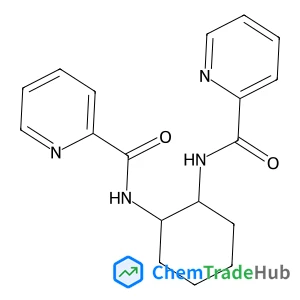
N,N'-(1R,2R)-1,2-Cyclohexanediyldi(2-pyridinecarboxamide)
CAS Number:
218290-24-5
Molecular Formula:
C18H20N4O2
Tatsuto Yui, Yuka Kobayashi, Yuri Yamada, Takako Tsuchino, Kazuhisa Yano, Tsukasa Torimoto, Haruo Inoue
Photochemical Electron Transfer (ET) between an organic dye, the porphyrin derivative TMPyP, and an electron acceptor, methyl viologen MV2+, have been investigated at the interface of two different inorganic films, i.e., layered titania nano-sheets (TNS) and a monolayer film of spherical and mono-dispersed mesoporous silica (sMPS) particles (ca. 0.5 μm). TMPyP ions were intercalated within the sMPS nano-cavities to form (TMPyP–sMPS) while MV2+ ions were intercalated into the TNS interlayers to form (MV2+–TNS). The (TMPyP–sMPS) and (MV2+–TNS) films were then stacked on a silica substrate in this order to form a (MV2+–TNS)/(TMPyP–sMPS) film and, upon UV light irradiation, ET could be induced. However, when this film was stacked inversely, i.e., for the (TMPyP–sMPS)/(MV2+–TNS) films on a silica substrate, no photoinduced ET were observed. Interestingly, however, even for this photo-inactive inversely stacked film, ET could be generated by inserting a gold vapor-deposited layer between the (MV2+–TNS) and (TMPyP–sMPS) films. The conjugation conditions at the interface of the inversely stacked (TMPyP–sMPS)/(MV2+–TNS) hybrid film were, thus, confirmed to strongly affect the photoinduced electron transfers and their efficiencies.
Andreas Hüther, Bernd Schäfer, Xiaoping Xu, Gerd Maurer
DOI: 10.1039/B108496H
Marc R. Roussel, Jichang Wang
DOI: 10.1039/B109310J
Anan Tongraar, Kritsana Sagarik, Bernd Michael Rode
DOI: 10.1039/B107786D
DOI: 10.1039/B108703G
DOI: 10.1039/B109277B
Pierre Borckmans, Guy Dewel
DOI: 10.1039/B109389B
Partha Hazra, Nilmoni Sarkar
DOI: 10.1039/B109447E
Gui-xia Liu, Yi-hong Ding, Ze-sheng Li, Qiang Fu, Xu-ri Huang, Chia-chung Sun, Au-chin Tang
DOI: 10.1039/B109758J
Vladimir S. Zykov, Stefan C. Müller
DOI: 10.1039/B110641B
John Tomkinson, Stewart F. Parker, Dale A. Braden, Bruce S. Hudson
DOI: 10.1039/B110091B
6-Bromo-2-methylimidazo[1,2-a]pyrimidine (CAS: 1111638-05-1) falls under various...
While there are no direct alternatives, similar compounds like 1-Pyrrolidineetha...
4-Methyl-2,6-bis(2-methyl-2-propanyl)phenyl methylcarbamate (CAS: 1918-11-2) is ...
2-(3-Bromo-4-fluorophenyl)-1,3-dioxolane (CAS: 77771-04-1) should be stored in a...
4,5,6,7-Tetrahydro-1H-indazole hydrochloride is a white crystalline solid with a...
(2R)-1-Methoxy-3-phenyl-2-propanamine is a chiral organic compound with the CAS ...
Ethyl 1-(1-phenylethyl)-1H-imidazole-5-carboxylate is used in various industries...
4-[(1E,3S)-1-(4-Hydroxyphenyl)-1,4-pentadien-3-yl]phenol (CAS: 17676-24-3) falls...
(S)-3-Amino-5-phenylpentanoic acid hydrochloride is primarily used in the pharma...
7-Methoxy-1-benzothiophene-2-carboxylic acid is typically synthesized by reactin...

Physical Chemistry Chemical Physics (PCCP) is an international journal co-owned by 19 physical chemistry and physics societies from around the world. This journal publishes original, cutting-edge research in physical chemistry, chemical physics and biophysical chemistry. To be suitable for publication in PCCP, articles must include significant innovation and/or insight into physical chemistry; this is the most important criterion that reviewers and Editors will judge against when evaluating submissions. The journal has a broad scope and welcomes contributions spanning experiment, theory, computation and data science. Topical coverage includes spectroscopy, dynamics, kinetics, statistical mechanics, thermodynamics, electrochemistry, catalysis, surface science, quantum mechanics, quantum computing and machine learning. Interdisciplinary research areas such as polymers and soft matter, materials, nanoscience, energy, surfaces/interfaces, and biophysical chemistry are welcomed if they demonstrate significant innovation and/or insight into physical chemistry. Joined experimental/theoretical studies are particularly appreciated when complementary and based on up-to-date approaches.