


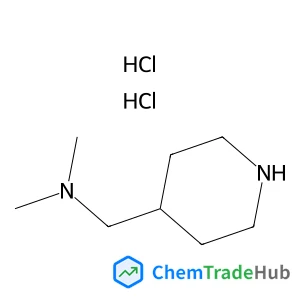
N,N-dimethyl(piperidin-4-yl)methanamine hydrochloride
CAS Number:
172281-72-0
Molecular Formula:
C8H20Cl2N2
Christian Tuma, Joachim Sauer
We propose use of a hybrid method to study problems that involve both bond rearrangements and van-der-Waals interactions. The method combines second-order Møller–Plesset perturbation theory (MP2) calculations for the reaction site with density functional theory (DFT) calculations for a large system under periodic boundary conditions. Hybrid MP2:DFT structure optimisation for a cluster embedded in the periodic model is the first of three steps in a multi-level approach. The second step is extrapolation of the MP2 energy to the complete basis set limit. The third step is extrapolating the high-level (MP2) correction to the limiting case of the full periodic structure. This is done by calculating the MP2 correction for a series of cluster models of increasing size, fitting an analytic expression to these energy corrections, and applying the fitted expression to the full periodic structure. We assume that, up to a constant, the high-level correction is described by a damped dispersion expression. Combining the results of all three steps yields an estimate of the MP2 reaction energy for the full periodic system at the complete basis set level. The method is designed for a reaction between a small or medium sized substrate molecule and a very large chemical system. For adsorption of isobutene in zeolite H-ferrierite, the energies obtained for the formation of different structures, the π-complex, the isobutoxide, the tert-butoxide, and the tert-butyl carbenium ion, are −78, −73, −48, and −21 kJ mol−1, respectively. This corresponds to corrections of the pure DFT (PBE functional) results by −62, −70, −67, and −29 kJ mol−1, respectively. Hence, the MP2 corrections are substantial and, perhaps more importantly, not the same for the different hydrocarbon species in the zeolite. Coupled-cluster (CCSD(T)) calculations change the MP2 energies by −4 kJ mol−1 (tert-butyl cation) or less (below ±1 kJ mol−1 for the other species).

Green Chemistry

Journal of Enzyme inhibition and Medicinal Chemistry

Current Pharmaceutical Biotechnology

Journal of Medical Biochemistry

Environmental Toxicology and Pharmacology

European Journal of Organic Chemistry

Molecules

Angewandte Chemie International Edition

Mini-Reviews in Medicinal Chemistry

Physical Chemistry Chemical Physics
Matthew B. Boucher, Simone Goergen, Nan Yi, Maria Flytzani-Stephanopoulos
DOI: 10.1039/C0CP02009E
Antonio Stocco, Jérôme Crassous, Anniina Salonen, Arnaud Saint-Jalmes, Dominique Langevin
DOI: 10.1039/C0CP01152E
Mitsuhiko Miyazaki, Akihiro Takeda, Shun-ichi Ishiuchi, Makoto Sakai, Otto Dopfer, Masaaki Fujii
DOI: 10.1039/C0CP01961E
William O. Oduro, Nick Cailuo, Kai Man K. Yu, Hongwei Yang, Shik Chi Tsang
DOI: 10.1039/C0CP01832E
R. M. Lynden-Bell, N. Giovambattista, P. G. Debenedetti, T. Head-Gordon, P. J. Rossky
DOI: 10.1039/C0CP01701A
Min Zhou, Shiyu Gan, Lijie Zhong, Xiandui Dong, Li Niu
DOI: 10.1039/C0CP01692F
Guo-Rue Hu, Chen-Sheng Chao, Hong-Wan Shiu, Cheng-Ting Wang, Won-Ru Lin, Yao-Jane Hsu, Meng-Fan Luo
DOI: 10.1039/C0CP00526F
Ali Ebrahimi, Mostafa Habibi-Khorassani, Sophia Bazzi
DOI: 10.1039/C0CP01279C
Günter Grampp
DOI: 10.1039/C0CP01517B
Franziska Fennel, Stefan Lochbrunner
DOI: 10.1039/C0CP01211D
Ethyl 4-chlorothieno[2,3-b]pyridine-5-carboxylate (CAS: 59713-58-5) can be synth...
5-Methyl-1H-indole-3-carbaldehyde (CAS: 52562-50-2) is subject to various regula...
(1,3-Dimethyl-2,4-dioxo-1,2,3,4-tetrahydro-5-pyrimidinyl)boronic acid is a white...
Waste containing Sulfocostunolide A (CAS: 1016983-51-9) should be handled with c...
When handling Murraxocin (CAS: 88478-44-8), ensure proper personal protective eq...
Formvar (CAS: 63148-64-1) is an alkyd resin characterized by a high molecular we...
(S)-4-benzyl-2-((benzyloxy)methyl)morpholine is generally safe when handled with...
Methyl 1-(5-bromo-2-pyrimidinyl)cyclopropanecarboxylate (CAS: 1447607-69-3) is p...
2-Methyl-1-phenyl-1-propanamine hydrochloride (CAS: 24290-47-9) is generally con...
3-(4-Bromophenyl)-2-methylpropanoic acid is synthesized through a multi-step pro...
Physical Chemistry Chemical Physics (PCCP) is an international journal co-owned by 19 physical chemistry and physics societies from around the world. This journal publishes original, cutting-edge research in physical chemistry, chemical physics and biophysical chemistry. To be suitable for publication in PCCP, articles must include significant innovation and/or insight into physical chemistry; this is the most important criterion that reviewers and Editors will judge against when evaluating submissions. The journal has a broad scope and welcomes contributions spanning experiment, theory, computation and data science. Topical coverage includes spectroscopy, dynamics, kinetics, statistical mechanics, thermodynamics, electrochemistry, catalysis, surface science, quantum mechanics, quantum computing and machine learning. Interdisciplinary research areas such as polymers and soft matter, materials, nanoscience, energy, surfaces/interfaces, and biophysical chemistry are welcomed if they demonstrate significant innovation and/or insight into physical chemistry. Joined experimental/theoretical studies are particularly appreciated when complementary and based on up-to-date approaches.
![Imidazo[1,5-a]pyrazine structure](https://static.chemtradehub.com/structs/274/274-49-7-d749.webp "Imidazo[1,5-a]pyrazine structure")





