












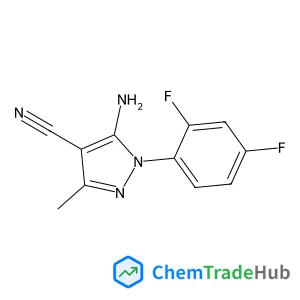
5-Amino-1-(2,4-difluorophenyl)-3-methyl-1H-pyrazole-4-carbonitrile
CAS Number:
1020057-92-4
Molecular Formula:
C11H8F2N4
Elisabet Ahlberg, Itai Panas, David J. Schiffrin
Two inner-sphere electrocatalytic channels for quinone-mediated reduction of molecular oxygen to form hydrogen peroxide have been addressed by means of density functional theory. Each of the channels comprises an initial rate determining chemical step and a subsequent electrochemical reduction step by which peroxide is produced. The reduction mechanism was determined for 9,10-anthraquinone and 9,10-phenanthrenequinone and the quantum chemical results are compared with experimental results. Two distinctly different structures were determined for the critical chemical step depending on whether the catalytic site is present as HQ˙ or Q˙−. While a superoxo species is formed on HQ˙, a van der Waals (vdW) type compound is formed on Q˙−. It is shown that the Gibbs energy of activation for the semiquinone/oxygen reaction is largely determined by the entropy term. The results explain the experimentally observed pH dependence of the O2 reduction rate on quinone functionalised electrodes.
Zhi Li, Cristian V. Ciobanu, Juncheng Hu, Juan-Pedro Palomares-Báez, José-Luis Rodríguez-López, Ryan Richards
DOI: 10.1039/C0CP01820A
R. M. Lynden-Bell, N. Giovambattista, P. G. Debenedetti, T. Head-Gordon, P. J. Rossky
DOI: 10.1039/C0CP01701A
Guo-Rue Hu, Chen-Sheng Chao, Hong-Wan Shiu, Cheng-Ting Wang, Won-Ru Lin, Yao-Jane Hsu, Meng-Fan Luo
DOI: 10.1039/C0CP00526F
Mitsuhiko Miyazaki, Akihiro Takeda, Shun-ichi Ishiuchi, Makoto Sakai, Otto Dopfer, Masaaki Fujii
DOI: 10.1039/C0CP01961E
Evgenia Dmitrieva, Lothar Dunsch
DOI: 10.1039/C0CP01264E
Francesca Bleken, Wegard Skistad, Katia Barbera, Marina Kustova, Silvia Bordiga, Pablo Beato, Karl Petter Lillerud, Stian Svelle, Unni Olsbye
DOI: 10.1039/C0CP01982H
Emilio Palomares, Amparo Forneli
DOI: 10.1039/C0CP01855D
Toshiyuki Yokoi, Junya Sakuma, Kazuhiko Maeda, Kazunari Domen, Takashi Tatsumi, Junko N. Kondo
DOI: 10.1039/C0CP02141E
Chun-Jiang Jia, Ferdi Schüth
DOI: 10.1039/C0CP02680H
Na Hao, Gongkui Xiao, Liying Liu, Paul Webley
DOI: 10.1039/C0CP01807D
Ethyl 4-chlorothieno[2,3-b]pyridine-5-carboxylate (CAS: 59713-58-5) can be synth...
5-Methyl-1H-indole-3-carbaldehyde (CAS: 52562-50-2) is subject to various regula...
(1,3-Dimethyl-2,4-dioxo-1,2,3,4-tetrahydro-5-pyrimidinyl)boronic acid is a white...
Waste containing Sulfocostunolide A (CAS: 1016983-51-9) should be handled with c...
When handling Murraxocin (CAS: 88478-44-8), ensure proper personal protective eq...
Formvar (CAS: 63148-64-1) is an alkyd resin characterized by a high molecular we...
(S)-4-benzyl-2-((benzyloxy)methyl)morpholine is generally safe when handled with...
Methyl 1-(5-bromo-2-pyrimidinyl)cyclopropanecarboxylate (CAS: 1447607-69-3) is p...
2-Methyl-1-phenyl-1-propanamine hydrochloride (CAS: 24290-47-9) is generally con...
3-(4-Bromophenyl)-2-methylpropanoic acid is synthesized through a multi-step pro...

Physical Chemistry Chemical Physics (PCCP) is an international journal co-owned by 19 physical chemistry and physics societies from around the world. This journal publishes original, cutting-edge research in physical chemistry, chemical physics and biophysical chemistry. To be suitable for publication in PCCP, articles must include significant innovation and/or insight into physical chemistry; this is the most important criterion that reviewers and Editors will judge against when evaluating submissions. The journal has a broad scope and welcomes contributions spanning experiment, theory, computation and data science. Topical coverage includes spectroscopy, dynamics, kinetics, statistical mechanics, thermodynamics, electrochemistry, catalysis, surface science, quantum mechanics, quantum computing and machine learning. Interdisciplinary research areas such as polymers and soft matter, materials, nanoscience, energy, surfaces/interfaces, and biophysical chemistry are welcomed if they demonstrate significant innovation and/or insight into physical chemistry. Joined experimental/theoretical studies are particularly appreciated when complementary and based on up-to-date approaches.

![9,9'-Spirobi[fluoren]-2-amine structure](https://static.chemtradehub.com/structs/118/118951-68-1-0d14.webp "9,9'-Spirobi[fluoren]-2-amine structure")




