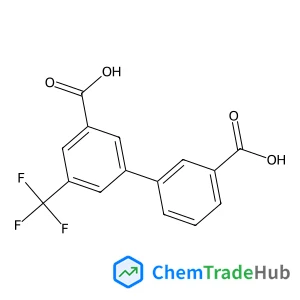
3-(3-Carboxyphenyl)-5-(trifluoromethyl)benzoic acid
CAS Number:
1261930-96-4
Molecular Formula:
C15H9F3O4
Jim Patel, Selma Mujcinovic, W. Roy Jackson, Andrea J. Robinson
Renewable natural oils can be converted into potentially high value terminal oxygenates by a single-pot, high yielding metathesis–isomerisation–methoxycarbonylation–transesterification reaction sequence.
Vytautas Balevičius, Jr., Arpa Galestian Pour, Janne Savolainen, Craig N. Lincoln, Vladimír Lukeš, Eberhard Riedle, Darius Abramavicius, Jürgen Hauer
DOI: 10.1039/C5CP00856E
DOI: 10.1039/C5CP02751A
Lei Huang, Zhaochi Feng, Xiuli Wang, Can Li
DOI: 10.1039/C6CP02808J
Min Zeng, Xiange Peng, Jianjun Liao, Guizhen Wang, Yanfang Li, Jianbao Li, Yong Qin, Joshua Wilson, Aimin Song
DOI: 10.1039/C6CP01299J
A. Piovano, A. Perrichon, M. Boehm, M. R. Johnson, W. Paulus
DOI: 10.1039/C5CP06464C
Cheng-Zhang Lu, Chia-Erh Liu, Vanessa K. Peterson, Shih-Chieh Liao, Jin-Ming Chen
DOI: 10.1039/C6CP00947F
Avinash Bhadani, Misako Tani, Takeshi Endo, Kenichi Sakai, Masahiko Abe, Hideki Sakai
DOI: 10.1039/C5CP02115D
I. Goikoetxea
DOI: 10.1039/C5CP02051D
4-Amino-3-bromophenol (CAS: 74440-80-5) falls under the classification of a haza...
(17beta)-3-Oxoestr-4-en-17-yl acetate should be stored in a cool, dry place away...
2-[(2,2-Diethoxyethyl)disulfanyl]-1,1-diethoxyethane (CAS: 76505-71-0) is a colo...
The market and research for 1-(β-D-ribofuranosyl)-1H-imidazo[4,5-c]pyridin-4-ami...
Waste containing Conjugated Estrogen (CAS: 12126-59-9) should be collected and d...
The market for Bis(2,2,2-trifluoroethyl) (methoxycarbonylmethyl)phosphonate (CAS...
There are several alternatives to 3,4'-Di-O-methylellagic acid (CAS: 57499-59-9)...
2-Chloro-N,N-dimethylpyridin-4-amine (CAS: 59047-70-0) is regulated under the Gl...
Cerium(3+);oxygen(2-);vanadium(5+) (CAS: 13597-19-8) is a complex inorganic comp...
7-Chloro-1-iodoisoquinoline (CAS: 1203579-27-4) is generally considered safe whe...

Green Chemistry provides a unique forum for the publication of innovative research on the development of alternative green and sustainable technologies. The scope of Green Chemistry is based on, but not limited to, the definition proposed by Anastas and Warner (Green Chemistry: Theory and Practice, P T Anastas and J C Warner, Oxford University Press, Oxford, 1998). Green chemistry is the utilisation of a set of principles that reduces or eliminates the use or generation of hazardous substances in the design, manufacture and application of chemical products. Green Chemistry is at the frontiers of this continuously-evolving interdisciplinary science and publishes research that attempts to reduce the environmental impact of the chemical enterprise by developing a technology base that is inherently non-toxic to living things and the environment. Submissions on all aspects of research relating to the endeavour are welcome. The journal publishes original and significant cutting-edge research that is likely to be of wide general appeal. To be published, work must present a significant advance in green chemistry. Papers must contain a comparison with existing methods and demonstrate advantages over those methods before publication can be considered. For more information please see this Editorial. Coverage includes the following, but is not limited to: Design (e.g. biomimicry, design for degradation/recycling/reduced toxicity…) Reagents & Feedstocks (e.g. renewables, CO2, solvents, auxiliary agents, waste utilization…) Synthesis (e.g. organic, inorganic, synthetic biology…) Catalysis (e.g. homogeneous, heterogeneous, enzyme, whole cell…) Process (e.g. process design, intensification, separations, recycling, efficiency…) Energy (e.g. renewable energy, fuels, photovoltaics, fuel cells, energy storage, energy carriers…) Applications (e.g. electronics, dyes, consumer products, coatings, pharmaceuticals, preservatives, building materials, chemicals for industry/agriculture/mining…) Impact (e.g. safety, metrics, LCA, sustainability, (eco)toxicology…) Green chemistry is, by definition, a continuously-evolving frontier. Therefore, the inclusion of a particular material or technology does not, of itself, guarantee that a paper is suitable for the journal. To be suitable, the novel advance should have the potential for reduced environmental impact relative to the state of the art. Green Chemistry does not normally deal with research associated with 'end-of-pipe' or remediation issues.
![Ethyl 5-[({[(2-methyl-2-propanyl)oxy]carbonyl}amino)methyl]-1,2-oxazole-3-carboxylate structure](https://static.chemtradehub.com/structs/253/253196-37-1-8450.webp "Ethyl 5-[({[(2-methyl-2-propanyl)oxy]carbonyl}amino)methyl]-1,2-oxazole-3-carboxylate structure")