


Local structure of xenon adsorbed in the nanospaces of zeolites as studied by high-pressure 129Xe NMR
Literature Information
Publication Date
2006-06-08
DOI
10.1039/B604633A
Impact Factor
3.676
Authors
Hironori Omi, Noriko Kato, Keisuke Miyakubo
View Original
Abstract
Pressure (0–10 MPa) and local density dependence of 129Xe NMR chemical shift of xenon in various microporous materials was investigated using an in situ high-pressure probe. The density dependence of the chemical shift was analyzed using virial expansion of the chemical shift by xenon density. Results indicate that the second virial coefficient depends on the pore size and shape, and that the void space affects xenon–xenon interaction in both microporous and mesoporous materials. Furthermore, to interpret the magnitude of the virial coefficient in terms of the local structure of the adsorbed xenon, we analyzed the local structure of adsorbed xenon in molecular sieve 5A using Xen clusters, thereby allowing description of the density dependence of the chemical shift. We also demonstrated the cluster model’s validity by applying it to molecular sieves 13X and ZSM-5. The latter showed that the adsorbed xenon exists as a xenon monomer up to the filling of about 0.6 in micropores. Larger xenon clusters up to n = 4 have been grown with increasing filling of xenon. According to analyses using the Xen cluster model, the second virial coefficient is related closely with the xenon cluster size, which contributes greatly to the chemical shift in the low loading region.
Recommended Journals

Advanced Engineering Materials

Mini-Reviews in Medicinal Chemistry

Molecular Diversity

Angewandte Chemie International Edition

Nature Reviews Drug Discovery

Journal of Medical Biochemistry

Environmental Toxicology and Pharmacology

European Journal of Organic Chemistry

Physical Chemistry Chemical Physics

Coloration Technology
Related Literature
Unimolecular decomposition of antimony and bismuth cluster ions studied by surface collision induced dissociation mass spectrometry
Thorsten M. Bernhardt, Bernhard Kaiser, Klaus Rademann
2002-02-26
Paper
DOI: 10.1039/B110194C
Inelastic neutron scattering spectra of the transverse acoustic modes of the normal alkanes
John Tomkinson, Stewart F. Parker, Dale A. Braden, Bruce S. Hudson
2002-01-30
Paper
DOI: 10.1039/B110091B
Thermodynamics of thermal methods for rapid screening of combinatorial libraries
Michael J. Blandamer, Paul M. Cullis, Peter T. Gleeson
2002-02-01
Paper
DOI: 10.1039/B107646A
Theoretical study on mechanisms of the high-temperature reactions C2H3 + H2O and C2H4 + OH
Gui-xia Liu, Yi-hong Ding, Ze-sheng Li, Qiang Fu, Xu-ri Huang, Chia-chung Sun, Au-chin Tang
2002-02-15
Paper
DOI: 10.1039/B109758J
Effects of surface tension and rotation on the Rayleigh–Taylor instability
A. H. A. Ayyad
2002-03-13
Paper
DOI: 10.1039/B106242P
Heat capacity behaviour of pore confined benzene and hexafluorobenzene in NaY zeolite
Guohua Zhao, Barara Groß, Herbert Dilger, Emil Roduner
2002-02-11
Paper
DOI: 10.1039/B110158G
From degeneration to damping of electrochemical oscillation induced by temperature controlling of heat-compensation type
Jinglei Lei, Jiuli Luo
2002-02-19
Paper
DOI: 10.1039/B108572G
Topological analysis of vapor–liquid equilibrium diagrams for distillation process design
Sergei Blagov, Hans Hasse
2002-02-15
Paper
DOI: 10.1039/B109541B
You might also like
Compound Q&A
What regulatory guidelines apply to 6-Bromo-2-methylimidazo[1,2-a]pyrimidine (CAS: 1111638-05-1)?
6-Bromo-2-methylimidazo[1,2-a]pyrimidine (CAS: 1111638-05-1) falls under various...
1111638-05-16-Bromo-2-methylimid...
Compound Q&A
Are there alternatives to 1-Pyrrolidineethanol, β-methyl-α-phenyl-, (αS,βR) (CAS: 123620-80-4) in synthesis?
While there are no direct alternatives, similar compounds like 1-Pyrrolidineetha...
123620-80-41-Pyrrolidineethanol...
Compound Q&A
Is 4-Methyl-2,6-bis(2-methyl-2-propanyl)phenyl methylcarbamate (CAS: 1918-11-2) safe?
4-Methyl-2,6-bis(2-methyl-2-propanyl)phenyl methylcarbamate (CAS: 1918-11-2) is ...
1918-11-24-Methyl-2,6-bis(2-m...
Compound Q&A
How should 2-(3-Bromo-4-fluorophenyl)-1,3-dioxolane (CAS: 77771-04-1) be stored?
2-(3-Bromo-4-fluorophenyl)-1,3-dioxolane (CAS: 77771-04-1) should be stored in a...
77771-04-12-(3-Bromo-4-fluorop...
Compound Q&A
What are the physical and chemical properties of 4,5,6,7-Tetrahydro-1H-indazole hydrochloride (CAS: 18161-11-0)?
4,5,6,7-Tetrahydro-1H-indazole hydrochloride is a white crystalline solid with a...
18161-11-04,5,6,7-Tetrahydro-1...
Compound Q&A
What is (2R)-1-Methoxy-3-phenyl-2-propanamine (CAS: 59919-07-2)?
(2R)-1-Methoxy-3-phenyl-2-propanamine is a chiral organic compound with the CAS ...
59919-07-2(2R)-1-Methoxy-3-phe...
Compound Q&A
What industries use Ethyl 1-(1-phenylethyl)-1H-imidazole-5-carboxylate (CAS: 56649-47-9)?
Ethyl 1-(1-phenylethyl)-1H-imidazole-5-carboxylate is used in various industries...
56649-47-9Ethyl 1-(1-phenyleth...
Compound Q&A
What regulatory guidelines apply to 4-[(1E,3S)-1-(4-Hydroxyphenyl)-1,4-pentadien-3-yl]phenol (CAS: 17676-24-3)?
4-[(1E,3S)-1-(4-Hydroxyphenyl)-1,4-pentadien-3-yl]phenol (CAS: 17676-24-3) falls...
17676-24-34-[(1E,3S)-1-(4-Hydr...
Compound Q&A
What industries use (S)-3-Amino-5-phenylpentanoic acid hydrochloride (CAS: 331846-97-0)?
(S)-3-Amino-5-phenylpentanoic acid hydrochloride is primarily used in the pharma...
331846-97-0(S)-3-Amino-5-phenyl...
Compound Q&A
How is 7-methoxy-1-benzothiophene-2-carboxylic acid (CAS: 88791-07-5) typically synthesized?
7-Methoxy-1-benzothiophene-2-carboxylic acid is typically synthesized by reactin...
88791-07-57-methoxy-1-benzothi...
Source Journal
Physical Chemistry Chemical Physics
CiteScore:
5.5
Self-citation Rate:
10.3%
Articles per Year:
3036
Physical Chemistry Chemical Physics (PCCP) is an international journal co-owned by 19 physical chemistry and physics societies from around the world. This journal publishes original, cutting-edge research in physical chemistry, chemical physics and biophysical chemistry. To be suitable for publication in PCCP, articles must include significant innovation and/or insight into physical chemistry; this is the most important criterion that reviewers and Editors will judge against when evaluating submissions. The journal has a broad scope and welcomes contributions spanning experiment, theory, computation and data science. Topical coverage includes spectroscopy, dynamics, kinetics, statistical mechanics, thermodynamics, electrochemistry, catalysis, surface science, quantum mechanics, quantum computing and machine learning. Interdisciplinary research areas such as polymers and soft matter, materials, nanoscience, energy, surfaces/interfaces, and biophysical chemistry are welcomed if they demonstrate significant innovation and/or insight into physical chemistry. Joined experimental/theoretical studies are particularly appreciated when complementary and based on up-to-date approaches.
Recommended Compounds



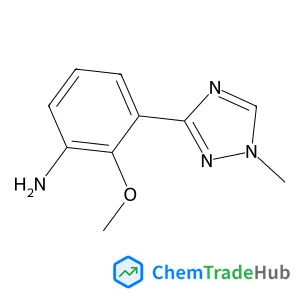
2-Methoxy-3-(1-methyl-1H-1,2,4-triazol-3-yl)aniline
CAS Number:
1609394-10-6
Molecular Formula:
C10H12N4O
Recommended Suppliers







Disclaimer
This page provides academic journal information for reference and research purposes only. We are not affiliated with any journal publishers and do not handle publication submissions. For publication-related inquiries, please contact the respective journal publishers directly.
If you notice any inaccuracies in the information displayed, please contact us at support@chemtradehub.com. We will promptly review and address your concerns.