












Selective aerobic oxidation in supercritical carbon dioxide catalyzed by the H5PV2Mo10O40 polyoxometalate
Literature Information
Publication Date
2006-04-25
DOI
10.1039/B603148J
Impact Factor
6.222
Authors
Galia Maayan, Benjamin Ganchegui, Ronny Neumann
View Original
Abstract
Selective aerobic oxidation of benzylic alcohols and of activated aromatic hydrocarbons occurs in supercritical CO2 as reaction medium using H5PV2Mo10O40 as a quasi-heterogeneous catalyst without further additives or co-solvents; efficient recycling is possible and no metal leaching is detectable in the product stream.
Related Literature
Identifying and mapping chemical bonding within phenolic resin using secondary electron hyperspectral imaging
Sameer F. Hamad, Euan Gray, Christopher M. Magazzeni, Fodio Longman, David E. J. Armstrong, Joel P. Foreman, Frederik Claeyssens, Cornelia Rodenburg
2020-12-15
Communication
DOI: 10.1039/D0PY01220C
Facile topological transformation of ABA triblock copolymers into multisite, single-chain-folding and branched multiblock copolymers via sequential click coupling and anthracene chemistry
Yanzhe He, Zhigang Wang, Peng Liu, Xiangdong Zhou, Youliang Zhao
2021-01-13
Paper
DOI: 10.1039/D0PY01649G
Visible-light reversible photopolymerisation: insights via online photoflow – electrospray ionisation – mass spectrometry
Matthias Van De Walle, Charlotte Petit, James P. Blinco, Christopher Barner-Kowollik
2020-09-30
Communication
DOI: 10.1039/D0PY01119C
Syntheses, characterization, multi-acid fluorescence sensing and electroluminescence properties of Cr(ii)-based metallopolymers
Anil Kumar, Shubham Bawa, Kapil Ganorkar, Sujit Kumar Ghosh, Anasuya Bandyopadhyay
2020-09-09
Paper
DOI: 10.1039/D0PY00953A
A covalent organic framework as a photocatalyst for atom transfer radical polymerization under white light irradiation
Xiaoling Fu, Hongjie Yang
2020-12-17
Communication
DOI: 10.1039/D0PY01545H
Ratiometric co-delivery of doxorubicin and docetaxel by covalently conjugating with mPEG-poly(β-malic acid) for enhanced synergistic breast tumor therapy
Zhe Yu, Hua Li, Yiyang Jia, Youbei Qiao, Chaoli Wang, Qing Zhou, Xin He, Shibin Yu, Tiehong Yang, Hong Wu
2020-09-28
Paper
DOI: 10.1039/D0PY01130D
Norbornadiene homopolymerization and norbornene/norbornadiene/1-octene terpolymerization by ansa-fluorenylamidotitanium-based catalysts
Haobo Yuan, Ryo Tanaka, Yuushou Nakayama, Takeshi Shiono
2020-10-06
Paper
DOI: 10.1039/D0PY01180K
A cardanol-based polybenzoxazine vitrimer: recycling, reshaping and reversible adhesion
Laura Puchot, Pierre Verge
2020-10-14
Paper
DOI: 10.1039/D0PY01239D
You might also like
Compound Q&A
What are the main uses of 1H-Indazole-6-carbonitrile (CAS: 141290-59-7)?
1H-Indazole-6-carbonitrile finds applications in pharmaceuticals, where it serve...
141290-59-71H-Indazole-6-carbon...
Compound Q&A
How should waste containing Dioctyl (2E)-2-butenedioate (CAS: 2997-85-5) be handled?
Waste containing Dioctyl (2E)-2-butenedioate (CAS: 2997-85-5) should be collecte...
2997-85-5Dioctyl (2E)-2-buten...
Compound Q&A
What industries use Sodium [(1,2-benzoxazol-3-ylmethyl)sulfonyl]azanide (CAS: 68291-98-5)?
Sodium [(1,2-benzoxazol-3-ylmethyl)sulfonyl]azanide is primarily used in pharmac...
68291-98-5Sodium [(1,2-benzoxa...
Compound Q&A
Are there alternatives to Dimethyl 4-(4,4,5,5-tetramethyl-1,3,2-dioxaborolan-2-yl)-2,6-pyridinedicarboxylate (CAS: 741709-66-0) in synthesis?
Dimethyl 4-(4,4,5,5-tetramethyl-1,3,2-dioxaborolan-2-yl)-2,6-pyridinedicarboxyla...
741709-66-0Dimethyl 4-(4,4,5,5-...
Compound Q&A
How should waste containing 2-Fluoro-6-hydrazinopyridine (CAS: 80714-39-2) be handled?
Waste containing 2-Fluoro-6-hydrazinopyridine (CAS: 80714-39-2) should be manage...
80714-39-22-Fluoro-6-hydrazino...
Compound Q&A
What is 6-Formyl-2-pyridinecarboxylic acid (CAS: 499214-11-8)?
6-Formyl-2-pyridinecarboxylic acid is an organic compound with the molecular for...
499214-11-86-Formyl-2-pyridinec...
Compound Q&A
What is the market or research trend for 3-(3,4-dimethoxyphenyl)-2,5-dimethyl-N-(2-morpholin-4-ylethyl)pyrazolo[1,5-a]pyrimidin-7-amine (CAS: 900874-91-1)?
Research trends for this compound indicate a focus on its potential applications...
900874-91-13-(3,4-dimethoxyphen...
Compound Q&A
How is 9H-Tribenzo[b,d,f]azepine (CAS: 29875-73-8) typically synthesized?
9H-Tribenzo[b,d,f]azepine is typically synthesized via a multi-step process invo...
29875-73-89H-Tribenzo[b,d,f]az...
Compound Q&A
How is 1-Cyclopropyl-7-ethoxy-6-fluoro-8-methoxy-4-oxo-1,4-dihydro-3-quinolinecarboxylic acid (CAS: 1797982-51-4) typically synthesized?
1-Cyclopropyl-7-ethoxy-6-fluoro-8-methoxy-4-oxo-1,4-dihydro-3-quinolinecarboxyli...
1797982-51-41-Cyclopropyl-7-etho...
Compound Q&A
How should waste containing Methyl 3-oxo-1,2,3,4-tetrahydro-6-quinoxalinecarboxylate (CAS: 671820-52-3) be handled?
Waste containing Methyl 3-oxo-1,2,3,4-tetrahydro-6-quinoxalinecarboxylate (CAS: ...
671820-52-3Methyl 3-oxo-1,2,3,4...
Source Journal
Chemical Communications

CiteScore:
8.6
Self-citation Rate:
4.7%
Articles per Year:
2458
ChemComm publishes urgent research which is of outstanding significance and interest to experts in the field, while also appealing to the journal’s broad chemistry readership. Our communication format is ideally suited to short, urgent studies that are of such importance that they require accelerated publication. Our scope covers all topics in chemistry, and research at the interface of chemistry and other disciplines (such as materials science, nanoscience, physics, engineering and biology) where there is a significant novelty in the chemistry aspects. Major topic areas covered include: Analytical Chemistry Catalysis Chemical Biology and medicinal chemistry Computational Chemistry and Machine Learning Energy and sustainable chemistry Environmental Chemistry Green Chemistry Inorganic Chemistry Materials Chemistry Nanoscience Organic Chemistry Physical Chemistry Polymer Chemistry Supramolecular Chemistry
Recommended Compounds
![Sodium 3-[(E)-(4-anilinophenyl)diazenyl]benzenesulfonate structure](https://static.chemtradehub.com/structs/587/587-98-4-035f.webp "Sodium 3-[(E)-(4-anilinophenyl)diazenyl]benzenesulfonate structure")
Sodium 3-[(E)-(4-anilinophenyl)diazenyl]benzenesulfonate
CAS Number:
587-98-4
Molecular Formula:
C18H14N3NaO3S
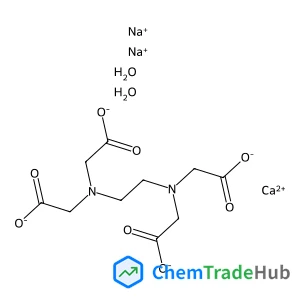
EthylenediaminetetraaceticacidcalciumDisodiumsalthydrate
CAS Number:
23411-34-9
Molecular Formula:
C10H16CaN2Na2O10
Recommended Suppliers





Disclaimer
This page provides academic journal information for reference and research purposes only. We are not affiliated with any journal publishers and do not handle publication submissions. For publication-related inquiries, please contact the respective journal publishers directly.
If you notice any inaccuracies in the information displayed, please contact us at support@chemtradehub.com. We will promptly review and address your concerns.