


Syntheses, characterization, multi-acid fluorescence sensing and electroluminescence properties of Cr(ii)-based metallopolymers
Literature Information
Publication Date
2020-09-09
DOI
10.1039/D0PY00953A
Impact Factor
5.582
Authors
Anil Kumar, Shubham Bawa, Kapil Ganorkar, Sujit Kumar Ghosh, Anasuya Bandyopadhyay
View Original
Abstract
Two novel Cr(II) based metallosupramolecular polymers have been synthesized with two ditopic rigid and flexible ligands in identical reaction conditions. Confirmation of the structure of both the polymers and the different properties of them were thoroughly studied using NMR, attenuated total reflectance infra-red spectra (ATR-IR), and other spectroscopic and morphological techniques, along with thermal, and electrochemical analysis to understand the structure–property relationship. The field emission scanning electron microscopy (FESEM) and atomic force microscopy (AFM) micrographs of the rigid and flexible polymers revealed an entirely different morphology for these two because of the inherent difference in the backbone rigidity. Both the metallopolymers worked as multi-acid sensors as their fluorescent properties varied in the presence of different acids. Reversible electroluminescent ON–OFF switching has been found in these polymers upon application of the appropriate potentials.
Recommended Journals

Journal of Chemical Sciences

Main Group Chemistry

Chinese Journal of Chemistry

Herald of the Russian Academy of Sciences

Bioorganic & Medicinal Chemistry Letters

Biocatalysis and Biotransformation

Atomization and Sprays

NDT & E International

Critical Reviews in Solid State and Materials Sciences

Journal of the Indian Institute of Science
Related Literature
Encapsulation of multi-walled carbon nanotubes (MWCNTs) in Ba2+-alginate to form coated micro-beads and their application to the pre-concentration/elimination of dibenzo-p-dioxin, dibenzofuran, and biphenyl from contaminated water
Bunshi Fugetsu, Shuya Satoh, Alexander Iles, Kazuhiko Tanaka, Norio Nishi, Fumio Watari
2004-06-11
Communication
DOI: 10.1039/B405325G
Calcium selective test strip for water and milk
L. F. Capitán-Vallvey, M. D. Fernández-Ramos, P. Álvarez de Cienfuegos Gálvez, F. Santoyo-González
2004-06-25
Paper
DOI: 10.1039/B403231D
Recent advances in the anti-counterfeiting applications of long persistent phosphors
Qingqing Kuang, Xiaochun Hou, Chengxue Du, Xiaojun Wang, Dangli Gao
2023-06-12
Perspective
DOI: 10.1039/D3CP01818K
A new class of cationic surfactants inspired by N-alkyl-N-methyl pyrrolidinium ionic liquids
Gary A. Baker, Siddharth Pandey, Shubha Pandey, Sheila N. Baker
2004-08-25
Communication
DOI: 10.1039/B410301G
Oxidative stress effects on erythrocytes determined by FT-IRspectrometry
2004-08-19
Paper
DOI: 10.1039/B408931F
An easily integrative and efficient micromixer and its application to the spectroscopic detection of glucose-catalyst reactions
T. H. Park, J. B. Choo
2005-01-24
Paper
DOI: 10.1039/B414180F
Ion-interaction chromatography of zwitterions. The fractional charge approach to model the influence of the mobile phase concentration of the ion-interaction reagent
Teresa Cecchi, Filippo Pucciarelli, Paolo Passamonti
2004-08-16
Paper
DOI: 10.1039/B404721D
Transition from Schottky to ohmic contacts in the C31 and MoS2 van der Waals heterostructure
Fei Lu, Shengli Zhang
2023-07-18
Paper
DOI: 10.1039/D3CP02357E
Immobilization of individual cells by local photo-polymerization on a chip
Hisataka Maruyama, Fumihito Arai, Toshio Fukuda, Tohoru Katsuragi
2005-01-31
Paper
DOI: 10.1039/B415400M
Forensic isotope ratio mass spectrometry of packaging tapes
James F. Carter, Polly L. Grundy, Jenny C. Hill, Neil C. Ronan, Emma L. Titterton, Richard Sleeman
2004-10-11
Paper
DOI: 10.1039/B409341K
You might also like
Compound Q&A
What are the main uses of 1H-Indazole-6-carbonitrile (CAS: 141290-59-7)?
1H-Indazole-6-carbonitrile finds applications in pharmaceuticals, where it serve...
141290-59-71H-Indazole-6-carbon...
Compound Q&A
How should waste containing Dioctyl (2E)-2-butenedioate (CAS: 2997-85-5) be handled?
Waste containing Dioctyl (2E)-2-butenedioate (CAS: 2997-85-5) should be collecte...
2997-85-5Dioctyl (2E)-2-buten...
Compound Q&A
What industries use Sodium [(1,2-benzoxazol-3-ylmethyl)sulfonyl]azanide (CAS: 68291-98-5)?
Sodium [(1,2-benzoxazol-3-ylmethyl)sulfonyl]azanide is primarily used in pharmac...
68291-98-5Sodium [(1,2-benzoxa...
Compound Q&A
Are there alternatives to Dimethyl 4-(4,4,5,5-tetramethyl-1,3,2-dioxaborolan-2-yl)-2,6-pyridinedicarboxylate (CAS: 741709-66-0) in synthesis?
Dimethyl 4-(4,4,5,5-tetramethyl-1,3,2-dioxaborolan-2-yl)-2,6-pyridinedicarboxyla...
741709-66-0Dimethyl 4-(4,4,5,5-...
Compound Q&A
How should waste containing 2-Fluoro-6-hydrazinopyridine (CAS: 80714-39-2) be handled?
Waste containing 2-Fluoro-6-hydrazinopyridine (CAS: 80714-39-2) should be manage...
80714-39-22-Fluoro-6-hydrazino...
Compound Q&A
What is 6-Formyl-2-pyridinecarboxylic acid (CAS: 499214-11-8)?
6-Formyl-2-pyridinecarboxylic acid is an organic compound with the molecular for...
499214-11-86-Formyl-2-pyridinec...
Compound Q&A
What is the market or research trend for 3-(3,4-dimethoxyphenyl)-2,5-dimethyl-N-(2-morpholin-4-ylethyl)pyrazolo[1,5-a]pyrimidin-7-amine (CAS: 900874-91-1)?
Research trends for this compound indicate a focus on its potential applications...
900874-91-13-(3,4-dimethoxyphen...
Compound Q&A
How is 9H-Tribenzo[b,d,f]azepine (CAS: 29875-73-8) typically synthesized?
9H-Tribenzo[b,d,f]azepine is typically synthesized via a multi-step process invo...
29875-73-89H-Tribenzo[b,d,f]az...
Compound Q&A
How is 1-Cyclopropyl-7-ethoxy-6-fluoro-8-methoxy-4-oxo-1,4-dihydro-3-quinolinecarboxylic acid (CAS: 1797982-51-4) typically synthesized?
1-Cyclopropyl-7-ethoxy-6-fluoro-8-methoxy-4-oxo-1,4-dihydro-3-quinolinecarboxyli...
1797982-51-41-Cyclopropyl-7-etho...
Compound Q&A
How should waste containing Methyl 3-oxo-1,2,3,4-tetrahydro-6-quinoxalinecarboxylate (CAS: 671820-52-3) be handled?
Waste containing Methyl 3-oxo-1,2,3,4-tetrahydro-6-quinoxalinecarboxylate (CAS: ...
671820-52-3Methyl 3-oxo-1,2,3,4...
Source Journal
Polymer Chemistry

CiteScore:
8.6
Self-citation Rate:
7.3%
Articles per Year:
457
Polymer Chemistry welcomes submissions in all areas of polymer science that have a strong focus on macromolecular chemistry. Manuscripts may cover a broad range of fields, yet no direct application focus is required.
Recommended Compounds



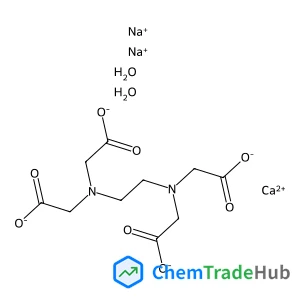
EthylenediaminetetraaceticacidcalciumDisodiumsalthydrate
CAS Number:
23411-34-9
Molecular Formula:
C10H16CaN2Na2O10
Recommended Suppliers



Disclaimer
This page provides academic journal information for reference and research purposes only. We are not affiliated with any journal publishers and do not handle publication submissions. For publication-related inquiries, please contact the respective journal publishers directly.
If you notice any inaccuracies in the information displayed, please contact us at support@chemtradehub.com. We will promptly review and address your concerns.