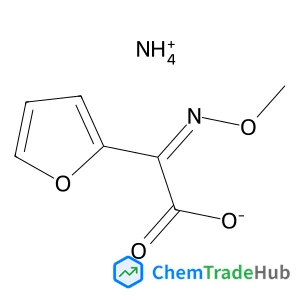
Ammonium (Z)-2-(furan-2-yl)-2-(methoxyimino)acetate
CAS Number:
97148-39-5
Molecular Formula:
C7H10N2O4
Adam D. Gill, Briana L. Hickey, Siwen Wang
Arrayed cavitand:fluorophore sensor complexes can selectively sense small citrulline modifications at arginine residues on post-translationally modified peptides. The sensor can differentiate between different numbers of citrulline modifications, and a simple two-fluorophore, 6-component array can effect cross-reactive discrimination between single modifications in aqueous solution.
Chuan Du, Dong Feng, Chaolang Chen, Jiadao Wang
DOI: 10.1039/C9CP01856E
Krishna K. Ghose, Alicia Bayon, Alister J. Page
DOI: 10.1039/C9CP02505G
Alessandra Ronchi, Paolo Brazzo, Mauro Sassi, Luca Beverina, Jacopo Pedrini, Francesco Meinardi, Angelo Monguzzi
DOI: 10.1039/C9CP01692A
A. Kortyna, A. J. Samin, T. A. Miller
DOI: 10.1039/C9CP90148E
Gersh O. Berim, Eli Ruckenstein
DOI: 10.1039/C9CP01791G
Qingqing Wang, Xianggang Kong, Huilei Han, Ge Sang, Guanghui Zhang, Tao Gao
DOI: 10.1039/C9CP02491C
Haibo Xiao, Xiaonan Wang, Ruilong Wang, Lingfang Xu, Shiheng Liang, Changping Yang
DOI: 10.1039/C9CP00850K
J. Halter, T. Gloor, B. Amoroso, F. N. Büchi
DOI: 10.1039/C9CP02149C
Evgeny Posenitskiy, Mathias Rapacioli, Bruno Lepetit, Didier Lemoine, Fernand Spiegelman
DOI: 10.1039/C9CP00603F
Seokjin Moon, Yuh Hijikata
DOI: 10.1039/C8CP06159A
1H-Indazole-6-carbonitrile finds applications in pharmaceuticals, where it serve...
Waste containing Dioctyl (2E)-2-butenedioate (CAS: 2997-85-5) should be collecte...
Sodium [(1,2-benzoxazol-3-ylmethyl)sulfonyl]azanide is primarily used in pharmac...
Dimethyl 4-(4,4,5,5-tetramethyl-1,3,2-dioxaborolan-2-yl)-2,6-pyridinedicarboxyla...
Waste containing 2-Fluoro-6-hydrazinopyridine (CAS: 80714-39-2) should be manage...
6-Formyl-2-pyridinecarboxylic acid is an organic compound with the molecular for...
Research trends for this compound indicate a focus on its potential applications...
9H-Tribenzo[b,d,f]azepine is typically synthesized via a multi-step process invo...
1-Cyclopropyl-7-ethoxy-6-fluoro-8-methoxy-4-oxo-1,4-dihydro-3-quinolinecarboxyli...
Waste containing Methyl 3-oxo-1,2,3,4-tetrahydro-6-quinoxalinecarboxylate (CAS: ...

ChemComm publishes urgent research which is of outstanding significance and interest to experts in the field, while also appealing to the journal’s broad chemistry readership. Our communication format is ideally suited to short, urgent studies that are of such importance that they require accelerated publication. Our scope covers all topics in chemistry, and research at the interface of chemistry and other disciplines (such as materials science, nanoscience, physics, engineering and biology) where there is a significant novelty in the chemistry aspects. Major topic areas covered include: Analytical Chemistry Catalysis Chemical Biology and medicinal chemistry Computational Chemistry and Machine Learning Energy and sustainable chemistry Environmental Chemistry Green Chemistry Inorganic Chemistry Materials Chemistry Nanoscience Organic Chemistry Physical Chemistry Polymer Chemistry Supramolecular Chemistry