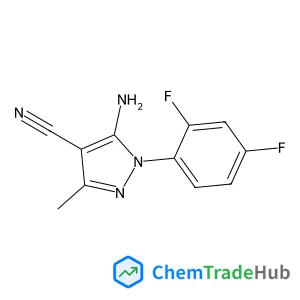
5-Amino-1-(2,4-difluorophenyl)-3-methyl-1H-pyrazole-4-carbonitrile
CAS Number:
1020057-92-4
Molecular Formula:
C11H8F2N4
The determination of the details of the spatial and electronic structure of functional sites (centers) in any system, be it in materials chemistry or in biology, is the first step towards understanding their function. When such sites happen to be paramagnetic in any point of their activity cycle, the tool box offered by a variety of high resolution electron paramagnetic resonance (EPR) spectroscopic techniques becomes very attractive for their characterization. This tool box has been considerably expanded by the developments in high field (HF) EPR in general, and HF electron nuclear double resonance (ENDOR), in particular. These have led to numerous new applications in the fields of biology, physics, chemistry and materials sciences. This overview focuses specifically on recent applications of pulsed HF ENDOR spectroscopy to microporous materials, such as zeotype materials, presenting the new opportunities it offers. First, a brief description of the theoretical basis required for the analysis of the HF ENDOR spectrum is given, followed by a description of the pulsed techniques used to record spectra and assign the signals, along with a brief presentation of the required instrumentation. Next, specific applications are given, including transition metal ions and complexes exchanged into zeolite cages, transition metal substitution into frameworks of zeolites, aluminophosphate molecular sieves, and silicious mesoporous materials, the interaction of NO with Lewis sites in zeolite cages and trapped S−3. We end with a discussion of the advantages and the shortcomings of the method and conclude with a future outlook.

Journal of Saudi Chemical Society

Saudi Pharmaceutical Journal

Current Opinion in Colloid & Interface Science

Russian Journal of Organic Chemistry

Russian Journal of Coordination Chemistry

Drug Discovery Today

Chemistry Education Research and Practice

Journal of Natural Medicines

Russian Journal of Applied Chemistry

Organic Process Research & Development
Junjie Song, Ying Yang, Lianghui Gao
DOI: 10.1039/D0CP05503D
Kyoungmin Min, Young-Han Shin
DOI: 10.1039/D0CP04974C
Bernadeta Jasiok, Mirosław Chorążewski, Eugene B. Postnikov, Claude Millot
DOI: 10.1039/D0CP06458K
Gyubaek Shin
DOI: 10.1039/D0CP02422H
Anastasia Filtschew, Pablo Beato, Søren B. Rasmussen, Christian Hess
DOI: 10.1039/D0CP05800A
Hamish Cavaye
DOI: 10.1039/D0CP06253G
Peng Wang
DOI: 10.1039/D0CP06081J
Maryam Ghiassee, Brandon C. Stevenson, P. B. Armentrout
DOI: 10.1039/D0CP06252A
Wolfgang Stahl
DOI: 10.1039/D0CP06057G
Ethyl 4-chlorothieno[2,3-b]pyridine-5-carboxylate (CAS: 59713-58-5) can be synth...
5-Methyl-1H-indole-3-carbaldehyde (CAS: 52562-50-2) is subject to various regula...
(1,3-Dimethyl-2,4-dioxo-1,2,3,4-tetrahydro-5-pyrimidinyl)boronic acid is a white...
Waste containing Sulfocostunolide A (CAS: 1016983-51-9) should be handled with c...
When handling Murraxocin (CAS: 88478-44-8), ensure proper personal protective eq...
Formvar (CAS: 63148-64-1) is an alkyd resin characterized by a high molecular we...
(S)-4-benzyl-2-((benzyloxy)methyl)morpholine is generally safe when handled with...
Methyl 1-(5-bromo-2-pyrimidinyl)cyclopropanecarboxylate (CAS: 1447607-69-3) is p...
2-Methyl-1-phenyl-1-propanamine hydrochloride (CAS: 24290-47-9) is generally con...
3-(4-Bromophenyl)-2-methylpropanoic acid is synthesized through a multi-step pro...

Physical Chemistry Chemical Physics (PCCP) is an international journal co-owned by 19 physical chemistry and physics societies from around the world. This journal publishes original, cutting-edge research in physical chemistry, chemical physics and biophysical chemistry. To be suitable for publication in PCCP, articles must include significant innovation and/or insight into physical chemistry; this is the most important criterion that reviewers and Editors will judge against when evaluating submissions. The journal has a broad scope and welcomes contributions spanning experiment, theory, computation and data science. Topical coverage includes spectroscopy, dynamics, kinetics, statistical mechanics, thermodynamics, electrochemistry, catalysis, surface science, quantum mechanics, quantum computing and machine learning. Interdisciplinary research areas such as polymers and soft matter, materials, nanoscience, energy, surfaces/interfaces, and biophysical chemistry are welcomed if they demonstrate significant innovation and/or insight into physical chemistry. Joined experimental/theoretical studies are particularly appreciated when complementary and based on up-to-date approaches.