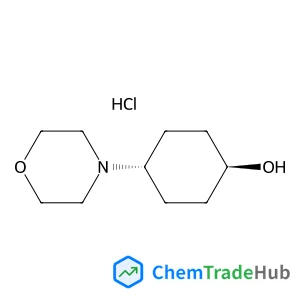
trans-4-(4-Morpholinyl)cyclohexanol hydrochloride (1:1)
CAS Number:
1588441-09-1
Molecular Formula:
C10H20ClNO2
A graphical abstract is available for this content
Tomoki Ogoshi, Tada-aki Yamagishi, Yoshiaki Nakamoto
DOI: 10.1039/B711800G
Alex M. Chen, Martha E. Ellison, Andrey Peresypkin, Robert M. Wenslow, Narayan Variankaval, Cecile G. Savarin, Theresa K. Natishan, David J. Mathre, Peter G. Dormer, Danielle H. Euler, Richard G. Ball, Zhixiong Ye, Yaling Wang, Ivan Santos
DOI: 10.1039/B612353H
Kosuke Namiki, Aiko Sakamoto, Masaki Murata, Shoko Kume, Hiroshi Nishihara
DOI: 10.1039/B713107K
Dapeng Zou, Samir Andersson, Rong Zhang, Shiguo Sun, Björn Åkermark, Licheng Sun
DOI: 10.1039/B712980G
Thomas Stey, Julian Henn, Dietmar Stalke
DOI: 10.1039/B612247G
Il'ya A. Gural'skiy, Pavlo V. Solntsev, Harald Krautscheid, Konstantin V. Domasevitch
DOI: 10.1039/B612660J
Cheuk-Fai Chow, Jean-Marie Lehn
DOI: 10.1039/B713413D
Juan Ramírez, Adrian-Mihail Stadler, Nathalie Kyritsakas, Jean-Marie Lehn
DOI: 10.1039/B612222A
Alexandra L. Pickering, Christoph Mitterbauer, Nigel D. Browning, Susan M. Kauzlarich, Philip P. Power
DOI: 10.1039/B614363F
Ethyl 4-chlorothieno[2,3-b]pyridine-5-carboxylate (CAS: 59713-58-5) can be synth...
5-Methyl-1H-indole-3-carbaldehyde (CAS: 52562-50-2) is subject to various regula...
(1,3-Dimethyl-2,4-dioxo-1,2,3,4-tetrahydro-5-pyrimidinyl)boronic acid is a white...
Waste containing Sulfocostunolide A (CAS: 1016983-51-9) should be handled with c...
When handling Murraxocin (CAS: 88478-44-8), ensure proper personal protective eq...
Formvar (CAS: 63148-64-1) is an alkyd resin characterized by a high molecular we...
(S)-4-benzyl-2-((benzyloxy)methyl)morpholine is generally safe when handled with...
Methyl 1-(5-bromo-2-pyrimidinyl)cyclopropanecarboxylate (CAS: 1447607-69-3) is p...
2-Methyl-1-phenyl-1-propanamine hydrochloride (CAS: 24290-47-9) is generally con...
3-(4-Bromophenyl)-2-methylpropanoic acid is synthesized through a multi-step pro...

Physical Chemistry Chemical Physics (PCCP) is an international journal co-owned by 19 physical chemistry and physics societies from around the world. This journal publishes original, cutting-edge research in physical chemistry, chemical physics and biophysical chemistry. To be suitable for publication in PCCP, articles must include significant innovation and/or insight into physical chemistry; this is the most important criterion that reviewers and Editors will judge against when evaluating submissions. The journal has a broad scope and welcomes contributions spanning experiment, theory, computation and data science. Topical coverage includes spectroscopy, dynamics, kinetics, statistical mechanics, thermodynamics, electrochemistry, catalysis, surface science, quantum mechanics, quantum computing and machine learning. Interdisciplinary research areas such as polymers and soft matter, materials, nanoscience, energy, surfaces/interfaces, and biophysical chemistry are welcomed if they demonstrate significant innovation and/or insight into physical chemistry. Joined experimental/theoretical studies are particularly appreciated when complementary and based on up-to-date approaches.
![Imidazo[1,5-a]pyrazine structure](https://static.chemtradehub.com/structs/274/274-49-7-d749.webp "Imidazo[1,5-a]pyrazine structure")