


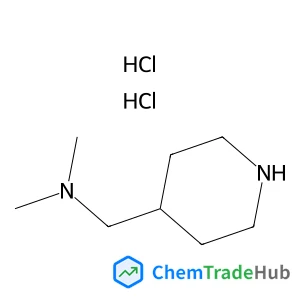
N,N-dimethyl(piperidin-4-yl)methanamine hydrochloride
CAS Number:
172281-72-0
Molecular Formula:
C8H20Cl2N2
Laura Rudd, Dominic J. Lee, Alexei A. Kornyshev
The unusual columnar aqueous mesophases of self-assembled guanosine stacks, such as 2′-deoxyguanosine 5′-monophosphate and 2′-deoxyguanosine 3′-monophosphate, are analyzed in terms of a general theory of azimuthal correlations between the charged helices. This theory considers forces, specific to the helical structure of each macromolecule, which depend on the azimuthal orientations of the molecules about their long axes. More specifically, in determining the magnitudes and decay lengths of these helix specific forces we utilize the Kornyshev–Leikin theory of electrostatic interaction between helical macromolecules and quantitatively fit experimental data. Together with explaining a number of the observed features of these mesophases, several new effects are predicted. Possible limitations and developments of our theoretical model are discussed, as well as new experiments to test the implications of the theory.

Organic Process Research & Development

Russian Journal of Organic Chemistry

Current Opinion in Solid State & Materials Science

Saudi Pharmaceutical Journal

Crystallography Reports

Russian Journal of Bioorganic Chemistry

Journal of Peptide Science

Acta Materialia

Journal of Natural Medicines

Russian Journal of Coordination Chemistry
M. Recio-Poo, A. Lobato, A. Otero-de-la-Roza, M. A. Salvadó, M. E. Arroyo-de Dompablo, J. M. Recio
DOI: 10.1039/D0CP05888B
Yiming Mi
DOI: 10.1039/D0CP05622G
Cristian Privat, José M. Granadino-Roldán, Jordi Bonet, Maria Santos Tomas, Juan J. Perez, Jaime Rubio-Martinez
DOI: 10.1039/D0CP05471B
Yaolong Zhang, Ce Hu, Bin Jiang
DOI: 10.1039/D0CP05089J
Jie Liu, Bing Bu, Michael Crowe, Dechang Li, Jiajie Diao, Baohua Ji
DOI: 10.1039/D0CP03546G
Chuqiao Yi, Yuliang Wu, Yayu Gao, Qingguo Du
DOI: 10.1039/D0CP05882C
Sigismund T. A. G. Melissen, Tangui Le Bahers, Stephan N. Steinmann
DOI: 10.1039/D0CP06063A
DOI: 10.1039/D0CP04761A
Xing Yang, Yuwei Wang, Ruining Xiao, Tao Wen, Yulin Shen, Huanxiang Liu, Yongfu Wang
DOI: 10.1039/D0CP04547K
Bartosz Błasiak, Wojciech Bartkowiak, Robert W. Góra
DOI: 10.1039/D0CP04636A
Ethyl 4-chlorothieno[2,3-b]pyridine-5-carboxylate (CAS: 59713-58-5) can be synth...
5-Methyl-1H-indole-3-carbaldehyde (CAS: 52562-50-2) is subject to various regula...
(1,3-Dimethyl-2,4-dioxo-1,2,3,4-tetrahydro-5-pyrimidinyl)boronic acid is a white...
Waste containing Sulfocostunolide A (CAS: 1016983-51-9) should be handled with c...
When handling Murraxocin (CAS: 88478-44-8), ensure proper personal protective eq...
Formvar (CAS: 63148-64-1) is an alkyd resin characterized by a high molecular we...
(S)-4-benzyl-2-((benzyloxy)methyl)morpholine is generally safe when handled with...
Methyl 1-(5-bromo-2-pyrimidinyl)cyclopropanecarboxylate (CAS: 1447607-69-3) is p...
2-Methyl-1-phenyl-1-propanamine hydrochloride (CAS: 24290-47-9) is generally con...
3-(4-Bromophenyl)-2-methylpropanoic acid is synthesized through a multi-step pro...

Physical Chemistry Chemical Physics (PCCP) is an international journal co-owned by 19 physical chemistry and physics societies from around the world. This journal publishes original, cutting-edge research in physical chemistry, chemical physics and biophysical chemistry. To be suitable for publication in PCCP, articles must include significant innovation and/or insight into physical chemistry; this is the most important criterion that reviewers and Editors will judge against when evaluating submissions. The journal has a broad scope and welcomes contributions spanning experiment, theory, computation and data science. Topical coverage includes spectroscopy, dynamics, kinetics, statistical mechanics, thermodynamics, electrochemistry, catalysis, surface science, quantum mechanics, quantum computing and machine learning. Interdisciplinary research areas such as polymers and soft matter, materials, nanoscience, energy, surfaces/interfaces, and biophysical chemistry are welcomed if they demonstrate significant innovation and/or insight into physical chemistry. Joined experimental/theoretical studies are particularly appreciated when complementary and based on up-to-date approaches.
![9H-Fluoren-9-ylmethyl [(2S)-1-hydroxy-3-(1H-indol-3-yl)-2-propanyl]carbamate structure](https://static.chemtradehub.com/structs/153/153815-60-2-a67d.webp "9H-Fluoren-9-ylmethyl [(2S)-1-hydroxy-3-(1H-indol-3-yl)-2-propanyl]carbamate structure")
![2-(Methylsulfonyl)-2,4,5,6-tetrahydropyrrolo[3,4-c]pyrazole structure](https://static.chemtradehub.com/structs/122/1226781-80-1-09d5.webp "2-(Methylsulfonyl)-2,4,5,6-tetrahydropyrrolo[3,4-c]pyrazole structure")





