












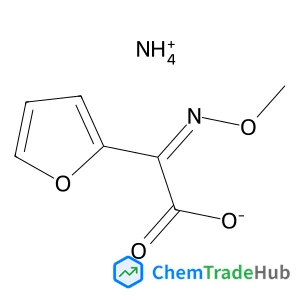
Ammonium (Z)-2-(furan-2-yl)-2-(methoxyimino)acetate
CAS Number:
97148-39-5
Molecular Formula:
C7H10N2O4
Martin J. Nash, John E. Maskall, Steve J. Hill
Novel HPLC-ICP-MS methodologies are developed using strong anion exchange (Phenomenex SAX-SB) and weak anion exchange (Alltec HAAX) stationary phases in conjunction with a range of aqueous mobile phases to enable simultaneous separations of inorganic Sb(III), Sb(V) and organic trimethylantimony dichloride (TMSb) species in synthetic solutions. Optimum isocratic separations of inorganic Sb(V) and Sb(III) species are achieved using mobile phases comprised of ammonium tartrate under controlled pH conditions, and rapid pH gradient elution profiles are developed to facilitate separations of the Sb(V), Sb(III) and TMSb species in a single chromatographic run. Optimum peak resolution is achieved when using the 100 × 4.6 mm HAAX column at 20 °C and 100 mM ammonium tartrate mobile phases with a gradient from pH 3.0 to pH 1.2, although a system peak co-elutes with TMSb under these conditions and precludes quantitative analyses. Interestingly, the elution order of Sb(V), Sb(III) and TMSb species reverses when the temperature of the HAAX stationary phase is increased to 60 °C, and concurrent use of a less acidic pH gradient elution profile from pH 2.3 to pH 1.5 is shown to enable successful species separations whilst preventing occurrence of the co-eluting system peak. Limits of detection are achieved in the sub ng mL−1 range using these novel HPLC-ICP-MS methodologies and provide scope for future environmental analysis applications.
Solmaz Saboohi, Hans J. Griesser
DOI: 10.1039/C6CP08630F
Muhamad Z. Mokhtar, Mu Chen, Eric Whittaker, Bruce Hamilton, Nicholas Aristidou, Ali Gholinia, Saif A. Haque, Brian R. Saunders
DOI: 10.1039/C7CP00471K
Yuezhi Mao, Paul R. Horn
DOI: 10.1039/C6CP08039A
Hakim Belmouaddine, Minghan Shi, Paul-Ludovic Karsenti, Ridthee Meesat, Léon Sanche, Daniel Houde
DOI: 10.1039/C6CP08080D
Rongzheng Wan, Guosheng Shi
DOI: 10.1039/C7CP00553A
L. Pavasaryte, A. Katelnikovas, V. Klimavicius, V. Balevicius, A. Krajnc, G. Mali, J. Plavec, A. Kareiva
DOI: 10.1039/C6CP07723D
J. Xu, T. F. He, L. Q. Chai, L. Qiao, X. Q. Zhang, P. Wang, W. M. Liu
DOI: 10.1039/C6CP08356K
DOI: 10.1039/C6CP08606C
Manju Verma, Parag A. Deshpande
DOI: 10.1039/C7CP00556C
Jefferson Esquina Tsuchida, Fabio Aparecido Ferri
DOI: 10.1039/C6CP07876A
1H-Indazole-6-carbonitrile finds applications in pharmaceuticals, where it serve...
Waste containing Dioctyl (2E)-2-butenedioate (CAS: 2997-85-5) should be collecte...
Sodium [(1,2-benzoxazol-3-ylmethyl)sulfonyl]azanide is primarily used in pharmac...
Dimethyl 4-(4,4,5,5-tetramethyl-1,3,2-dioxaborolan-2-yl)-2,6-pyridinedicarboxyla...
Waste containing 2-Fluoro-6-hydrazinopyridine (CAS: 80714-39-2) should be manage...
6-Formyl-2-pyridinecarboxylic acid is an organic compound with the molecular for...
Research trends for this compound indicate a focus on its potential applications...
9H-Tribenzo[b,d,f]azepine is typically synthesized via a multi-step process invo...
1-Cyclopropyl-7-ethoxy-6-fluoro-8-methoxy-4-oxo-1,4-dihydro-3-quinolinecarboxyli...
Waste containing Methyl 3-oxo-1,2,3,4-tetrahydro-6-quinoxalinecarboxylate (CAS: ...

Analyst publishes analytical and bioanalytical research that reports premier fundamental discoveries and inventions, and the applications of those discoveries, unconfined by traditional discipline barriers.
![Sodium 3-[(E)-(4-anilinophenyl)diazenyl]benzenesulfonate structure](https://static.chemtradehub.com/structs/587/587-98-4-035f.webp "Sodium 3-[(E)-(4-anilinophenyl)diazenyl]benzenesulfonate structure")
![Sodium (2Z)-7-{[(2R)-2-amino-2-carboxyethyl]sulfanyl}-2-({[(1S)-2,2-dimethylcyclopropyl]carbonyl}amino)-2-heptenoate structure](https://static.chemtradehub.com/structs/811/81129-83-1-441c.webp "Sodium (2Z)-7-{[(2R)-2-amino-2-carboxyethyl]sulfanyl}-2-({[(1S)-2,2-dimethylcyclopropyl]carbonyl}amino)-2-heptenoate structure")




