


Reporting measurement uncertainty and coverage intervals near natural limits
Literature Information
Publication Date
2006-05-11
DOI
10.1039/B518084H
Impact Factor
4.616
Authors
View Original
Abstract
Different methods of treating data which lie close to a natural limit in a feasible range, such as zero or 100% mass or mole fraction, are discussed and recommendations made concerning the most appropriate. The methods considered include discarding observations beyond the limit, shifting observations to the limit, truncation of a classical confidence interval based on Student's t (coupled with shifting the result to the limit if outside the feasible range), truncation and renormalisation of an assumed normal distribution, and the maximum density interval of a Bayesian estimate based on a normal measurement distribution and a uniform prior within the feasible range. Based on consideration of bias and simulation to assess coverage, it is recommended that for most purposes, a confidence interval near a natural limit should be constructed by first calculating the usual confidence interval based on Student's t, then truncating the out-of-range portion to leave an asymmetric interval and adjusting the reported value to within the resulting interval if required. It is suggested that the original standard uncertainty is retained for uncertainty propagation purposes.
Recommended Journals

Bioorganic & Medicinal Chemistry

Herald of the Russian Academy of Sciences

Topics in Catalysis

Journal of the Indian Institute of Science

Acta Metallurgica Sinica-English Letters

Colloid Journal

NDT & E International

Electroanalysis

Chinese Journal of Chemistry

Critical Reviews in Solid State and Materials Sciences
Related Literature
Hierarchical porous Ni@boehmite/nickel aluminum oxide flakes with enhanced microwave absorption ability
Junwei Liu, Xiaoqin Guo, Wanyu Zhao, Luyang Liang, Chao Ma, Rui Zhang
2017-03-06
Paper
DOI: 10.1039/C7CP00629B
Spectroscopic evidence for the origin of odd–even effects in self-assembled monolayers and effects of substrate roughness
Jian Liu, Ian D. Tevis, Richard S. Andino, Christina M. Miller, Lawrence D. Ziegler, Xin Chen
2017-02-15
Paper
DOI: 10.1039/C6CP07580K
Conformational structures of jet-cooled acetaminophen–water clusters: a gas phase spectroscopic and computational study
Ahreum Min, Ahreum Ahn, Cheol Joo Moon, Ji Hoon Lee, Yeon Guk Seong, Seong Keun Kim, Myong Yong Choi
2017-01-12
Paper
DOI: 10.1039/C6CP06863D
A velocity map imaging study of the photodissociation of the methyl iodide cation
S. Marggi Poullain, D. V. Chicharro, L. Rubio-Lago, L. Bañares
2017-02-24
Paper
DOI: 10.1039/C7CP00319F
Observation of perpendicular exchange bias in an Ir-doped Fe2O3/Co ultrathin film system
S. Ye, S. P. Pati, Y. Shiokawa, M. Al-Mahdawi, T. Nozaki
2017-02-24
Paper
DOI: 10.1039/C7CP00445A
Tuning calcium biosensors with a single-site mutation: structural dynamics insights from femtosecond Raman spectroscopy
Sean R. Tachibana, Longteng Tang, Yanli Wang, Weimin Liu
2017-02-13
Paper
DOI: 10.1039/C6CP08821J
Comparison of fast electron transfer kinetics at platinum, gold, glassy carbon and diamond electrodes using Fourier-transformed AC voltammetry and scanning electrochemical microscopy
Robert A. Lazenby, Kiran Bano, Jie Zhang, Alan M. Bond, Julie V. Macpherson, Patrick R. Unwin
2017-03-06
Paper
DOI: 10.1039/C7CP00968B
Controlling the termination and photochemical reactivity of the SrTiO3(110) surface
Yisi Zhu, Paul A. Salvador, Gregory S. Rohrer
2017-02-24
Paper
DOI: 10.1039/C6CP08608J
A DFT+U investigation of hydrogen adsorption on the LaFeO3(010) surface
Isaac W. Boateng, Richard Tia, Evans Adei, Nelson Y. Dzade
2017-02-17
Paper
DOI: 10.1039/C6CP08698E
You might also like
Compound Q&A
What are the main uses of 1H-Indazole-6-carbonitrile (CAS: 141290-59-7)?
1H-Indazole-6-carbonitrile finds applications in pharmaceuticals, where it serve...
141290-59-71H-Indazole-6-carbon...
Compound Q&A
How should waste containing Dioctyl (2E)-2-butenedioate (CAS: 2997-85-5) be handled?
Waste containing Dioctyl (2E)-2-butenedioate (CAS: 2997-85-5) should be collecte...
2997-85-5Dioctyl (2E)-2-buten...
Compound Q&A
What industries use Sodium [(1,2-benzoxazol-3-ylmethyl)sulfonyl]azanide (CAS: 68291-98-5)?
Sodium [(1,2-benzoxazol-3-ylmethyl)sulfonyl]azanide is primarily used in pharmac...
68291-98-5Sodium [(1,2-benzoxa...
Compound Q&A
Are there alternatives to Dimethyl 4-(4,4,5,5-tetramethyl-1,3,2-dioxaborolan-2-yl)-2,6-pyridinedicarboxylate (CAS: 741709-66-0) in synthesis?
Dimethyl 4-(4,4,5,5-tetramethyl-1,3,2-dioxaborolan-2-yl)-2,6-pyridinedicarboxyla...
741709-66-0Dimethyl 4-(4,4,5,5-...
Compound Q&A
How should waste containing 2-Fluoro-6-hydrazinopyridine (CAS: 80714-39-2) be handled?
Waste containing 2-Fluoro-6-hydrazinopyridine (CAS: 80714-39-2) should be manage...
80714-39-22-Fluoro-6-hydrazino...
Compound Q&A
What is 6-Formyl-2-pyridinecarboxylic acid (CAS: 499214-11-8)?
6-Formyl-2-pyridinecarboxylic acid is an organic compound with the molecular for...
499214-11-86-Formyl-2-pyridinec...
Compound Q&A
What is the market or research trend for 3-(3,4-dimethoxyphenyl)-2,5-dimethyl-N-(2-morpholin-4-ylethyl)pyrazolo[1,5-a]pyrimidin-7-amine (CAS: 900874-91-1)?
Research trends for this compound indicate a focus on its potential applications...
900874-91-13-(3,4-dimethoxyphen...
Compound Q&A
How is 9H-Tribenzo[b,d,f]azepine (CAS: 29875-73-8) typically synthesized?
9H-Tribenzo[b,d,f]azepine is typically synthesized via a multi-step process invo...
29875-73-89H-Tribenzo[b,d,f]az...
Compound Q&A
How is 1-Cyclopropyl-7-ethoxy-6-fluoro-8-methoxy-4-oxo-1,4-dihydro-3-quinolinecarboxylic acid (CAS: 1797982-51-4) typically synthesized?
1-Cyclopropyl-7-ethoxy-6-fluoro-8-methoxy-4-oxo-1,4-dihydro-3-quinolinecarboxyli...
1797982-51-41-Cyclopropyl-7-etho...
Compound Q&A
How should waste containing Methyl 3-oxo-1,2,3,4-tetrahydro-6-quinoxalinecarboxylate (CAS: 671820-52-3) be handled?
Waste containing Methyl 3-oxo-1,2,3,4-tetrahydro-6-quinoxalinecarboxylate (CAS: ...
671820-52-3Methyl 3-oxo-1,2,3,4...
Source Journal
Analyst

CiteScore:
7.8
Self-citation Rate:
5.6%
Articles per Year:
653
Analyst publishes analytical and bioanalytical research that reports premier fundamental discoveries and inventions, and the applications of those discoveries, unconfined by traditional discipline barriers.
Recommended Compounds
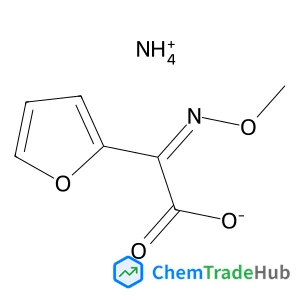
Ammonium (Z)-2-(furan-2-yl)-2-(methoxyimino)acetate
CAS Number:
97148-39-5
Molecular Formula:
C7H10N2O4
![Sodium (2Z)-7-{[(2R)-2-amino-2-carboxyethyl]sulfanyl}-2-({[(1S)-2,2-dimethylcyclopropyl]carbonyl}amino)-2-heptenoate structure](https://static.chemtradehub.com/structs/811/81129-83-1-441c.webp "Sodium (2Z)-7-{[(2R)-2-amino-2-carboxyethyl]sulfanyl}-2-({[(1S)-2,2-dimethylcyclopropyl]carbonyl}amino)-2-heptenoate structure")
Sodium (2Z)-7-{[(2R)-2-amino-2-carboxyethyl]sulfanyl}-2-({[(1S)-2,2-dimethylcyclopropyl]carbonyl}amino)-2-heptenoate
CAS Number:
81129-83-1
Molecular Formula:
C16H25N2NaO5S
Recommended Suppliers





Disclaimer
This page provides academic journal information for reference and research purposes only. We are not affiliated with any journal publishers and do not handle publication submissions. For publication-related inquiries, please contact the respective journal publishers directly.
If you notice any inaccuracies in the information displayed, please contact us at support@chemtradehub.com. We will promptly review and address your concerns.