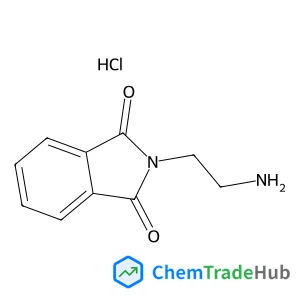
2-(2-Aminoethyl)-1H-isoindole-1,3(2H)-dione hydrochloride (1:1)
CAS Number:
30250-67-0
Molecular Formula:
C10H11ClN2O2
Floria Antolini, Barbara Gehrhus, Peter B. Hitchcock, Michael F. Lappert
Reactions of the silylene Si[(NCH2But)2C6H4-1,2], [Si(NN)], with NaOMe, excess Na or 1/3 Na yield the X-ray-characterised crystalline compounds [Na{μ-Si(NN)OMe}(THF)(OEt2)]2 (2b), [Na(THF)2Si(NN)]2 (3) and [Na(THF)4][{Si(NN)}3-c] (4).
DOI: 10.1039/D2RE00183G
Danim Yun, Zhongyao Zhang, David W. Flaherty
DOI: 10.1039/D2RE00160H
Flavio Tollini, Alice Occhetta, Francesca Broglia, Vincenzo Calemma, Stefano Carminati, Giuseppe Storti, Mattia Sponchioni, Davide Moscatelli
DOI: 10.1039/D2RE00191H
Jyoti Shah, Abha Shukla, Manoranjan Kar, Govind Gupta, Shipra Jain, R. K. Kotnala
DOI: 10.1039/D2RE00094F
Johannes G. H. Hermens, Mathieu L. Lepage, Arjan Kloekhorst, Erik Keller, Robin Bloem, Maurice Meijer, Ben L. Feringa
DOI: 10.1039/D2RE00310D
Thomas Roider, Norbert Frommknecht, Alexandra Höltzel, Ulrich Tallarek
DOI: 10.1039/D2RE00142J
DOI: 10.1039/D2RE00231K
Ujjal Mondal, Ganapati D. Yadav
DOI: 10.1039/D2RE00025C
David M. Walker, Joel M. Hawkins, Saif A. Khan
DOI: 10.1039/D1RE00462J
DOI: 10.1039/D2RE00170E
Waste containing 2-Ethyl-4-Methyl-1H-Imidazole-5-Carbaldehyde (CAS: 88634-80-4) ...
Triethoxy(octyl)silane (CAS: 1385031-14-0) is widely used in the pharmaceuticals...
Several alternatives to 3-iodo-7-nitro-1H-indazole (CAS: 864724-64-1) exist in t...
Yes, there are alternatives to Benzene, bis[(trimethoxysilyl)ethyl] (CAS: 266317...
Isothiazole-3-carbonitrile (CAS: 1452-17-1) is generally considered safe when us...
(3-Chlorophenyl)methanol (CAS: 873-63-2) is considered low to moderately toxic. ...
(2S,3S)-2-Hydroxy-3-({[(2-methyl-2-propanyl)oxy]carbonyl}amino)-3-(2-naphthyl)pr...
Proper handling of methyl 2-(bromomethyl)-5-methoxybenzoate requires the use of ...
6,8-Dibromoimidazo[1,2-a]pyridine-2-carboxylic acid (CAS: 904805-36-3) is an aro...
3-Amino-5-bromo-2-pyridinecarbonitrile is considered safe when handled under pro...

ChemComm publishes urgent research which is of outstanding significance and interest to experts in the field, while also appealing to the journal’s broad chemistry readership. Our communication format is ideally suited to short, urgent studies that are of such importance that they require accelerated publication. Our scope covers all topics in chemistry, and research at the interface of chemistry and other disciplines (such as materials science, nanoscience, physics, engineering and biology) where there is a significant novelty in the chemistry aspects. Major topic areas covered include: Analytical Chemistry Catalysis Chemical Biology and medicinal chemistry Computational Chemistry and Machine Learning Energy and sustainable chemistry Environmental Chemistry Green Chemistry Inorganic Chemistry Materials Chemistry Nanoscience Organic Chemistry Physical Chemistry Polymer Chemistry Supramolecular Chemistry