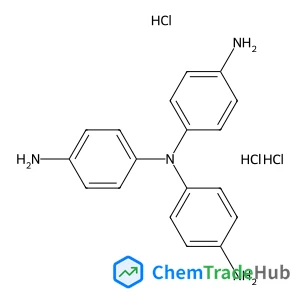
N1,N1-Bis(4-aminophenyl)benzene-1,4-diamine trihydrochloride
CAS Number:
114254-48-7
Molecular Formula:
C18H21Cl3N4
Alexander Sheldrick, David Müller, Alan Günther, Pablo Nieto, Otto Dopfer
The optical properties of flavins strongly depend on the charge and oxidation states as well as the environment. Herein, the electronic spectrum of cold protonated lumichrome, the smallest flavin molecule, is recorded by means of photodissociation in the visible range (VISPD) in a cryogenic ion trap tandem mass spectrometer coupled to an electrospray ionization source. The vibronic spectrum is assigned to the S1 ← S0 (ππ*) transition of the most stable N5-protonated isomer by comparison with quantum chemical calculations at the PBE0/cc-pVDZ level in combination with multidimensional Franck–Condon simulations. Analysis of the geometric and electronic structures of neutral and protonated lumichrome explains the large red shift of the band origin upon protonation (ΔS1 ∼ −6000 cm−1), which corresponds to the increase in proton affinity upon S1 excitation as a result of charge transfer. N5 protonation greatly modifies the structure of the central pyrazine ring of the chromophore. The orbitals involved in S1 ← S0 excitation include an important fraction of the probability at the central ring and they are, hence, largely influenced by the positive charge of the attached proton. The rich vibronic spectrum indicates the large geometry change upon S1 excitation. This combined experimental and computational approach is shown to be suitable to determine the optical properties of flavins as a function of oxidation, protonation, metalation, and microsolvation state.
Lilian K. Ellis-Gibbings, William G. Fortune, Bridgette Cooper, Jonathan Tennyson, Stephen D. Price
DOI: 10.1039/D1CP01328A
DOI: 10.1039/D0CP06002J
Natalia Porotnikova, Andrei Farlenkov, Sergey Naumov, Maxim Vlasov, Anna Khodimchuk, Andrey Fetisov, Maxim Ananyev
DOI: 10.1039/D1CP01099A
Thomas M. Fuchs, Rolf Schäfer
DOI: 10.1039/D1CP01227D
Erdogan Celik, Yanjiao Ma, Torsten Brezesinski
DOI: 10.1039/D1CP00834J
Kaiyi Luo, Wenyu Hu, Jiaxuan Wei, Qiuping Zhang, Zhonghao Wu, Dongyang Li, Feng Miao, Yi Huang, Min Xu, Jian Ma, Gang Chen, Xudong Cui, Pierre Ruterana
DOI: 10.1039/D0CP06649D
Ching H. Wu, Chi C. Hua, Chun I. Wang
DOI: 10.1039/D1CP00869B
Andres Jaramillo-Botero, Xue-hai Ju, William A. Goddard, III
DOI: 10.1039/D0CP05767C
Edurne Avellanal-Zaballa, Alejandro Prieto-Castañeda, Carolina Díaz-Norambuena, Jorge Bañuelos, Antonia R. Agarrabeitia, Inmaculada García-Moreno, Santiago de la Moya, María J. Ortiz
DOI: 10.1039/D1CP00991E
Waste containing N-Methoxy-N-methyl-1,3-thiazole-5-carboxamide (CAS: 898825-89-3...
N-(4-Biphenylyl)dibenzo[b,d]furan-4-amine should be stored in a tightly sealed c...
The market for 3-Acetamido-5-amino-2,4,6-triiodobenzoic acid (CAS: 1713-07-1) is...
Benzyl 2-O-acetyl-3,4,6-tri-O-benzyl-beta-D-galactopyranoside (CAS: 61820-03-9) ...
2-Ethylpiperazine dihydrochloride (CAS: 438050-52-3) is regulated under the Glob...
1,1'-[1,3-Phenylenebis(methylene)]bis(3-methyl-1H-pyrrole-2,5-dione) (CAS: 11946...
Several alternatives can be used in the synthesis of 5-Fluoro-2-(1-pyrrolidinyl)...
Proper personal protective equipment (PPE) must be worn when handling this compo...
When handling 6-Bromoimidazo[1,2-a]pyridin-8-amine, it is important to wear appr...
Alternatives to (2S,4R)-4-(4-Nitrobenzyl)pyrrolidine-2-carboxylic acid hydrochlo...

Physical Chemistry Chemical Physics (PCCP) is an international journal co-owned by 19 physical chemistry and physics societies from around the world. This journal publishes original, cutting-edge research in physical chemistry, chemical physics and biophysical chemistry. To be suitable for publication in PCCP, articles must include significant innovation and/or insight into physical chemistry; this is the most important criterion that reviewers and Editors will judge against when evaluating submissions. The journal has a broad scope and welcomes contributions spanning experiment, theory, computation and data science. Topical coverage includes spectroscopy, dynamics, kinetics, statistical mechanics, thermodynamics, electrochemistry, catalysis, surface science, quantum mechanics, quantum computing and machine learning. Interdisciplinary research areas such as polymers and soft matter, materials, nanoscience, energy, surfaces/interfaces, and biophysical chemistry are welcomed if they demonstrate significant innovation and/or insight into physical chemistry. Joined experimental/theoretical studies are particularly appreciated when complementary and based on up-to-date approaches.