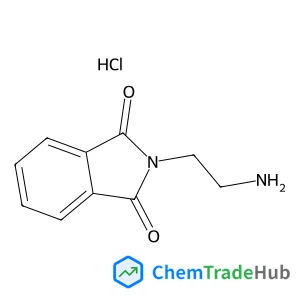
2-(2-Aminoethyl)-1H-isoindole-1,3(2H)-dione hydrochloride (1:1)
CAS Number:
30250-67-0
Molecular Formula:
C10H11ClN2O2
Philip J. Bailey, Robert A. Coxall, Caroline M. Dick, Sylvie Fabre, Simon Parsons, Lesley J. Yellowlees
Treatment of dimethylmagnesium with bulky α-diimine ligands provides either the biradical methyl-bridged complexes [(α-diimine−˙)Mg+(μ-CH3)]2via single electron transfer (SET), or the product of methyl transfer to an imine carbon atom depending upon conditions.
Honghui Zhang, Wenjin Li
DOI: 10.1039/D0CP04162A
Chih-Kai Lin, Qian-Rui Huang, Jer-Lai Kuo
DOI: 10.1039/D0CP03519J
Yan Li, Ning Liu, Chengna Dai, Ruinian Xu, Bin Wu, Gangqiang Yu, Biaohua Chen
DOI: 10.1039/D0CP03126G
Manzoor Ahmad Dar
DOI: 10.1039/D0CP01918F
Alexander I. Dalinger, Leonid S. Lepnev, Sergey Z. Vatsadze
DOI: 10.1039/D0CP04909C
Chaoqun Zhang, Hannah Korslund, Lan Cheng
DOI: 10.1039/D0CP04608F
DOI: 10.1039/D0CP02470H
Prasanta Bandyopadhyay, Soumyadip Ray, Md. Motin Seikh
DOI: 10.1039/C9CP05374C
Dmitriy V. Marasanov, Leonid Yu. Mironov, Yevgeniy M. Sgibnev, Ilya E. Kolesnikov, Nikolay V. Nikonorov
DOI: 10.1039/D0CP02786C
Waste containing 2-Ethyl-4-Methyl-1H-Imidazole-5-Carbaldehyde (CAS: 88634-80-4) ...
Triethoxy(octyl)silane (CAS: 1385031-14-0) is widely used in the pharmaceuticals...
Several alternatives to 3-iodo-7-nitro-1H-indazole (CAS: 864724-64-1) exist in t...
Yes, there are alternatives to Benzene, bis[(trimethoxysilyl)ethyl] (CAS: 266317...
Isothiazole-3-carbonitrile (CAS: 1452-17-1) is generally considered safe when us...
(3-Chlorophenyl)methanol (CAS: 873-63-2) is considered low to moderately toxic. ...
(2S,3S)-2-Hydroxy-3-({[(2-methyl-2-propanyl)oxy]carbonyl}amino)-3-(2-naphthyl)pr...
Proper handling of methyl 2-(bromomethyl)-5-methoxybenzoate requires the use of ...
6,8-Dibromoimidazo[1,2-a]pyridine-2-carboxylic acid (CAS: 904805-36-3) is an aro...
3-Amino-5-bromo-2-pyridinecarbonitrile is considered safe when handled under pro...

ChemComm publishes urgent research which is of outstanding significance and interest to experts in the field, while also appealing to the journal’s broad chemistry readership. Our communication format is ideally suited to short, urgent studies that are of such importance that they require accelerated publication. Our scope covers all topics in chemistry, and research at the interface of chemistry and other disciplines (such as materials science, nanoscience, physics, engineering and biology) where there is a significant novelty in the chemistry aspects. Major topic areas covered include: Analytical Chemistry Catalysis Chemical Biology and medicinal chemistry Computational Chemistry and Machine Learning Energy and sustainable chemistry Environmental Chemistry Green Chemistry Inorganic Chemistry Materials Chemistry Nanoscience Organic Chemistry Physical Chemistry Polymer Chemistry Supramolecular Chemistry
![N-[(5,6-Dichloro-1H-benzimidazol-2-yl)methyl]-9-(1-methyl-1H-pyrazol-4-yl)-2-(4-morpholinyl)-9H-purin-6-amine structure](https://static.chemtradehub.com/structs/238/2387704-62-1-25f4.webp "N-[(5,6-Dichloro-1H-benzimidazol-2-yl)methyl]-9-(1-methyl-1H-pyrazol-4-yl)-2-(4-morpholinyl)-9H-purin-6-amine structure")