












Determination of aromatic hydrotropic drugs in pharmaceutical preparations by the surfactant-binding degree method
Literature Information
Publication Date
2005-05-24
DOI
10.1039/B503827H
Impact Factor
4.616
Authors
Ana Pedraza, María Dolores Sicilia, Soledad Rubio, Dolores Pérez-Bendito
View Original
Abstract
An aggregation parameter-based analytical approach, the surfactant-dye binding degree (SDBD) method, was used, for the first time, to determine aromatic hydrotropic compounds. The anionic dye Coomassie Brilliant Blue G (CBBG) was used as inductor of didodecyldimethylammonium bromide (DDABr) aggregates, whose formation was monitored from changes in the spectral features of the dye. Interactions between hydrotrope and DDABr molecules resulted in a decrease of the degree of binding of the cationic surfactant to CBBG, which was proportional to the concentration of hydrotrope in the aqueous solution. The CBBG–DDABr–hydrotrope chemical system was found to fit to the mathematical expression previously derived for the determination of amphiphilic compounds. The hydrotrope–surfactant bond strength determined the sensitivity achieved for the determination of hydrotropic compounds, which was highly dependent on the molecular structure of the analyte. The high precision (the relative standard deviation for 7 mg l−1 of salicylic acid was 0.8%), rapidity (measurements were performed in a few minutes) and low cost (in both instrumentation and reactants) of the proposed method, made it especially suitable for quality control. The practical analytical applicability of the SDBD method for the control of hydrotropic drugs in pharmaceutical preparations was demonstrated by quantifying salicylic acid and acetyl salicylic acid in liquid (solutions) and solid (tablets, granulates, unguents, gels and creams) samples, which were directly analyzed after dissolution of the samples.
Related Literature
Partitioning of caffeine in lipid bilayers reduces membrane fluidity and increases membrane thickness
Adree Khondker, Alexander Dhaliwal, Richard J. Alsop, Jennifer Tang, An-Chang Shi, Maikel C. Rheinstädter
2017-02-13
Paper
DOI: 10.1039/C6CP08104E
A DFT+U investigation of hydrogen adsorption on the LaFeO3(010) surface
Isaac W. Boateng, Richard Tia, Evans Adei, Nelson Y. Dzade
2017-02-17
Paper
DOI: 10.1039/C6CP08698E
Erbium ion implantation into diamond – measurement and modelling of the crystal structure
Pavla Nekvindová, David Sedmidubský, Michal Hušák, Zdeněk Remeš, Marián Varga, Alexander Kromka, Roman Böttger, Jiří Oswald
2017-01-26
Paper
DOI: 10.1039/C6CP08851A
Effects of Ge and Sn substitution on the metal–semiconductor transition and thermoelectric properties of Cu12Sb4S13 tetrahedrite
Yasufumi Kosaka, Koichiro Suekuni, Katsuaki Hashikuni, Yohan Bouyrie, Michihiro Ohta
2017-03-06
Paper
DOI: 10.1039/C7CP00351J
Capturing the multiscale dynamics of membrane protein complexes with all-atom, mixed-resolution, and coarse-grained models
Chenyi Liao, Xiaochuan Zhao, Jiyuan Liu, Severin T. Schneebeli, John C. Shelley, Jianing Li
2017-03-06
Paper
DOI: 10.1039/C7CP00200A
Conformational structures of jet-cooled acetaminophen–water clusters: a gas phase spectroscopic and computational study
Ahreum Min, Ahreum Ahn, Cheol Joo Moon, Ji Hoon Lee, Yeon Guk Seong, Seong Keun Kim, Myong Yong Choi
2017-01-12
Paper
DOI: 10.1039/C6CP06863D
Packing energetics determine the folding routes of the RNase-H proteins
Shachi Gosavi
2017-03-10
Paper
DOI: 10.1039/C6CP08940B
Simultaneous covalent and noncovalent carbon nanotube/Ag3PO4 hybrids: new insights into the origin of enhanced visible light photocatalytic performance
Wei-Qing Huang, Zhong Xie, Wangyu Hu, Ping Peng, Gui-Fang Huang
2017-02-17
Paper
DOI: 10.1039/C6CP08853H
Calculations of current densities for neutral and doubly charged persubstituted benzenes using effective core potentials
Markus Rauhalahti, Stefan Taubert, Dage Sundholm, Vincent Liégeois
2017-02-13
Paper
DOI: 10.1039/C7CP00194K
Controlling the termination and photochemical reactivity of the SrTiO3(110) surface
Yisi Zhu, Paul A. Salvador, Gregory S. Rohrer
2017-02-24
Paper
DOI: 10.1039/C6CP08608J
You might also like
Compound Q&A
What are the main uses of 1H-Indazole-6-carbonitrile (CAS: 141290-59-7)?
1H-Indazole-6-carbonitrile finds applications in pharmaceuticals, where it serve...
141290-59-71H-Indazole-6-carbon...
Compound Q&A
How should waste containing Dioctyl (2E)-2-butenedioate (CAS: 2997-85-5) be handled?
Waste containing Dioctyl (2E)-2-butenedioate (CAS: 2997-85-5) should be collecte...
2997-85-5Dioctyl (2E)-2-buten...
Compound Q&A
What industries use Sodium [(1,2-benzoxazol-3-ylmethyl)sulfonyl]azanide (CAS: 68291-98-5)?
Sodium [(1,2-benzoxazol-3-ylmethyl)sulfonyl]azanide is primarily used in pharmac...
68291-98-5Sodium [(1,2-benzoxa...
Compound Q&A
Are there alternatives to Dimethyl 4-(4,4,5,5-tetramethyl-1,3,2-dioxaborolan-2-yl)-2,6-pyridinedicarboxylate (CAS: 741709-66-0) in synthesis?
Dimethyl 4-(4,4,5,5-tetramethyl-1,3,2-dioxaborolan-2-yl)-2,6-pyridinedicarboxyla...
741709-66-0Dimethyl 4-(4,4,5,5-...
Compound Q&A
How should waste containing 2-Fluoro-6-hydrazinopyridine (CAS: 80714-39-2) be handled?
Waste containing 2-Fluoro-6-hydrazinopyridine (CAS: 80714-39-2) should be manage...
80714-39-22-Fluoro-6-hydrazino...
Compound Q&A
What is 6-Formyl-2-pyridinecarboxylic acid (CAS: 499214-11-8)?
6-Formyl-2-pyridinecarboxylic acid is an organic compound with the molecular for...
499214-11-86-Formyl-2-pyridinec...
Compound Q&A
What is the market or research trend for 3-(3,4-dimethoxyphenyl)-2,5-dimethyl-N-(2-morpholin-4-ylethyl)pyrazolo[1,5-a]pyrimidin-7-amine (CAS: 900874-91-1)?
Research trends for this compound indicate a focus on its potential applications...
900874-91-13-(3,4-dimethoxyphen...
Compound Q&A
How is 9H-Tribenzo[b,d,f]azepine (CAS: 29875-73-8) typically synthesized?
9H-Tribenzo[b,d,f]azepine is typically synthesized via a multi-step process invo...
29875-73-89H-Tribenzo[b,d,f]az...
Compound Q&A
How is 1-Cyclopropyl-7-ethoxy-6-fluoro-8-methoxy-4-oxo-1,4-dihydro-3-quinolinecarboxylic acid (CAS: 1797982-51-4) typically synthesized?
1-Cyclopropyl-7-ethoxy-6-fluoro-8-methoxy-4-oxo-1,4-dihydro-3-quinolinecarboxyli...
1797982-51-41-Cyclopropyl-7-etho...
Compound Q&A
How should waste containing Methyl 3-oxo-1,2,3,4-tetrahydro-6-quinoxalinecarboxylate (CAS: 671820-52-3) be handled?
Waste containing Methyl 3-oxo-1,2,3,4-tetrahydro-6-quinoxalinecarboxylate (CAS: ...
671820-52-3Methyl 3-oxo-1,2,3,4...
Source Journal
Analyst

CiteScore:
7.8
Self-citation Rate:
5.6%
Articles per Year:
653
Analyst publishes analytical and bioanalytical research that reports premier fundamental discoveries and inventions, and the applications of those discoveries, unconfined by traditional discipline barriers.
Recommended Compounds
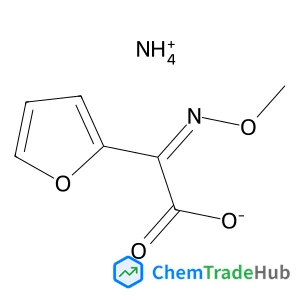
Ammonium (Z)-2-(furan-2-yl)-2-(methoxyimino)acetate
CAS Number:
97148-39-5
Molecular Formula:
C7H10N2O4
Recommended Suppliers




Disclaimer
This page provides academic journal information for reference and research purposes only. We are not affiliated with any journal publishers and do not handle publication submissions. For publication-related inquiries, please contact the respective journal publishers directly.
If you notice any inaccuracies in the information displayed, please contact us at support@chemtradehub.com. We will promptly review and address your concerns.