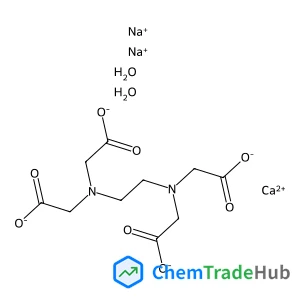
EthylenediaminetetraaceticacidcalciumDisodiumsalthydrate
CAS Number:
23411-34-9
Molecular Formula:
C10H16CaN2Na2O10
Claudia R. Schröder, Bernhard M. Weidgans, Ingo Klimant
In this work we present optical pH sensors especially designed for pH measurements in marine environment. Embedded in an uncharged, highly proton-permeable hydrogel matrix, the two novel lipophilic carboxyfluorescein derivatives 2′,7′-dihexyl-5(6)-N-octadecyl-carboxamidofluorescein (DHFA) and 2′,7′-dihexyl-5(6)-N-octadecyl-carboxamidofluorescein ethyl ester (DHFAE) have apparent dissociation constants of ca. 8.4. The pH transition range of the sensors perfectly matches the pH range occurring in seawater and marine sediment (ca. pH 7.2–9.2). The cross-sensitivity towards ionic strength (IS) was found to be low for DHFA-containing membranes and was even negligible when using DHFAE as indicator. The quantum yield (QY) of DHFA (0.94basic) is similar to that of fluorescein (0.97basic). QYs of 0.62basic and 0.22acidic were found for DHFAE. The optical properties of the indicators enable referenced measuring schemes. Lactonisation of the DHFAE chromophore is prevented by esterification of the carboxyl group in 2 position. Thus, internally referenced dual wavelength measurements are possible since the emission maxima of the basic and acidic form of DHFAE differ by 30 nm. Dual lifetime referenced (DLR) measurements were made with pH sensors incorporating ruthenium-(II)-tris-4,7-diphenyl-1,10-phenanthroline (Ru(dpp)3)-containing reference particles in addition to the indicator. This type of sensor can be applied for pH imaging or in phase-modulation measurements of pH.
Adree Khondker, Alexander Dhaliwal, Richard J. Alsop, Jennifer Tang, An-Chang Shi, Maikel C. Rheinstädter
DOI: 10.1039/C6CP08104E
Jianyang Li, Sam Gollon, Ming Qiu, Dongsheng Guan, Xiaoru Guo, Junhong Chen
DOI: 10.1039/C6CP07733A
Baotao Kang, Daeheum Cho, Jin Yong Lee
DOI: 10.1039/C7CP00137A
J. F. Eckhard, D. Neuwirth, C. Panosetti, H. Oberhofer, K. Reuter, M. Tschurl, U. Heiz
DOI: 10.1039/C6CP07631A
Sean R. Tachibana, Longteng Tang, Yanli Wang, Weimin Liu
DOI: 10.1039/C6CP08821J
Simon Wiemers-Meyer, Sascha Nowak
DOI: 10.1039/C6CP08653E
DOI: 10.1039/C6CP07203H
G. Attilio Ardizzoia, Stefano Brenna
DOI: 10.1039/C6CP07793E
Chao Yuan, Mengyu Huang, Yanhua Cheng, Xiaobing Luo
DOI: 10.1039/C7CP00209B
Tim Kohlmann, Robert Naumann, Christoph Kerzig, Martin Goez
DOI: 10.1039/C6CP08491E
1H-Indazole-6-carbonitrile finds applications in pharmaceuticals, where it serve...
Waste containing Dioctyl (2E)-2-butenedioate (CAS: 2997-85-5) should be collecte...
Sodium [(1,2-benzoxazol-3-ylmethyl)sulfonyl]azanide is primarily used in pharmac...
Dimethyl 4-(4,4,5,5-tetramethyl-1,3,2-dioxaborolan-2-yl)-2,6-pyridinedicarboxyla...
Waste containing 2-Fluoro-6-hydrazinopyridine (CAS: 80714-39-2) should be manage...
6-Formyl-2-pyridinecarboxylic acid is an organic compound with the molecular for...
Research trends for this compound indicate a focus on its potential applications...
9H-Tribenzo[b,d,f]azepine is typically synthesized via a multi-step process invo...
1-Cyclopropyl-7-ethoxy-6-fluoro-8-methoxy-4-oxo-1,4-dihydro-3-quinolinecarboxyli...
Waste containing Methyl 3-oxo-1,2,3,4-tetrahydro-6-quinoxalinecarboxylate (CAS: ...

Analyst publishes analytical and bioanalytical research that reports premier fundamental discoveries and inventions, and the applications of those discoveries, unconfined by traditional discipline barriers.
![Sodium 3-[(E)-(4-anilinophenyl)diazenyl]benzenesulfonate structure](https://static.chemtradehub.com/structs/587/587-98-4-035f.webp "Sodium 3-[(E)-(4-anilinophenyl)diazenyl]benzenesulfonate structure")