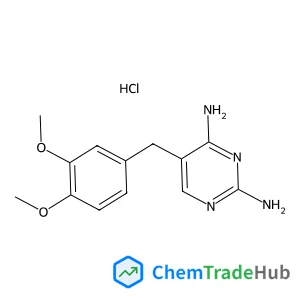
5-(3,4-Dimethoxybenzyl)-2,4-pyrimidinediamine hydrochloride (1:1)
CAS Number:
2507-23-5
Molecular Formula:
C13H17ClN4O2
P. Asselin, M. Goubet, Z. Latajka, P. Soulard, M. Lewerenz
Fourier transform infrared spectra of the νs stretching bands of HF and DF bonded to (CH2)2O have been recorded at 0.5 cm−1 resolution in a cooled cell and in a supersonic expansion seeded with argon. The analysis of the congested spectra of this type of medium strength hydrogen bonded complexes exploits a combination of controlled temperature effects in the ranges 25–80 K and 200–300 K and a band contour simulation program accounting for homogeneous and inhomogeneous contributions. Significant anharmonic couplings between the donor stretch mode and three of the low frequency intermolecular modes are found to be responsible for the characteristic hot band patterns in the νs fundamental region of cell spectra. A global analysis of sum and difference combination bands involving νs provides reliable values of intermolecular frequencies, anharmonic coupling constants and a good estimate of the dissociation energy of the complex which compares favorably with ab initio results. The effective linewidth provides a lower bound for the predissociation lifetime of 1.5 ps for HF and 7 ps for DF containing complexes, respectively. The correlation between effective linewidths and vibrational densities of states for (CH2)2O–HF and –DF underlines the important role of intramolecular vibrational redistribution in the vibrational dynamics of these complexes while the lifetime decrease for HF (or DF) bonded to oxygenated cyclic ethers with respect to sulfured homologues might be explained by the change in the arrangement of the acid relative to the plane of the acceptor subunit.

Acta Materialia

Journal of Peptide Science

Journal of Saudi Chemical Society

Journal of Natural Medicines

Chemical Communications

Russian Journal of Bioorganic Chemistry

Crystallography Reports

Current Opinion in Colloid & Interface Science

Chemistry Education Research and Practice

Organic Process Research & Development
Lixia Sun, Qianwang Chen, Yan Tang, Ying Xiong
DOI: 10.1039/B704689H
Masilamani Jeganmohan, Chien-Hong Cheng
DOI: 10.1039/B800440D
Benjamin Glettner, Sara Hein, R. Amaranatha Reddy, Ute Baumeister, Carsten Tschierske
DOI: 10.1039/B703907G
Yan Yan, Fuqiang Zhang, Yan Meng, Bo Tu, Dongyuan Zhao
DOI: 10.1039/B702232H
C. V. Ramana, Challa Nageswara Reddy, Rajesh G. Gonnade
DOI: 10.1039/B801755G
Zili Wu, Shenghu Zhou, Haoguo Zhu, Sheng Dai, Steven H. Overbury
DOI: 10.1039/B803834A
Patricia Horcajada, Suzy Surblé, Christian Serre, Do-Young Hong, You-Kyong Seo, Jong-San Chang, Jean-Marc Grenèche, Irene Margiolaki, Gérard Férey
DOI: 10.1039/B704325B
Huanrong Li, Yige Wang, Wenjun Zhang, Binyuan Liu, Gion Calzaferri
DOI: 10.1039/B702175E
Satish Kumar Nune, Masato Tanaka
DOI: 10.1039/B703165C
When considering alternatives to 1-(4-Chlorophenyl)-N-hydroxymethanimine (CAS: 3...
This compound should be stored in a cool, dry place away from direct sunlight. I...
3-(4-Bromophenyl)-5-(2-fluorophenyl)-1,2,4-oxadiazole is synthesized through a m...
5-Chloro-2-(4-chlorophenyl)-4-methyl-6-[3-(1-piperidinyl)propoxy]pyrimidine (CAS...
2-Chloro-4-(difluoromethoxy)pyridine is used in the pharmaceutical industry for ...
3-Chloro-6-methylpyridazine (CAS: 1121-79-5) is classified under the Globally Ha...
Several alternatives can be used in the synthesis of Methyl 4,5-dimethyl-2-nitro...
Alternatives to (2E,2'E)-3,3'-(1,4-Phenylene)bisacrylaldehyde include other acry...
3-Amino-5-chloropyridin-2-ol hydrochloride is an organic compound with the CAS n...
When handling 6,7-Difluoro-2,3-dihydro-4H-chromen-4-one, it is essential to wear...

Physical Chemistry Chemical Physics (PCCP) is an international journal co-owned by 19 physical chemistry and physics societies from around the world. This journal publishes original, cutting-edge research in physical chemistry, chemical physics and biophysical chemistry. To be suitable for publication in PCCP, articles must include significant innovation and/or insight into physical chemistry; this is the most important criterion that reviewers and Editors will judge against when evaluating submissions. The journal has a broad scope and welcomes contributions spanning experiment, theory, computation and data science. Topical coverage includes spectroscopy, dynamics, kinetics, statistical mechanics, thermodynamics, electrochemistry, catalysis, surface science, quantum mechanics, quantum computing and machine learning. Interdisciplinary research areas such as polymers and soft matter, materials, nanoscience, energy, surfaces/interfaces, and biophysical chemistry are welcomed if they demonstrate significant innovation and/or insight into physical chemistry. Joined experimental/theoretical studies are particularly appreciated when complementary and based on up-to-date approaches.