













Evidence for the first oxidative insertion of a transition metal into a digallane(4): synthesis, structural characterisation and EPR studies of [Cp2ZrIII{Ga[N(Ar)C(H)]2}2][Li(THF)4], Ar = C6H3Pri2-2,6
Literature Information
Publication Date
2005-01-19
DOI
10.1039/B417720G
Impact Factor
6.222
Authors
Robert J. Baker, Cameron Jones, Damien M. Murphy
View Original
Abstract
Treatment of “ZrCp2” with the digallane(4), [{Ga[N(Ar)C(H)]2}2], Ar = C6H3Pri2-2,6, in the presence of excess BunLi leads to the first example of a gallyl–Group 4 complex, [Cp2Zr{Ga[N(Ar)C(H)]2}2][Li(THF)4], via an unprecedented oxidative insertion reaction; the paramagnetic complex has been characterised by X-ray crystallography and EPR spectroscopy.
Related Literature
Strategies for optimizing the performance of carbazole thiophene appended unsymmetrical squaraine dyes for dye-sensitized solar cells
Cherumuttathu H. Suresh
2015-08-07
Paper
DOI: 10.1039/C5CP03371C
Retinal shows its true colours: photoisomerization action spectra of mobility-selected isomers of the retinal protonated Schiff base
N. J. A. Coughlan, B. D. Adamson, L. Gamon, K. Catani, E. J. Bieske
2015-08-05
Paper
DOI: 10.1039/C5CP03611A
Analyzing torquoselectivity in electrocyclic ring opening reactions of trans-3,4-dimethylcyclobutene and 3-formylcyclobutene through electronic structure principles
Alejandro Morales-Bayuelo, Sudip Pan, Julio Caballero, Pratim K. Chattaraj
2015-08-07
Paper
DOI: 10.1039/C5CP02647D
Crystallographic transformation of limestone during calcination under CO2
Jose Manuel Valverde, Santiago Medina
2015-07-21
Paper
DOI: 10.1039/C5CP02715B
Selective detection and complete identification of triglycerides in cortical bone by high-resolution 1H MAS NMR spectroscopy
Peizhi Zhu, Michael D. Morris
2016-06-29
Communication
DOI: 10.1039/C6CP03506J
Photolysis study of fluorinated ketones under natural sunlight conditions
Yolanda Díaz-de-Mera, Alfonso Aranda, Alberto Notario, Ana Rodríguez, Diana Rodríguez, Iván Bravo
2015-07-28
Paper
DOI: 10.1039/C5CP03527A
Influence of the sterol aliphatic side chain on membrane properties: a molecular dynamics study
J. P. Prates Ramalho, Daniel Huster
2015-07-31
Paper
DOI: 10.1039/C5CP03097H
Activity and stability trends of perovskite oxides for oxygen evolution catalysis at neutral pH
Chen Ling, Hongfei Jia
2015-08-07
Communication
DOI: 10.1039/C5CP04248H
You might also like
Compound Q&A
What precautions should be taken when handling 4-(2-Furylmethyl)thiomorpholine 1,1-dioxide (CAS: 79206-94-3)?
When handling 4-(2-Furylmethyl)thiomorpholine 1,1-dioxide (CAS: 79206-94-3), it ...
79206-94-34-(2-Furylmethyl)thi...
Compound Q&A
What precautions should be taken when handling 4-Chloro-N-[2-(4-morpholinyl)ethyl]benzamide (CAS: 71320-77-9)?
When handling 4-Chloro-N-[2-(4-morpholinyl)ethyl]benzamide (CAS: 71320-77-9), it...
71320-77-94-Chloro-N-[2-(4-mor...
Compound Q&A
How should waste containing 2-[2-(2-Methoxyethoxy)ethoxy]ethyl 4-methylbenzenesulfonate (CAS: 62921-74-8) be handled?
Waste containing this compound (CAS: 62921-74-8) should be handled according to ...
62921-74-82-[2-(2-Methoxyethox...
Compound Q&A
How should waste containing (S)-Methyl 2-amino-3-cyclohexylpropanoate be handled?
Waste containing (S)-Methyl 2-amino-3-cyclohexylpropanoate should be collected i...
40056-18-6(S)-Methyl 2-amino-3...
Compound Q&A
How is 5-({4-[(2S,4R)-4-Hydroxy-2-methyltetrahydro-2H-pyran-4-yl]-2-thienyl}sulfanyl)-1-methyl-1,3-dihydro-2H-indol-2-one (CAS: 166882-70-8) typically synthesized?
This compound can be synthesized using a multi-step process involving the conjug...
166882-70-85-({4-[(2S,4R)-4-Hyd...
Compound Q&A
Are there alternatives to (2E)-3-(3,4-Dichlorophenyl)acrylic acid (CAS: 7312-27-8) in synthesis?
There are several alternatives to (2E)-3-(3,4-Dichlorophenyl)acrylic acid in syn...
7312-27-8(2E)-3-(3,4-Dichloro...
Compound Q&A
How should Ethyl 6-(2-nitrophenyl)imidazo[2,1-b][1,3]thiazole-3-carboxylate (CAS: 925437-84-9) be stored?
Ethyl 6-(2-nitrophenyl)imidazo[2,1-b][1,3]thiazole-3-carboxylate (CAS: 925437-84...
925437-84-9Ethyl 6-(2-nitrophen...
Compound Q&A
How should waste containing 2-(1,3-Thiazol-2-yl)ethanamine (CAS: 18453-07-1) be handled?
Waste containing 2-(1,3-Thiazol-2-yl)ethanamine (CAS: 18453-07-1) should be coll...
18453-07-12-(1,3-Thiazol-2-yl)...
Compound Q&A
How is Methyl 5-iodo-2-methylbenzoate (CAS: 103440-54-6) typically synthesized?
Methyl 5-iodo-2-methylbenzoate can be synthesized through the iodination of meth...
103440-54-6Methyl 5-iodo-2-meth...
Compound Q&A
How is 5-Chloro[1,2,4]triazolo[1,5-a]pyridine (CAS: 1427399-34-5) typically synthesized?
5-Chloro[1,2,4]triazolo[1,5-a]pyridine is commonly synthesized via the condensat...
1427399-34-55-Chloro[1,2,4]triaz...
Source Journal
Chemical Communications

CiteScore:
8.6
Self-citation Rate:
4.7%
Articles per Year:
2458
ChemComm publishes urgent research which is of outstanding significance and interest to experts in the field, while also appealing to the journal’s broad chemistry readership. Our communication format is ideally suited to short, urgent studies that are of such importance that they require accelerated publication. Our scope covers all topics in chemistry, and research at the interface of chemistry and other disciplines (such as materials science, nanoscience, physics, engineering and biology) where there is a significant novelty in the chemistry aspects. Major topic areas covered include: Analytical Chemistry Catalysis Chemical Biology and medicinal chemistry Computational Chemistry and Machine Learning Energy and sustainable chemistry Environmental Chemistry Green Chemistry Inorganic Chemistry Materials Chemistry Nanoscience Organic Chemistry Physical Chemistry Polymer Chemistry Supramolecular Chemistry
Recommended Compounds
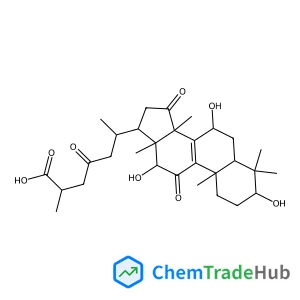
(3beta,7beta,12beta)-3,7,12-Trihydroxy-11,15,23-trioxolanost-8-en-26-oic acid
CAS Number:
98665-22-6
Molecular Formula:
C30H44O8
![[4-Amino-2-(methylsulfanyl)-5-pyrimidinyl]methanol structure](https://static.chemtradehub.com/structs/588/588-36-3-fc73.webp "[4-Amino-2-(methylsulfanyl)-5-pyrimidinyl]methanol structure")
Recommended Suppliers






Disclaimer
This page provides academic journal information for reference and research purposes only. We are not affiliated with any journal publishers and do not handle publication submissions. For publication-related inquiries, please contact the respective journal publishers directly.
If you notice any inaccuracies in the information displayed, please contact us at support@chemtradehub.com. We will promptly review and address your concerns.