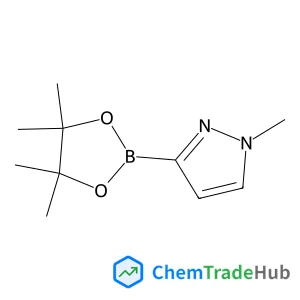
1-Methyl-3-(4,4,5,5-tetramethyl-1,3,2-dioxaborolan-2-yl)-1H-pyrazole
CAS Number:
1020174-04-2
Molecular Formula:
C10H17BN2O2
Gary E. Douberly, Jeremy M. Merritt, Roger E. Miller
Two IR lasers are used in a pump–probe configuration to observe photo-induced isomerization between the linear and bent isomers of HCN–HF, formed in helium nanodroplets. Vibrational excitation of the C–H and H–F stretching modes of these complexes provides sufficient energy to surmount the barriers between them. The extent of population transfer is found to be different for pumping the two isomers. In the case of linear HCN–HF, the results suggest that the complex undergoes vibrational predissociation, followed by geminate recombination. Excitation of the higher energy bent HF–HCN isomer results in complete population transfer to the linear complex. This isomer specific population transfer provides important clues regarding the associated vibrational dynamics.
Xiaoxu Mao, Shoukui Hu, Ke Shang, Guangwei Yang, Jinhao Yan, Chao Ma, Jun Yin
DOI: 10.1039/D1PY00128K
Bo Pang, Rui Liu, Guang Han, Wei Wang
DOI: 10.1039/D1PY00087J
Pauline Sautrot-Ba, Vlasta Brezová, Jean-Pierre Malval, Annalisa Chiappone, Louise Breloy, Samir Abbad-Andaloussi, Davy-Louis Versace
DOI: 10.1039/D1PY00126D
Huiqun Wang, Sebla Onbulak, Steven Weigand, Frank S. Bates, Marc A. Hillmyer
DOI: 10.1039/D0PY01728K
Xiaojun Wang, Xueyan Zhang, Yong Wang, Shengtao Ding
DOI: 10.1039/D1PY00718A
Jianjun Li, Jiaqi Chen, Jiang Wu, Handan Lei, Yuting Tian
DOI: 10.1039/D1PY00493J
Huan-Huan Ding, Mu-Han Zhao, Le Zhai, Jian-Bin Zhen, Le-Yun Sun, Jia-Zhu Chigan, Cheng Chen, Jia-Qi Li, Han Gao, Ke-Wu Yang
DOI: 10.1039/D0PY01751E
Wei Wen
DOI: 10.1039/D1PY00223F
Safiya Nisar, Sonal Chauhan, Gurmeet Singh, Virender Singh, Sunita Rattan
DOI: 10.1039/D0PY01729A
When handling 4-(2-Furylmethyl)thiomorpholine 1,1-dioxide (CAS: 79206-94-3), it ...
When handling 4-Chloro-N-[2-(4-morpholinyl)ethyl]benzamide (CAS: 71320-77-9), it...
Waste containing this compound (CAS: 62921-74-8) should be handled according to ...
Waste containing (S)-Methyl 2-amino-3-cyclohexylpropanoate should be collected i...
This compound can be synthesized using a multi-step process involving the conjug...
There are several alternatives to (2E)-3-(3,4-Dichlorophenyl)acrylic acid in syn...
Ethyl 6-(2-nitrophenyl)imidazo[2,1-b][1,3]thiazole-3-carboxylate (CAS: 925437-84...
Waste containing 2-(1,3-Thiazol-2-yl)ethanamine (CAS: 18453-07-1) should be coll...
Methyl 5-iodo-2-methylbenzoate can be synthesized through the iodination of meth...
5-Chloro[1,2,4]triazolo[1,5-a]pyridine is commonly synthesized via the condensat...

Physical Chemistry Chemical Physics (PCCP) is an international journal co-owned by 19 physical chemistry and physics societies from around the world. This journal publishes original, cutting-edge research in physical chemistry, chemical physics and biophysical chemistry. To be suitable for publication in PCCP, articles must include significant innovation and/or insight into physical chemistry; this is the most important criterion that reviewers and Editors will judge against when evaluating submissions. The journal has a broad scope and welcomes contributions spanning experiment, theory, computation and data science. Topical coverage includes spectroscopy, dynamics, kinetics, statistical mechanics, thermodynamics, electrochemistry, catalysis, surface science, quantum mechanics, quantum computing and machine learning. Interdisciplinary research areas such as polymers and soft matter, materials, nanoscience, energy, surfaces/interfaces, and biophysical chemistry are welcomed if they demonstrate significant innovation and/or insight into physical chemistry. Joined experimental/theoretical studies are particularly appreciated when complementary and based on up-to-date approaches.
![[4-(Heptyloxy)phenyl]boronic acid structure](https://static.chemtradehub.com/structs/136/136370-19-9-ad33.webp "[4-(Heptyloxy)phenyl]boronic acid structure")